
Conversion Tracking That Tells You Which Variant Actually Wins
Stop guessing which variant wins. Start knowing. Teams that track the right conversion goals make faster decisions, ship winning variants sooner, and stop wasting traffic on pages that don’t convert.
No credit card required · Cancel anytime
Why Conversion Tracking Pays for Itself
The Revenue Impact of Measuring What Matters
Without conversion tracking, you’re flying blind. You might have a winning variant running right now and not know it. Or worse, you’re sending traffic to a losing variant because you called it based on gut feeling.
Here’s what proper conversion tracking changes:
Faster decisions. When you know your primary conversion and confidence level, you don’t need three meetings to decide if a test worked. You check the dashboard, see 95% confidence, and implement.
Higher cumulative uplift. Teams that track correctly implement winners 2-3x faster than teams that argue about which metric to look at. Over 12 months, that speed compounds into 20-30% more conversions.
Less wasted ad spend. Every day a losing variant runs is a day you’re paying for traffic that converts worse than it should. Proper tracking catches losers faster and auto-stop rules shut them down before they burn budget.
Stakeholder confidence. When you can show a clear conversion rate, uplift percentage, and confidence level, nobody questions the result. The data speaks.
Focus on What Drives Revenue
One Goal Decides the Winner. The Rest Is Context.
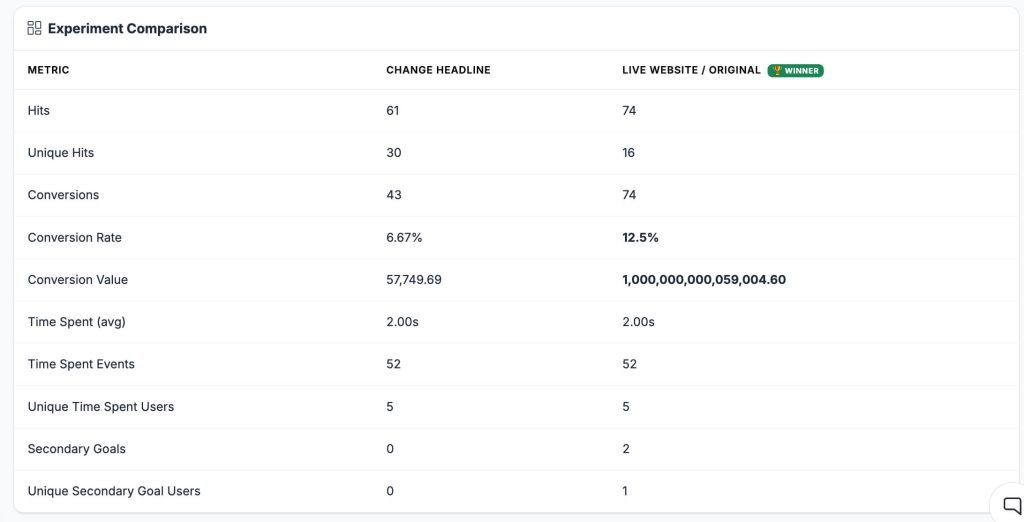
Every goal you create is either a primary conversion or an observation.
Your primary conversion is the single action that determines which variant wins. It counts toward your conversion rate and is the number you use to call the result. One primary conversion per experiment. Keep it focused.
Observations are everything else you want to track without letting it influence the outcome. Maybe you’re curious about scroll depth while your primary goal is a form submission. Observations give you that extra layer of insight without muddying the main result.
This separation is what lets you act fast. You’re not staring at five metrics trying to decide which one matters. You defined the winner before the test started. When 95% confidence hits, you implement and move on. No meetings. No debate.
6 Goal Types, Every Use Case Covered
Six Ways to Track What Matters
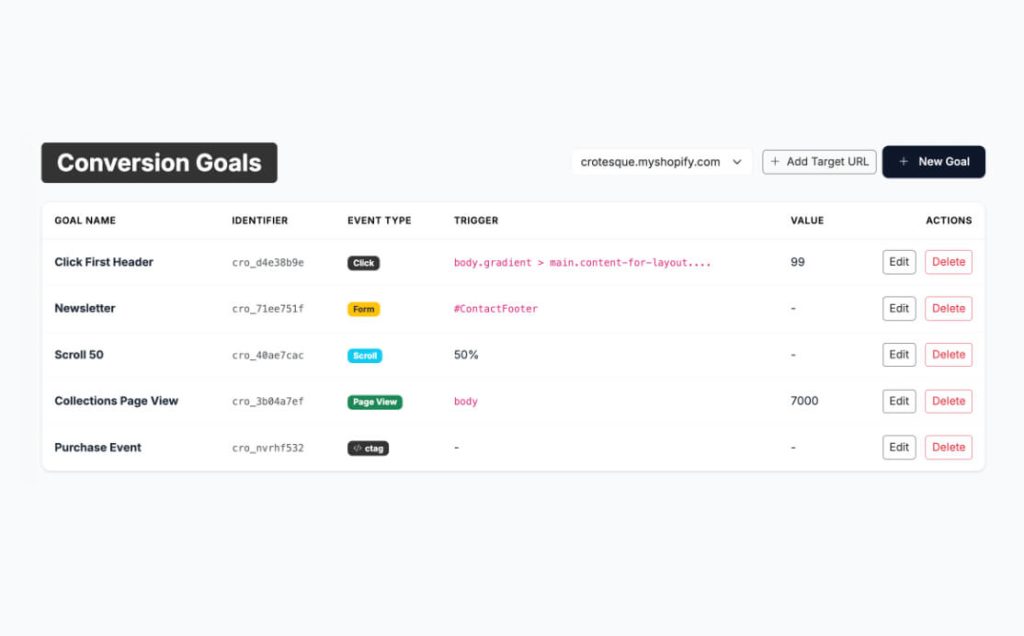
Not every conversion looks the same. A product page needs to track add-to-cart clicks. A lead gen page needs form submissions. A content page might care about scroll depth. CROLabs gives you six goal types so you can track the action that actually matters for each experiment.
🚀 The right goal type means you’re measuring the action that actually drives revenue, not a vanity metric that looks good in a report. A 15% uplift on “time on page” means nothing if nobody clicks the buy button. A 5% uplift on “purchase click” changes your bottom line.
Element click.
Fires when a visitor clicks a specific button, link, or image. The most common goal type. Works great for CTAs, navigation, and any clickable element.
Form submission.
Fires when a visitor submits a form. Contact forms, lead gen forms, checkout forms. If it has a submit button, you can track it.
Page visit.
Fires when a visitor lands on a specific URL. Perfect for thank you pages, order confirmations, or any destination that signals a completed action.
Scroll depth.
Fires when a visitor scrolls to a percentage of the page. Useful for long landing pages where you want to know if people are actually reaching your CTA.
Time on page.
Fires when a visitor spends a set amount of time on the page. A solid proxy for engagement when there is no obvious click or form to track.
Custom event.
Fires based on a JavaScript event you define. Video plays, multi-step interactions, events from third-party tools. If the standard types do not cover it, custom events will.
Set Up in Under 60 Seconds
How to Set Up Your Goals
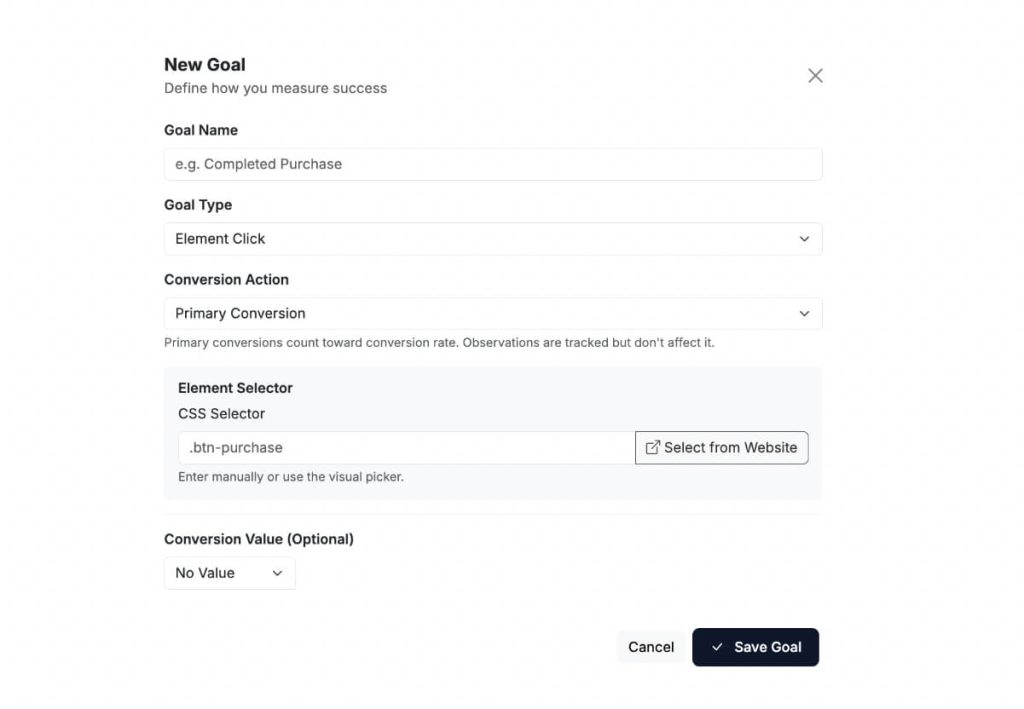
Open your Lab. Go to the Goals tab. Click Create New Goal. Give it a name, pick a type, configure it, and choose whether it’s a primary conversion or an observation. Done.
One goal can be connected to multiple experiments, and one experiment can have multiple goals. You don’t have to recreate the same goal every time you launch a new test. Build your goal library once and reuse it across your entire testing program.
Set your goals before you launch the experiment. Goals only track from the moment they’re active. If you go live first and add the goal two days later, those two days of data are gone.
Know Which Version Wins With Real Data
See Your Results in Real Time
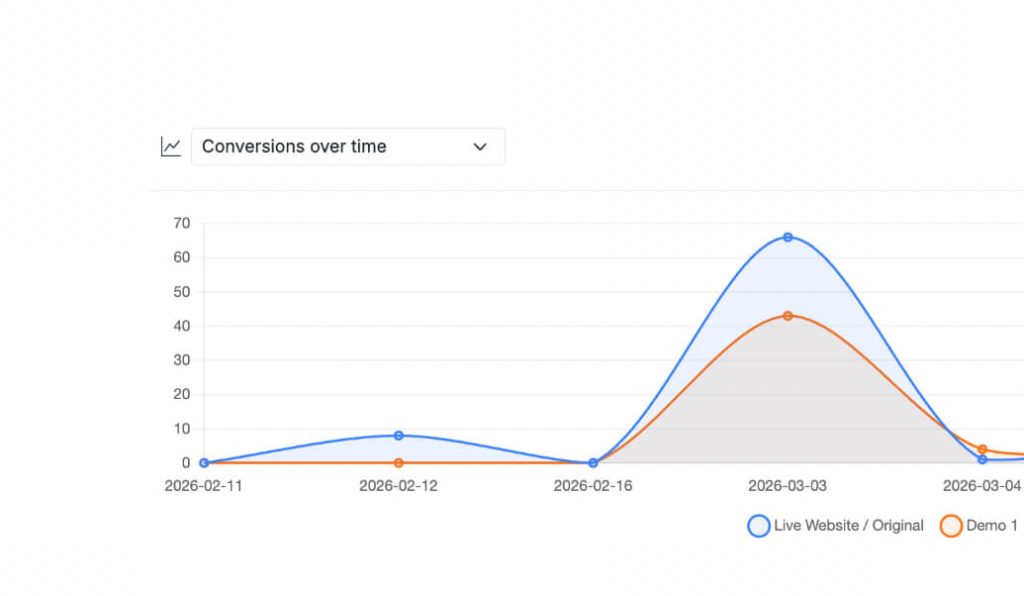
Once your experiment is running, conversion data flows into the Results tab automatically.
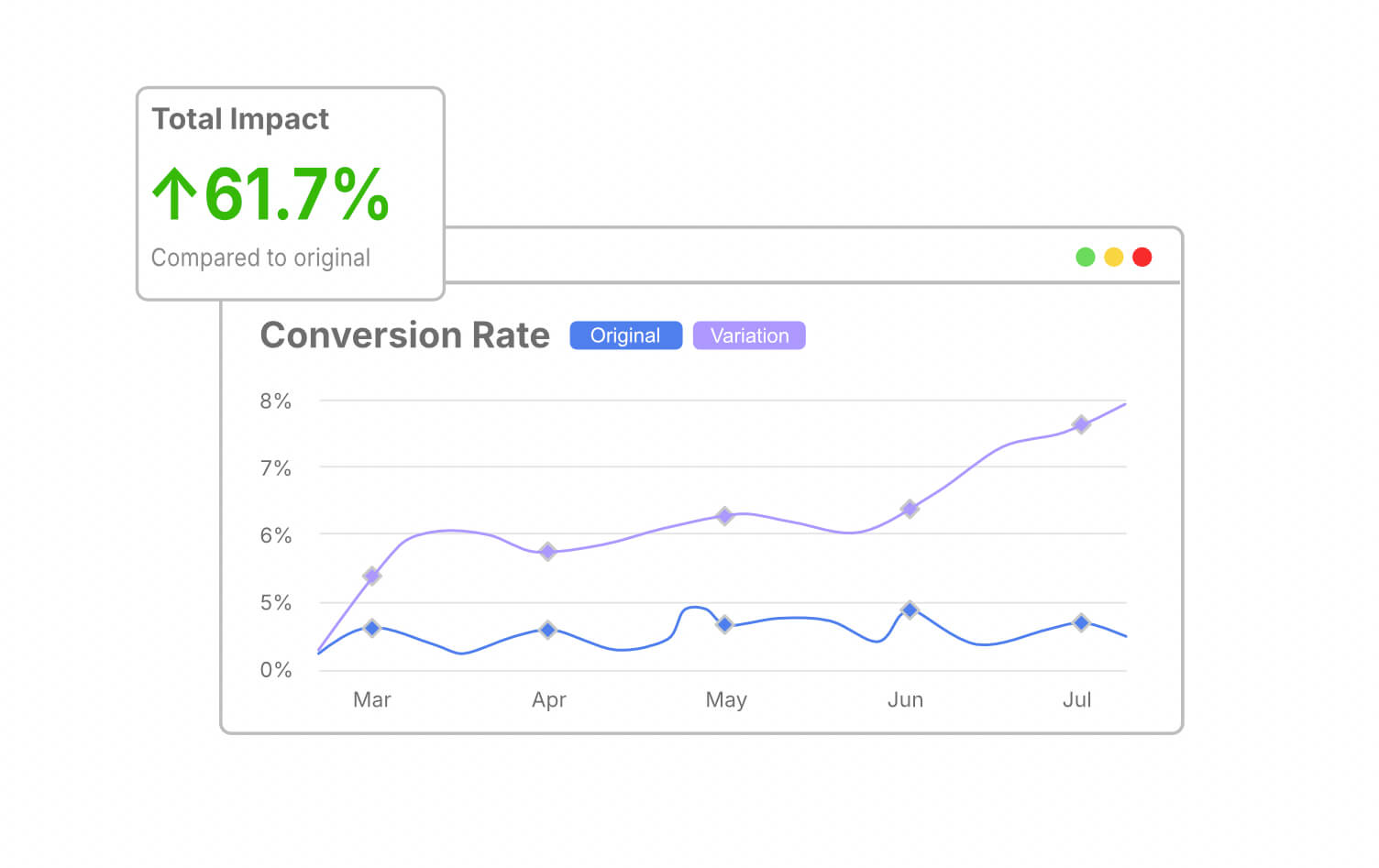
You see conversion rate per variant, uplift compared to the original, and statistical confidence. All in one view. No exporting. No spreadsheet gymnastics.
This is where testing turns into revenue. A variant with 12% higher conversion rate on a page that gets 50,000 visitors a month isn’t a nice stat. That’s thousands of additional conversions you’d have missed without tracking.
Observations show up alongside the primary result so you get the full picture without switching tabs. When one variant hits 95% confidence, you know it’s real.
Share results with stakeholders inside GA4. No new reporting workflow required. Enable the built-in URL tag feature and your experiment data shows up in the analytics tool your team already uses.
Avoid the Most Common Tracking Mistakes
Get Reliable Data Every Time
Test your goal before you launch. Open the page in a private window, complete the conversion action yourself, and check if it fires. A misconfigured goal gives you data you can’t trust.
One primary conversion per experiment. Multiple primary goals make results harder to interpret. Track the one thing that matters most. Use observations for everything else.
Name your goals clearly. “Goal 1” tells you nothing in three months. “Pricing Page CTA Click” tells you exactly what you’re measuring.
Check for adblockers. Some adblockers can prevent conversion events from firing. Test with extensions disabled to confirm your tracking works. This only affects individual visitors with adblockers, not your entire setup.
Testimonials
Your Words. Not Ours.

We switched from VWO because the pricing was getting out of hand. CROLabs does everything we need at a fraction of the cost, and the AI recommendations are something VWO never had.
Kleinfeldt & Thum Media

I signed up mainly for the A/B testing, but the AI Advisor is what kept me. It flagged conversion issues on my landing pages I'd been missing for months. Specific, prioritized, easy to act on. Two tests from the suggestions, both won. Impressed.
KC Malik Consulting & Development

Honestly I was skeptical about the AI recommendations but they've been surprisingly solid. It flagged stuff on our landing page that we'd been missing for months. Ran two tests from the suggestions and both won. Not bad for the first week.
CORE Marketing
Start Tracking What Actually Matters
Sign up free and set up your first conversion goal in minutes. No credit card. No developer. Just clear answers about what’s working and what’s not.
FAQ