tl;dr – summary
- Conversion Rate Optimization (CRO) increases the percentage of existing website visitors who complete a desired goal, such as a purchase or form submission.
- CRO directly boosts revenue from existing traffic and significantly lowers Customer Acquisition Costs (CAC).
- Even a minor increase in conversion rate, like from 2% to 2.5%, can lead to a substantial revenue increase (e.g., $25,000 monthly from $100,000).
- AI-driven, no-code solutions make CRO accessible for SMEs and marketing teams without developers or enterprise budgets.
- CROLabs features an autonomous AI Advisor that identifies conversion blockers by analyzing website layout, copy, Calls-to-Action, and page speed.
On This Page
Automate Insights and Boost Revenue Without Code
Many businesses view Conversion Rate Optimization (CRO) as a complex, expensive endeavor reserved for large enterprises with dedicated development teams. This perception frequently deters marketing managers and founders from pursuing a strategy proven to increase revenue from existing traffic. One mistake we see constantly is letting technical barriers prevent valuable experimentation.
This guide shatters that misconception. We provide a practical, accessible roadmap for SMEs, marketing teams, and founders to demystify CRO. You will learn how AI-driven, no-code solutions, specifically CROLabs, empower you to identify conversion blockers, launch A/B tests, and significantly boost your revenue without needing developers or enterprise budgets.
What is Conversion Rate Optimization and Why It’s Indispensable for Your Business Growth?
Conversion Rate Optimization (CRO) focuses on increasing the percentage of your website visitors who complete a desired goal. This means getting more customers, leads, or subscribers from your existing traffic without needing to attract additional visitors. A desired goal could be a purchase, a form submission, or an email newsletter signup.
Many businesses prioritize heavy spending on paid advertising to acquire new visitors. In our experience, continuously chasing new traffic without optimizing conversion rates often leads to diminishing returns and inflated ad spend. CRO ensures you maximize the value from every visitor you already have.
CRO directly improves your bottom line. It increases revenue from existing traffic and significantly lowers your Customer Acquisition Costs (CAC). We track specific metrics like bounce rate by segment, time on page for crucial content, and micro-conversion rates, not just the final purchase. These details provide crucial clues for where optimization opportunities truly lie.
Optimizing micro-conversions creates a clearer path to larger, macro-conversions. A micro-conversion might involve adding an item to a cart, downloading a lead magnet, or clicking a specific product detail. Improving these smaller steps collectively drives your overall business goals, such as a completed purchase.
Consider a website generating $100,000 in monthly revenue with a 2% conversion rate from 500,000 visitors. An increase to just 2.5% means $125,000 in revenue, a $25,000 monthly uplift. This significant impact occurs without any additional ad spend, demonstrating CRO’s powerful effect on profitability.
Turn More Visitors Into Customers. Automatically.
Identify hidden conversion blockers, launch no-code experiments, and turn more visitors into customers.
Free trial. No credit card required.
Pinpointing Your Conversion Blockers: The Autonomous AI Advisor
Identifying the precise reasons visitors fail to convert on a website traditionally demands significant manual effort and specialized analytics skills. Marketing teams often spend countless hours sifting through heatmaps, session recordings, and complex funnel reports, a process many smaller businesses find overwhelming without a dedicated data analyst or developer. This lengthy analysis frequently stalls vital experimentation.
CROLabs addresses this challenge directly with its AI Advisor, an autonomous feature that intelligently crawls your website. This AI acts like an expert consultant, systematically analyzing every element to uncover potential issues hindering conversions. It works without requiring any manual setup beyond the initial five-minute code snippet.
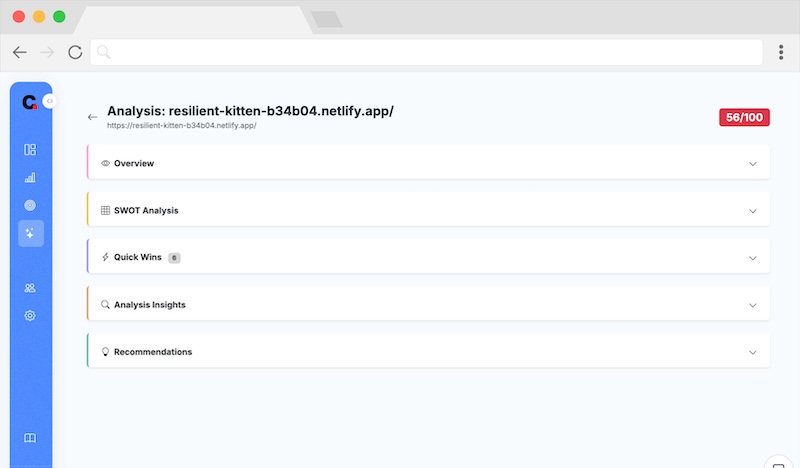
The AI Advisor thoroughly examines your page across multiple critical dimensions. It scrutinizes the website’s layout for usability and flow, evaluates the copy for clarity and persuasive strength, assesses Calls-to-Action (CTAs) for visibility and compelling language, and measures page speed impacts on user experience.
One mistake we see constantly is assuming a potential blocker is indeed causing issues without validation. The AI Advisor takes this a step further; it challenges its own findings. When the AI identifies a potential problem, like a slow-loading image on a mobile version of your product page, it correlates that finding with behavioral data patterns and established CRO best practices. For example, it might identify a generic CTA like “Submit” on a lead form. It then analyzes industry benchmarks and anonymized visitor interaction data to confirm if specific alternatives, like “Get Your Free Quote” or “Download Now,” consistently yield higher conversion rates for similar contexts.
This deeper analysis ensures recommendations are robust and genuinely impactful, prioritizing those with the highest potential return. The AI Advisor might suggest revising a vague headline like “Our Solutions” to something benefit-driven, such as “Boost Your Sales by 30% with [Product X].” It ensures you focus on the changes that matter most.
Once the AI Advisor delivers its prioritized list of actionable recommendations, launching an experiment becomes a single-click process. You simply select a recommendation, and CROLabs’ visual editor instantly sets up an A/B test, removing any need for developer involvement. This drastically simplifies the entire workflow, making sophisticated CRO accessible to everyone.
Experimentation Made Effortless: No-Code Testing and Automated A/B Split Testing
Every effective experiment starts with a clear, testable hypothesis and defined success metrics. Instead of broadly stating “improve sales,” a good hypothesis pinpoints a specific change and its expected outcome, like “changing the primary Call-to-Action button’s color from blue to green will increase click-through rate by 7% among first-time visitors.” Identifying these targets early ensures you measure the right thing and understand what “success” truly means for your business.
Designing these changes is straightforward with CROLabs’ No-Code Visual Editor. This tool allows you to directly click and modify any element on your live website, including headlines, button text, image placements, or color schemes. You make alterations directly on the page, seeing the results immediately without needing a web developer or touching any code.
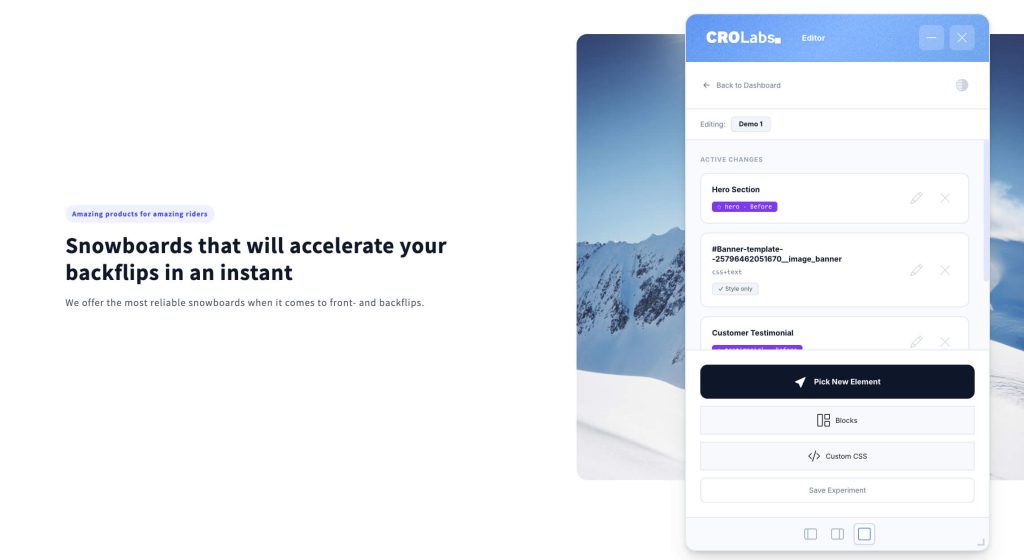
Once your variant is designed, CROLabs automates the entire A/B and multivariate testing process. The platform handles traffic splitting, distributing visitors evenly or proportionally between your original page and test variants. It also manages variant assignment and cookie management, ensuring returning visitors consistently see the same version to maintain test integrity.
One mistake we constantly see involves poor experiment design. Attempting to test too many variables at once in a single experiment, like changing a headline, image, and button color simultaneously, often yields inconclusive data. Instead, focus on isolating individual changes to clearly attribute performance gains. Similarly, running a test with insufficient traffic can lead to prolonged experiments that never reach statistical significance.
Optimal test duration gathers enough data without tying up resources indefinitely. CROLabs monitors your data velocity and suggests appropriate run times. This ensures you conclude tests confidently, either rolling out winning variants or discarding underperforming ones, moving quickly to your next experiment.
Mapping Visitor Journeys: Uncovering Precise Drop-Off Points for Targeted Optimization
Traditional analytics often aggregates data, obscuring the precise moments visitors leave your site. You might know 20% of users drop off on your product page, but not exactly what they did just before exiting. This lack of granular insight makes targeted optimization difficult.
CROLabs’ Experimentation Paths feature moves beyond these aggregated views. It lets you visualize the exact journeys individual visitors take through your website, from entry to exit. This visual mapping capability highlights precise points of friction and abandonment.
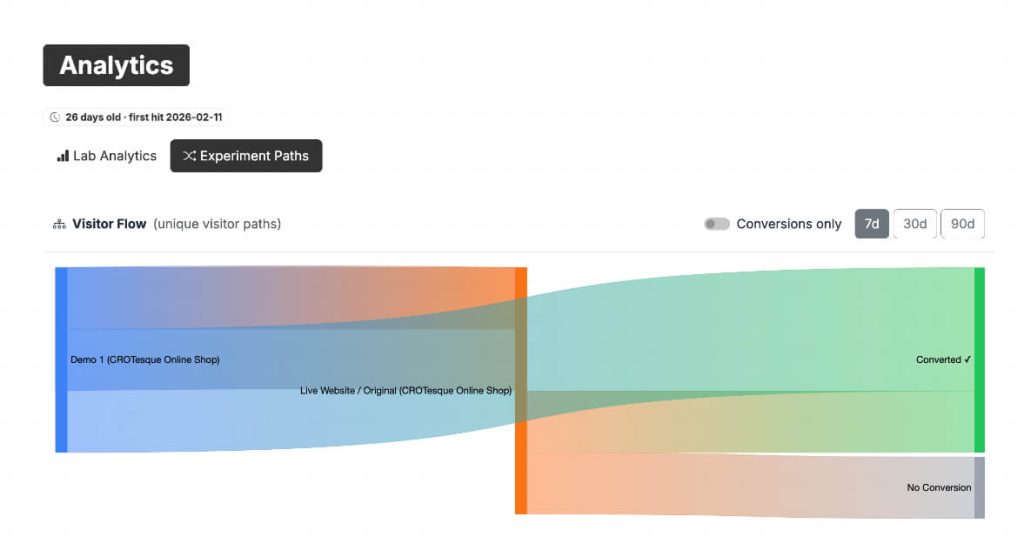
Imagine seeing visitors consistently leave your site on the shipping details page, specifically after entering their address but before confirming the order. This specific drop-off suggests issues like unexpected shipping costs, a lack of transparent payment options, or missing trust signals at that critical juncture. Pinpointing these moments guides your testing efforts.
In our experience, knowing exactly where visitors abandon informs your next test for maximum impact. You stop guessing why conversions falter and start addressing specific bottlenecks. This approach drastically reduces wasted effort on irrelevant changes.
Optimizing different page types requires varied strategies. For an initial landing page, the priority is immediate value proposition clarity and a compelling, singular Call-to-Action. Visitors should instantly understand your offer and what to do next.
Product pages demand detailed descriptions, high-quality visuals, and persuasive social proof like reviews or testimonials. The goal here is to build desire and overcome purchase hesitations.
The checkout flow focuses on minimizing friction and building trust. Reducing the number of steps, offering guest checkout, and prominently displaying security badges often improves completion rates.
One mistake we constantly see involves businesses struggling to balance conversion optimization with user experience. By identifying precise drop-off points, you fix genuine user pain points. This naturally drives conversions, rather than resorting to aggressive tactics. Addressing the reasons visitors leave, like unclear pricing or complex forms, naturally improves their journey and your results.
Sustainable CRO: Maximizing ROI, Budget-Friendly Tools, and Ironclad Privacy
Successful conversion rate optimization focuses on sustainable, incremental improvements. Expecting massive, overnight gains from a single test is unrealistic. Instead, small, compounding uplifts across multiple experiments accumulate into significant long-term revenue growth.
Even a modest 0.5% increase in a key conversion rate, maintained over time, can translate into substantial financial returns. For example, a recent client increased their checkout completion rate by 7% over three months, leading to a 15% increase in revenue from their existing website traffic.
Effective CRO directly reduces wasted ad spend. By converting more of your current visitors, you decrease reliance on continually acquiring new, often expensive, traffic. This approach naturally lowers your customer acquisition costs (CAC) because every visitor counts more towards your bottom line.
A common misconception is that sophisticated CRO requires an enterprise-level budget or a team of developers. CROLabs provides an affordable alternative for SMEs, marketing teams, and founders. It delivers advanced experimentation capabilities without requiring expensive subscriptions or any coding knowledge.
In our experience, prioritizing experiments with a clear framework helps maximize their impact. We often guide users toward frameworks like the ICE score (Impact, Confidence, Ease). This helps you launch tests with the highest potential return, given their expected effort and your belief in the outcome.
Privacy-First Optimization: Anonymity and Compliance
Modern CRO must respect user privacy. CROLabs is GDPR compliant by default, collecting absolutely no personally identifiable information (PII). This means we never store names, emails, or IP addresses; our system operates purely on anonymized behavioral data.
Because CROLabs collects no PII, your visitors remain entirely anonymous. This privacy-first approach means you do not need to display an intrusive tracking cookie banner, which improves the user experience and reduces friction for every visitor to your site.
The platform is built and hosted entirely within Germany and the EU. This ensures zero US data transfers, providing crucial security and compliance benefits, especially for European businesses navigating GDPR regulations. Setting up CROLabs takes just five minutes with a single line of code, providing peace of mind and powerful optimization tools.
Unlocking Growth with Accessible Optimization
Conversion rate optimization once seemed an exclusive domain, often reserved for enterprises with large budgets and dedicated development teams. That landscape has fundamentally shifted. Focusing on your existing traffic, rather than constantly chasing new visitors, offers a direct path to sustainable revenue growth. The real power comes from systematically identifying conversion blockers and running targeted experiments.
Modern, AI-powered platforms remove the historical barriers to entry. You can now automate insight generation and launch full A/B split tests without needing developers or deep technical knowledge. This democratization of the process makes powerful CRO tools available to marketing teams and founders of all sizes.
Discover how simple it is to put these principles into practice for your business. Take the next step by exploring CROLabs to identify your site’s conversion blockers, launch visual experiments, and boost your conversion rates. Experience firsthand how AI can transform your site’s performance in just minutes.
Conversion Rate Optimization in a nutshell
Here are some of the most frequently asked questions about conversion rate optimization.