tl;dr
AI eCommerce optimization helps online stores find and fix the UX, content, trust, and checkout issues that stop visitors from buying. Instead of relying on guesswork or slow audits, AI gives teams faster insights and better test ideas so they can improve conversions more confidently.
Quick facts
- Average eCommerce cart abandonment rate: 70.19% (Baymard Institute, 2025)
- Average eCommerce conversion rate: 1-4% (IRP Commerce, 2025)
- AI-referred sessions grew 527% between January and May 2025 (SparkToro, 2025)
Most eCommerce brands spend a lot of time and money getting people to their store.
Paid ads. Product photos. Influencer campaigns. SEO. Email flows. Social content.
But once visitors arrive, many still leave without buying.
They abandon carts. They ignore calls to action. They browse a product page for a few seconds and disappear. And when that happens, the first reaction is often to blame the product, the price, or the traffic source.
Sometimes that is true.
But often, the bigger problem is the shopping experience.
Your website may be creating small moments of friction that stop people from moving forward.
A confusing layout.
A weak product description.
A checkout step that feels unnecessary.
A missing trust signal.
A call to action that is technically there but easy to overlook.
The challenge is that these issues are not always obvious. That is where AI eCommerce optimization can help.
What is AI eCommerce optimization and how does it work?
AI eCommerce optimization is the use of artificial intelligence to analyze and improve the parts of your online store that influence customer behavior and conversion rates.
In simple terms, it helps you understand what might be stopping visitors from buying, and what you can do about it.
Traditional conversion rate optimization often depends on manual reviews, slow testing cycles, and a lot of interpretation. A team looks at the website, forms a hypothesis, runs a test, waits for results, and then decides what to do next.
That process can work well, but it can also be slow and expensive.
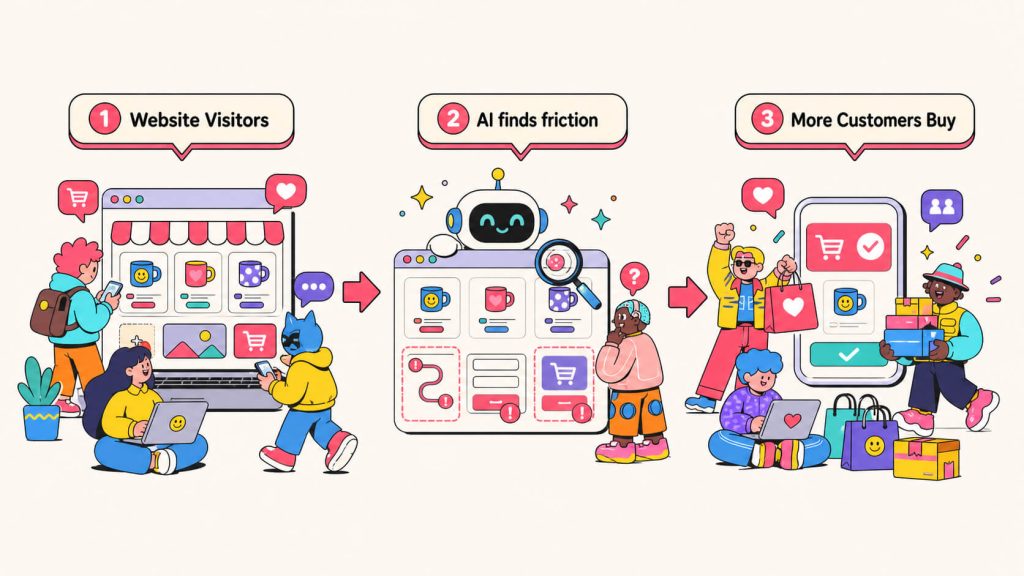
AI makes the process faster. It can review page structure, UX patterns, content, calls to action, behavioral signals, and checkout flows at scale. Instead of looking at one page at a time, it can scan large parts of your store and highlight where improvements are likely to matter most.
This does not mean AI replaces human judgment.
It means your team gets a better starting point.
Instead of asking, “What should we test next?” with no clear direction, you can start with sharper questions:
Where are users getting stuck?
Which pages create unnecessary friction?
Which product descriptions fail to answer buyer questions?
Which CTAs are easy to miss?
Where do trust signals need to be stronger?
That is the real value of AI in eCommerce optimization. It helps connect data with action.
Why do traditional UX audits miss conversion problems?
A classic UX audit usually follows a familiar pattern.
You hire a consultant or agency. They review your website over several weeks. Then you receive a long report with findings, screenshots, and recommendations.
Some of those recommendations may be useful. But there are also common problems.
Many audits are static. They capture your website at one point in time, often taking four to eight weeks to complete. They may not reflect how different traffic sources behave, how users interact with specific pages, or where friction appears across the full customer journey.
They can also be hard to act on.
A 60-page report with dozens of recommendations might look impressive, but it often leaves teams asking the same question:
Where do we actually start?
AI-powered optimization makes this easier. Instead of giving broad advice based on general best practices, AI can look at your specific website and identify specific issues.
That matters because no two stores are exactly the same.
A fashion brand, a supplement store, a B2B eCommerce catalog, and a high-ticket electronics shop all need different experiences. The right optimization approach depends on the product, audience, price point, traffic source, and buying intent.
Generic advice can only take you so far.
Why AI matters for eCommerce teams now
Online stores are under more pressure than ever.
According to Baymard Institute, the average cart abandonment rate across eCommerce sits at 70.19%, meaning most stores lose more than seven out of ten potential customers before they complete a purchase. At the same time, average conversion rates remain stubbornly low, typically between 1-4% across most industries (IRP Commerce).
That combination, expensive traffic with low conversion, is exactly why conversion optimization has become a practical priority, not just a nice-to-have.
If your store already gets traffic, improving the experience can be one of the most effective ways to grow revenue. You are not trying to find completely new customers. You are helping more of your existing visitors complete the journey.
AI helps because it brings speed and scale.
It can review hundreds or thousands of pages much faster than a human team could. It can look for repeated patterns across product pages, category pages, landing pages, and checkout flows. It can also help remove some of the bias that often appears in website decisions.
For example, teams often debate things like button copy, homepage layout, or product page design based on personal preferences.
Someone likes a certain headline. Someone else thinks the page is too long. Another person wants to copy a competitor.
AI does not remove the need for discussion, but it can make the discussion more grounded. Instead of relying only on opinions, you can look at signals that suggest where users hesitate, drop off, or fail to understand what to do next.
That changes the conversation.
What can AI analyze in an eCommerce store?
AI eCommerce optimization can support several areas of your website.
1. User experience
AI can help identify friction in navigation, layouts, product discovery, filters, search, mobile usability, and checkout flows.
For example, it may flag that important information is buried too low on the page, that a product page lacks clear next steps, or that the checkout process creates unnecessary effort.
These are often the issues that quietly reduce conversion rates.
2. Product content
Product descriptions do more than fill space on a page.
They need to answer the questions customers have before buying. What is included? Who is it for? What problem does it solve? What makes it different? What should the customer expect after purchase?
AI can review whether your product copy is clear, useful, and easy to scan.
It can also help identify when the copy focuses too much on features and not enough on benefits.
3. Calls to action
A call to action should make the next step obvious.
AI can review CTA placement, wording, clarity, and visibility. It can help identify whether buttons are easy to find, whether the wording matches the buying stage, and whether the page gives users enough confidence to click.
Sometimes a small CTA issue can create a big conversion problem.
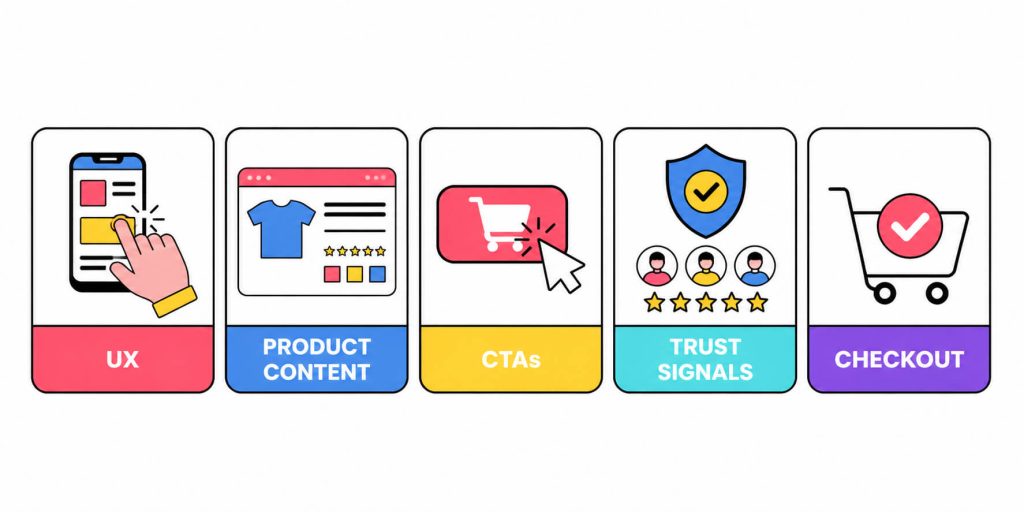
4. Trust signals
People rarely buy from a store just because the product looks good.
They also need to trust the business.
Reviews, guarantees, delivery details, return policies, secure payment badges, customer photos, and clear contact information can all reduce hesitation.
AI can help identify whether these trust signals are present, clear, and placed where customers need them most.
5. Checkout friction
Checkout is where small problems become expensive.
Unclear form fields, surprise costs, weak error messages, forced account creation, limited payment options, or confusing delivery details can all lead to abandonment.
AI can review checkout flows and highlight where the experience may be creating unnecessary doubt or effort.
AI content optimization is not just about better wording
When people hear “AI content optimization,” they often think of grammar checks, SEO keywords, or rewriting product descriptions.
That is part of it, but it is not the full picture.
In eCommerce, content has a direct role in conversion.
A headline needs to orient the visitor quickly. A product description needs to reduce uncertainty. A CTA needs to make the next step feel natural. A checkout message needs to be clear enough that users do not stop and second-guess themselves.
Good eCommerce copy is not just polished.
It helps people make decisions.
AI can evaluate content through that lens. It can look at whether your copy is specific, scannable, benefit-led, and matched to the customer’s intent.
For example, a product page might have plenty of text, but still fail to answer basic buying questions. Or a category page might include SEO copy that adds words but does not help shoppers choose.
AI can help separate useful content from noise.
From insight to testing
Finding problems is only the first step.
The bigger question is what to do next.
This is where AI becomes especially useful for testing. Instead of running A/B tests based on gut feeling, competitor copying, or internal debates, AI can help prioritize test ideas based on likely impact.
AI vs. traditional CRO: what changes
| Factor | Traditional CRO | AI-Powered CRO |
|---|---|---|
| Audit speed | 4–8 weeks | Hours to days |
| Pages reviewed | Selected sample | Entire site |
| Bias | Human subjectivity | Data-driven starting point |
| Test hypothesis quality | Based on experience and gut | Grounded in site-specific signals |
| Cost to start | High (agency retainer) | Lower (tool or audit access) |
| Human judgment still needed | Yes | Yes |
A better testing process usually starts with three questions:
- What problem are we trying to solve?
- Why does this problem matter?
- What change do we believe will improve the experience?
AI can help sharpen each of those questions.
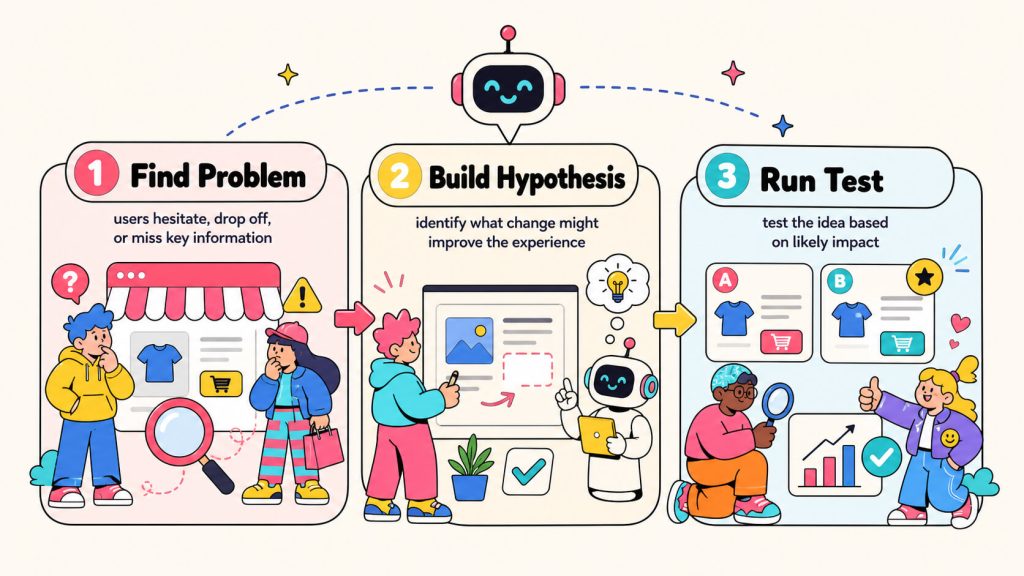
AI helps turn insights into stronger hypotheses and better testing decisions.
For example, instead of testing a random homepage redesign, you might discover that users are not reaching important product categories. Instead of changing button colors, you might find that visitors do not understand the value proposition. Instead of rewriting every product description, you might identify a specific set of pages where missing information is likely hurting conversions.
That leads to better hypotheses. And better hypotheses usually lead to better tests.
Does AI replace CRO strategy and human judgment?
It is important to be realistic.
AI will not magically fix a poor offer, weak product-market fit, or a broken business model. It also should not be treated as a final decision-maker.
The best results come when AI supports human strategy.
AI can surface patterns, identify friction, and suggest opportunities. But your team still needs to decide what matters, what fits your brand, what is technically possible, and what should be tested first.
Think of AI as a strong diagnostic tool.
It can help you see the store more clearly. It can point you toward areas that deserve attention. It can reduce the amount of guesswork.
But the final decisions should still be guided by business context.
Is AI eCommerce optimization worth it?
AI eCommerce optimization is not about chasing a trend. It is about making better decisions faster.
Here is what it actually delivers:
- Friction visibility Most online stores have improvement opportunities hiding in plain sight. AI surfaces them without requiring a months-long audit.
- Better content AI helps identify product copy that confuses rather than converts, so your team fixes the right pages first.
- Stronger trust signals Reviews, guarantees, and return policy placement are often overlooked. AI can flag where they are missing or buried.
- Better testing decisions Instead of guessing what to A/B test, AI gives your team a data-grounded starting point.
- More revenue from existing traffic Growth is not only about getting more people to your website. It is also about helping more of the right people buy once they get there.
If your eCommerce store already has traffic, improving the experience can have a direct impact on revenue, without increasing your ad spend.
Your free CRO audit is one login away: Analyze Your eCommerce Store