Updated Oct 2026
A website can show its human visitors two versions of a product page and measure which one gets more clicks or purchases, but AI agents (i.e agentic web visitors) may interact with that same business in a different way.
An agent could retrieve product information from a structured feed, check availability through an API, read product attributes, compare prices, and then call a checkout endpoint.
OpenAI’s current Agentic Commerce Protocol, for example, uses structured product feeds containing information such as product identifiers, descriptions, prices, inventory, and fulfillment details. Checkout can then happen through merchant-side systems connected to the protocol.
That creates another place to experiment.
If an agent is making decisions from the information your systems provide, you can test how that information is presented and how easily the agent can act on it.
The interesting part is figuring out what an experiment looks like when the visitor is an AI agent, what you should measure, and how you decide whether a result is worth rolling out.
On This Page
What Does an AI Agent Actually Consume From a Website?
There isn’t one standard way an AI agent interacts with a website.
Some systems can browse pages like a human. Others work through APIs, structured feeds, or specific tools exposed by a website. Agentic commerce is increasingly being built around structured product information and machine-readable interfaces.
For example, OpenAI’s current commerce documentation requires product feeds to contain information such as:
- Product ID
- Product title
- Description
- Product URL
- Brand
- Seller
- Image
- Availability
- Price
The same documentation supports additional information for things such as variants, shipping, returns, reviews, and checkout eligibility.
This matters for experimentation because each of these pieces of information can influence what an agent can understand or do.
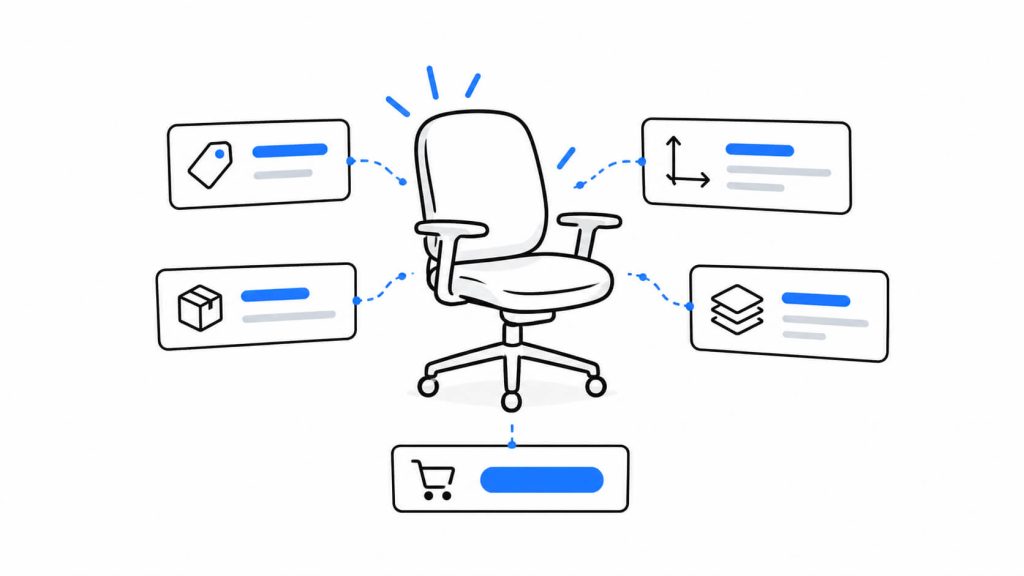
Imagine an online furniture store selling an office chair.
A human visitor might spend several minutes looking at the product photos, reading reviews, checking the dimensions, and opening the shipping information.
An agent could retrieve the chair’s dimensions directly from structured data, compare the price with other products, check whether it is in stock, and use the available purchase flow.
The elements being tested have moved closer to the underlying data and infrastructure.
That gives you several possible experimentation surfaces:
| Agent-facing surface | What you could experiment with |
| Product feed | Product descriptions, attributes, availability information |
| Structured data | Schema fields, completeness, formatting |
| API | Response structure, required fields, error handling |
| Tool definitions | Names, descriptions, parameters and available actions |
| Checkout flow | Number of steps, required information, validation |
| Product variants | How sizes, colors and other options are represented |
| Pricing data | How prices, currencies and promotions are supplied |
| Content | The information an agent receives when evaluating a product |
The important question becomes less about changing what a page looks like and more about changing what an agent can understand and act on.
Can You A/B Test for AI Agents?
Yes, although the implementation depends on what you are testing.
Traditional client-side A/B testing usually changes something in the visitor’s browser. A testing platform might randomly assign a visitor to version A or B and use JavaScript to show the appropriate variation.
That model becomes less useful when the experience is delivered through an API or structured feed.
Server-side experimentation is one way to handle this.
The server receives the request, determines which experiment bucket the request belongs to, and returns the corresponding version of the data or experience.
Where Does CROLabs Fit Into This?
CROLabs helps teams run experiments to understand how changes to their websites affect conversion performance. Its A/B testing capabilities, alongside its AI-powered CRO tools, give teams a way to investigate potential improvements, test variations, and use the results to inform their next steps.
For AI-agent experiences, the same experimentation mindset can be applied to the information and interactions an agent relies on. That may require server-side testing or changes to the APIs and data feeds behind a website, depending on the setup. These are separate implementation considerations from testing a conventional webpage through a CRO platform.
If you’re already using CROLabs to improve your website’s conversion rate, agent-facing experimentation is another area to explore as more customer journeys begin to involve AI systems.
Start Testing What Actually Moves Conversions
You don’t have to wait for agentic commerce to mature before improving your conversion rate. Use CROLabs to identify conversion issues, build experiments, and measure what actually improves your website performance.
Zendesk uses a similar concept for testing AI agent experiences. Its documentation describes label-based separation, AI-agent or channel-based separation, and a traffic-split API as ways to route different users through different versions of an agent experience.
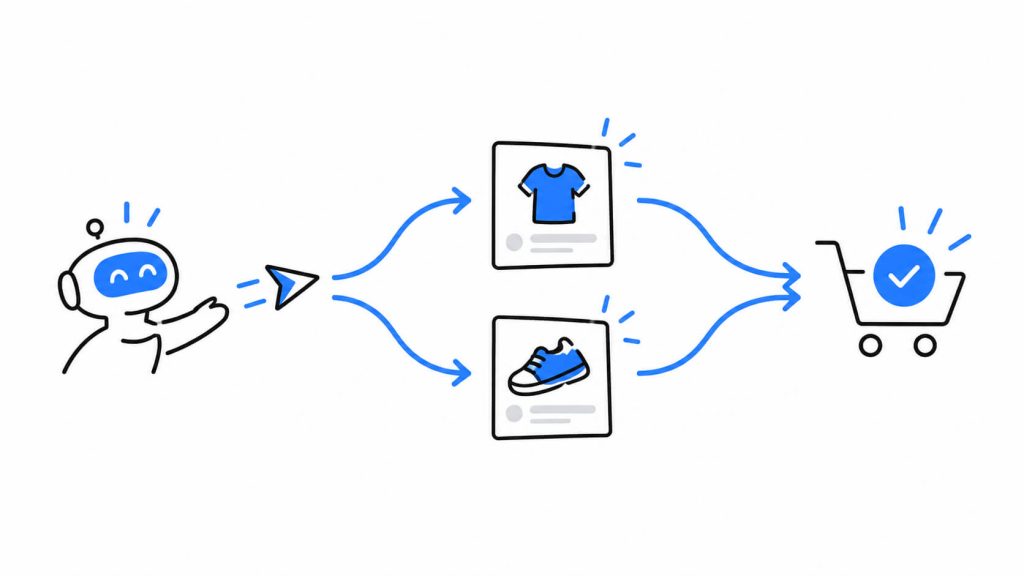
For an ecommerce business, the setup could look something like this:
1. Identify the agent or agent-facing request
The system needs some way to determine which traffic should enter the experiment.
A User-Agent header may provide useful information when an agent identifies itself. OpenAI’s commerce API documentation, for example, includes a User-Agent header in its API requests.
Other systems may use an API endpoint, authentication method, integration identifier, or another signal.
This part needs careful handling because agent detection is not universal. Some AI systems may browse using ordinary browser infrastructure, while others may identify themselves through an API.
2. Assign the request to an experiment
Once the relevant traffic has been identified, the server can assign it to a control or variant.
For example:
| Group | Product data |
| Control | Existing product feed |
| Variant | Revised product descriptions and attribute structure |
The assignment needs to remain consistent for the unit being measured.
If the same agent sees version A during one request and version B during another, the experiment becomes harder to interpret.
3. Return the appropriate experience
The variation could live in the feed, API response, tool definition, checkout flow, or another part of the agent-facing system.
Suppose a travel company wants to test how agents evaluate its tours.
The control version could return:
Guided coastal tour. Duration: 6 hours. Price: $120.
The variant could provide a more structured response with explicit fields for duration, start time, included transport, cancellation terms, accessibility information, and price.
The test isn’t about whether one paragraph sounds nicer.
It is about whether the agent can use the information more effectively when completing the task.
4. Record what happens next
This is where the experiment becomes useful.
You need to connect the variation to an outcome.
For a product discovery experiment, that could be whether the agent selects the product.
For a booking flow, it could be whether the agent successfully completes the booking.
For a checkout experiment, it could be whether the order is successfully submitted.
The exact event depends on the job the agent is trying to complete.
What Can You Actually Test?
There are more possibilities here than simply changing product descriptions.
Product information
Structured product data can contain the information an agent uses to understand an item.
You could test whether making attributes more explicit changes the agent’s ability to select the correct product.
Consider a clothing retailer with a jacket available in several versions.
One feed might describe each variant mainly through a product title and a general description.
Another could make attributes such as size, material, waterproof rating, weight, and color explicit at the variant level.
The experiment could measure whether an agent given a specific user request selects the correct variant more often.
OpenAI’s current product-feed specification already supports variant-level information, including separate item IDs, prices, availability, URLs, images, and variant attributes.
API responses
The API itself can become an experimentation surface.
Imagine a rental company where an agent needs to search available cars.
Version A returns a large response containing information that the agent doesn’t need for the task.
Version B returns a smaller response with clearly defined fields for vehicle type, price, availability, pickup location, and booking requirements.
You could measure whether the agent reaches a successful booking more often and how long the process takes.
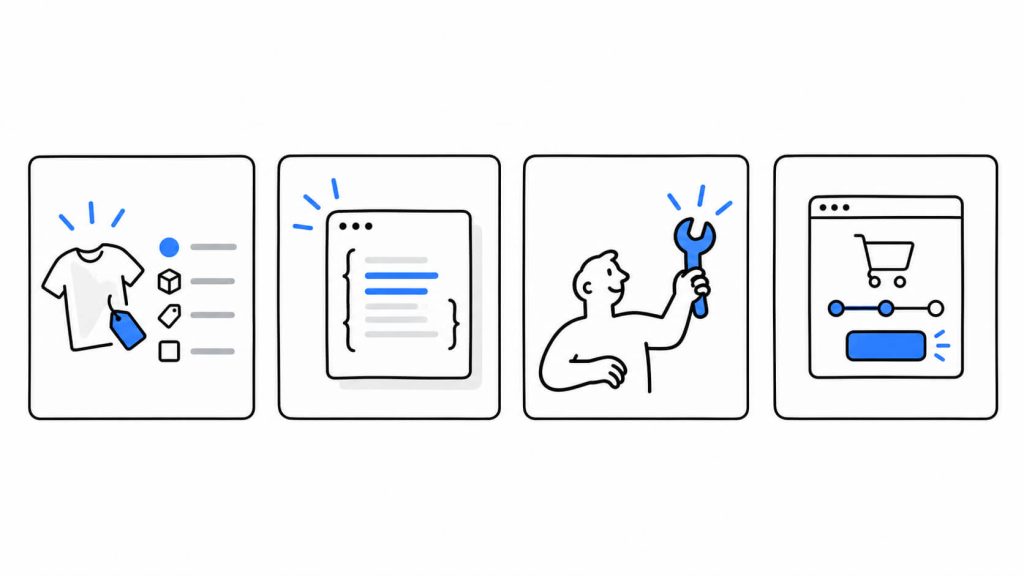
Tool descriptions and parameters
Agents often interact with tools by deciding which function to call and what information to provide.
That creates another area worth testing.
For example, a support platform could expose a tool called get_customer_order.
The experiment could test different descriptions or parameter requirements to see whether agents choose the tool correctly and provide valid inputs.
This is closer to experimentation inside an agentic interface than traditional website CRO.
Checkout flows
Agentic commerce also creates opportunities to test the path from product selection to completed transaction.
OpenAI’s current commerce architecture allows ChatGPT to call merchant endpoints to create or update a checkout session, while the merchant handles validation, fulfillment options, payment processing, and the final order decision.
That means an experiment could examine things such as:
- Required checkout fields
- Validation behaviour
- Error responses
- Fulfillment options
- How product variants are selected
- How order states are returned
A useful experiment here might be surprisingly small.
Changing the way an API communicates an invalid quantity could determine whether an agent retries correctly or abandons the transaction.
Turning Experiment Ideas Into CRO Tests
Choosing what to test is often one of the harder parts of conversion optimization. A team may have several possible explanations for why a page or user journey is underperforming, but limited time to investigate each one.
This is where tools such as CROLabs can help. Its AI Advisor helps teams identify potential conversion issues and decide what to investigate, while its experimentation features let them test changes to their website experiences.
For example, if an ecommerce team suspects that a product page is failing to answer important buying questions, it could investigate the issue, form a hypothesis about the information visitors need, and test a suitable page variation. That experiment would evaluate the human-facing website experience. Testing whether an AI agent can interpret the same product information correctly would require a separate agent-specific test setup.
The two approaches can inform a broader conversion strategy, even when they require different testing infrastructure.
What Should You Measure?
A normal website experiment might focus on conversion rate, revenue per visitor, or click-through rate.
Agent experiments need a slightly different measurement framework.
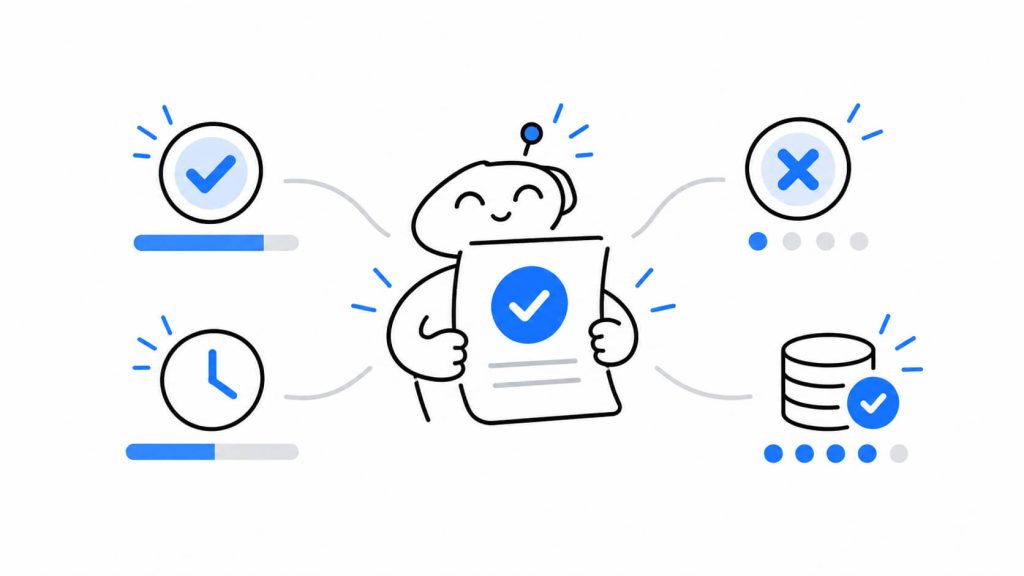
The first metric should usually relate to the task the agent was supposed to complete.
Task completion rate
Did the agent complete the requested task?
For ecommerce, that might mean successfully purchasing the requested product.
For travel, it could mean completing a reservation.
For customer service, it could mean resolving the customer’s request without transferring the conversation.
This is often more useful than measuring whether an agent clicked something along the way.
Action success rate
An agent can reach the right general outcome while making several failed tool calls.
Track successful API calls, valid parameters, completed transactions, and other meaningful actions.
For example:
| Metric | Control | Variant |
| Successful task completion | 72% | 81% |
| Invalid tool calls | 14% | 8% |
| Checkout errors | 9% | 5% |
| Median completion time | 18s | 13s |
These numbers are illustrative, but the structure shows how an experiment could be evaluated.
Turn CRO Ideas Into Measurable Experiments
Think you’ve found a conversion problem? CROLabs helps you investigate potential issues, build testable hypotheses, and run A/B tests to find out whether a change actually works.
Time to completion
Latency matters when an agent has to perform several actions.
You can measure the time between the initial request and successful task completion.
For multi-step tasks, it can also help to measure the time spent at individual stages.
Token or processing efficiency
Depending on the system, you may be able to measure how much model processing is required to complete a task.
A cleaner response or more precise tool definition could reduce unnecessary processing.
This is an area where traditional website analytics won’t tell you much.
Data accuracy
This is particularly important when an agent is using product information.
Did it retrieve the correct price?
Did it choose the correct variant?
Did it report the correct availability?
Did it apply the correct promotion?
An experiment that increases completed actions while introducing incorrect product information would need much closer scrutiny.
Business outcomes
Eventually, the experiment needs to connect to the business.
Depending on the use case, that could include:
- Completed purchases
- Booking value
- Revenue
- Refunds
- Support resolution
- Customer escalations
- Failed transactions
The metric should follow the purpose of the agent interaction.
The Hard Part: Knowing What Caused the Result
This is where agent experimentation gets more complicated.
AI systems can behave differently even when the input is unchanged. Atlan’s 2026 research guide on production A/B testing for LLM applications notes that identical runs can produce different outputs and recommends treating LLM experimentation differently from conventional deterministic software testing.
That means a single successful interaction isn’t enough to establish that a variation works.
You need repeated trials and consistent experimental conditions.
The problem becomes even more interesting when the agent itself changes.
Suppose an ecommerce company runs an experiment for three months.
During that period:
- The underlying AI model changes.
- The agent receives a new system prompt.
- The retailer changes its product catalogue.
- Competitors change their prices.
- The site’s inventory changes.
The experiment may show a difference between A and B, but some of that difference could come from changes outside the tested variation.
This makes experiment logging important.
At minimum, you want to know which variation the agent received, which agent or model interacted with it, what task it attempted, what tools it called, and what outcome followed.
Should You Test With Real Agents or Simulated Agents?
Both approaches can be useful.
Real agent traffic gives you evidence from actual user tasks. It also brings all the messiness of production traffic, which can make the results harder to control.
Simulated agents give you a controlled environment for testing large numbers of scenarios before exposing a change to production.
There is already research exploring this approach.
A 2026 Amazon Science paper introduced a framework for using AI agents to simulate A/B test outcomes. The researchers evaluated the approach against 67 historical marketing experiments. Their baseline system reproduced the direction of historical effects in about 70% of tests, but the authors also found that this result did not establish reliable directional signal against simple baselines. Their work suggests that agent-based simulation can help with experimentation research while still requiring careful validation.
That distinction matters.
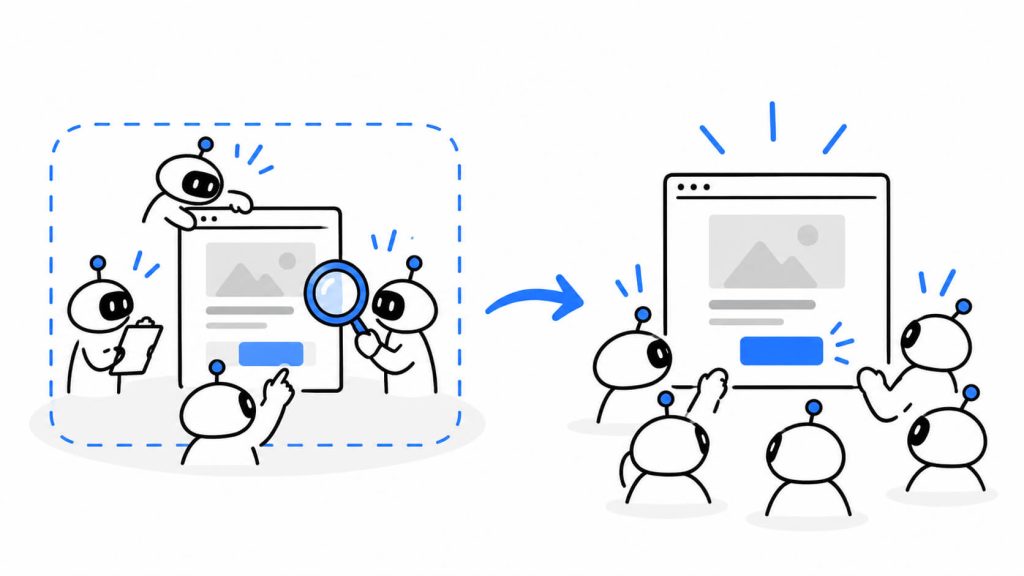
A simulated agent can help answer:
“Does this change look worth testing?”
A production experiment can help answer:
“What happened when real traffic encountered this change?”
Those are different questions.
A practical workflow could therefore use simulations to screen ideas and live experiments to validate the changes that survive that screening.
What Would an AI Agent A/B Testing Setup Look Like?
The technical setup will vary depending on the system, but the basic flow can be simple.
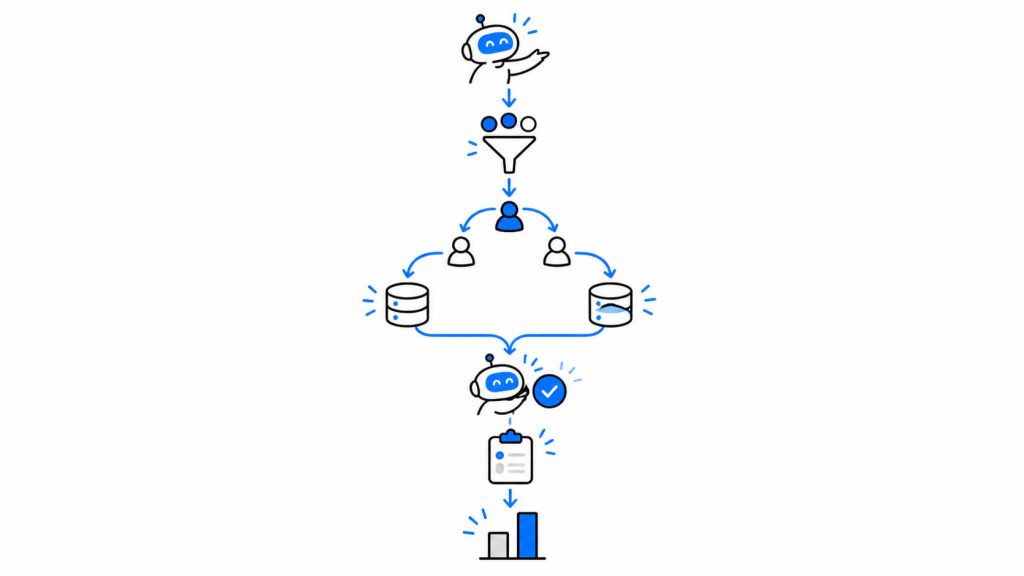
For a commerce site, the tested layer could sit between the product catalogue and the agent-facing feed.
For an API-driven service, it could sit inside the API gateway or application logic.
For an AI support agent, the split could happen inside the agent workflow itself.
The experiment should also have a defined primary metric before it starts.
For example:
Experiment: revised product attribute structure
Primary metric: correct product selection rate
Secondary metrics: task completion, time to completion, invalid requests, revenue
Guardrail metrics: incorrect product information, failed checkout, refund rate
That gives the team something specific to evaluate when the test ends.
What Happens After You Find a Winner?
The result still needs to make its way into the system.
This sounds obvious, but agent-facing experiments can involve more than changing a button or publishing a new landing page.
The tested information may exist in a product feed, API response, database, schema, middleware layer, or checkout service.
So the rollout needs to cover the actual source of the variation.
It is also worth checking whether the result applies across different agent types.
An API response that works well for one agent may behave differently with another.
That is one reason to record agent identity, model version, task type, and experiment assignment wherever the system allows it.
You may find that a variation improves product selection for one class of tasks while having little effect on another.
That is useful information too.
Where Does This Leave A/B Testing?
A/B testing for AI agents is possible, but the experimentation surface is changing.
A human visitor might respond to a headline, image, layout, or CTA.
An agent can make decisions using product feeds, structured attributes, APIs, tool definitions, and transaction endpoints.
Those systems can be tested.
The measurement also needs to move closer to the action the agent is trying to complete. Task completion, successful tool calls, data accuracy, latency, and business outcomes can tell you much more than a conventional page-level conversion metric in some agentic workflows.
This is still an emerging area. The standards for agentic commerce are developing, and research into agent-based experimentation is still working out where simulated agents can provide reliable signals.
For teams already running A/B tests, that creates an interesting extension to the experimentation roadmap.
The question is no longer limited to which version of a webpage converts more human visitors.
It can also be:
Which version gives an AI agent the information and actions it needs to complete the job?
For teams looking to improve website conversions today, CROLabs provides tools for identifying conversion issues, investigating potential improvements, and running A/B tests to measure their impact. Its AI Advisor can help teams decide what to work on, while experimentation helps them evaluate whether a change improves performance.
As AI agents become a more common part of online discovery and purchasing, teams will also need to understand how those agents interact with their websites and the systems behind them. Building a reliable experimentation process now can help establish the measurement practices needed to evaluate those experiences as they develop.
Explore CROLabs to see how its CRO and experimentation tools can support your website optimization work.
Ready to Run Better CRO Experiments?
From spotting conversion issues to testing potential improvements, CROLabs gives your team the tools to turn CRO ideas into measurable experiments.
FAQs
Can you A/B test an AI agent?
Yes. AI agent experiences can be split into different versions and measured against defined outcomes. Zendesk, for example, documents several approaches for A/B testing AI agent experiences, including label-based separation and traffic splitting through an API.
For agentic websites, the experiment can also happen on the server side, where different requests receive different versions of structured data, API responses, product feeds, or other machine-readable information.
Can you A/B test a website for AI agents?
Yes. The test may involve information that an agent consumes rather than visual elements that a human sees.
Product attributes, feed structures, API responses, tool definitions, checkout behaviour, and other machine-readable components can all become potential test surfaces.
Do AI agents use structured data?
Many agentic systems can consume structured information through feeds, APIs, and other machine-readable interfaces. OpenAI’s current Agentic Commerce Protocol, for example, uses structured product feeds containing information such as price, availability, product attributes, and seller information.
The exact information available to an agent depends on the system and integration.
What metrics should you use for AI agent A/B tests?
Start with the outcome the agent is supposed to achieve.
Useful metrics can include task completion rate, successful tool calls, time to completion, data accuracy, failed actions, revenue, and other business-specific outcomes.
For LLM-based systems, you may also want to track model-processing metrics and evaluate output quality separately.
Can AI agents be used to simulate A/B tests?
Yes, researchers are exploring this.
Amazon Science researchers published a 2026 framework for simulating A/B test outcomes with AI agents and evaluated it against 67 historical marketing experiments. Their findings show potential for agent-based simulation while also highlighting limitations around reliability and baseline comparison.
Simulation can therefore be useful for evaluating ideas before committing production traffic, while live experiments remain important for measuring actual behaviour.
Is server-side A/B testing the same as traditional A/B testing?
The experimental principle is similar: assign traffic to different versions and compare outcomes.
The implementation can be different.
Instead of changing what appears in a browser, a server-side experiment can change the response returned to a request. That makes it useful for APIs, product feeds, backend workflows, and other agent-facing systems.
What is the biggest challenge with A/B testing AI agents?
Attribution and consistency are major challenges.
The agent, model, prompt, available tools, product data, and surrounding environment can all influence the outcome. Changes in any of these areas can affect results.
That makes experiment design and logging particularly important when testing agent-facing experiences.