Updated Oct 2026
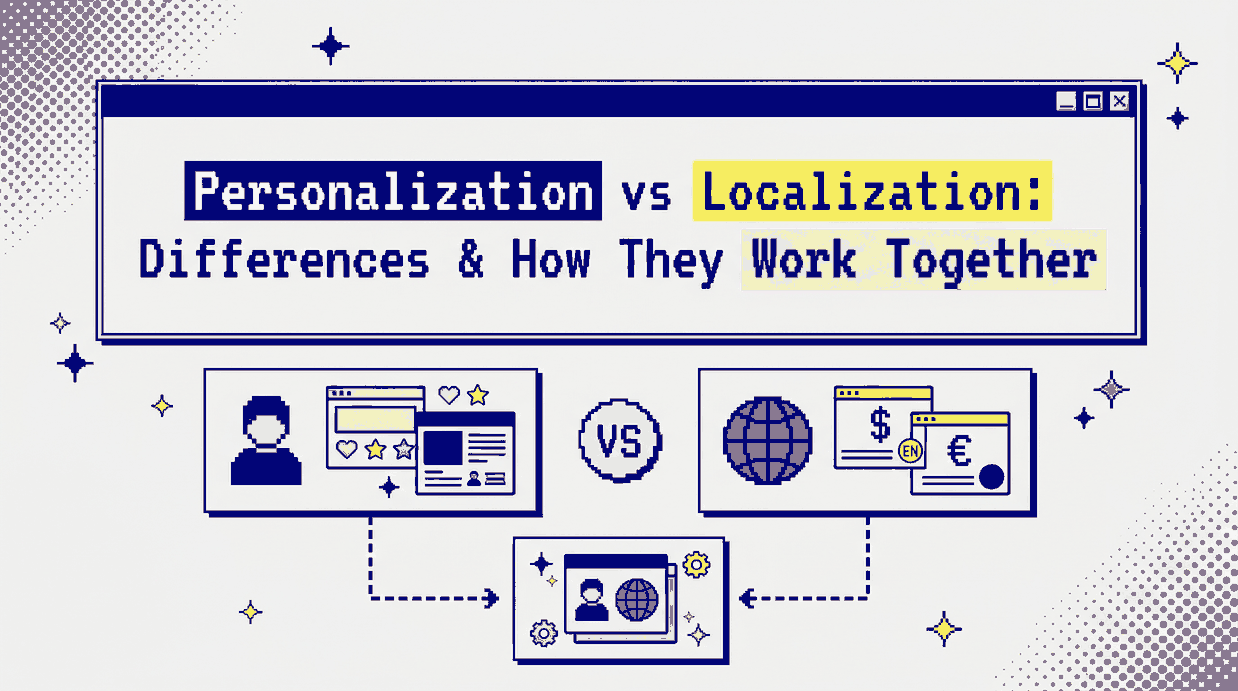
Both personalization and localization are part of the broad ecosystem of conversion rate optimization, but they do separate jobs on a website.
Understanding how personalization and localization differ helps businesses decide what information to use, which parts of a website to adapt, and how to test the effect on conversions.
Below, we define each practice, compare them side by side, look at the data each one runs on, and go through a way to layer them on a single page and test the outcome.
Personalization adjusts a page to the visitor, using behavior, traffic source or profile data. Localization adapts the website to the market a visitor is in, with changes to language, prices, payment options, date formats, and local requirements.
How a website applies each layer matters, since the experience needs to feel relevant to the visitor and work properly in their market.
On This Page
What Is Personalization?
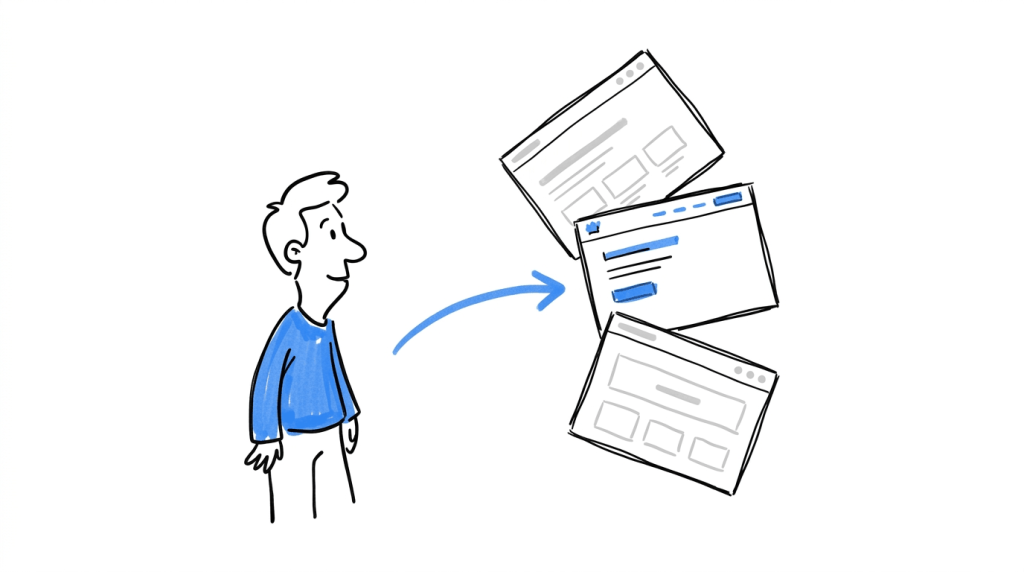
Personalization is the practice of changing a website’s content, offers or layout for a visitor, or a group of visitors, based on what you know about them. The changes draw on information such as browsing behavior, referral sources, industry, company size, purchase history, or preferences visitors have shared.
For example, imagine two people visiting the same pricing page. One arrived through an ad for invoicing software, while the other came from an article comparing several products.
Personalization allows the page to speak to each visitor’s interests, highlighting invoicing features for the first and competitive advantages for the second. Both visitors use the same URL, although the messaging changes to match their reasons for visiting.
The information used to personalize a website generally falls into four categories:
- Behavioral: Pages viewed, scroll depth, previous visits, and items in a shopping cart.
- Source-based: The ad, email, referral link, or search query that brought someone to the website.
- Firmographic: Details such as industry, company size, and job role, particularly for B2B websites.
- Declared: Preferences visitors deliberately share, often called zero-party data.
Each category offers different insights into visitor intent. Behavioral data, for instance, comes from observed activity, while zero-party data comes directly from what people choose to tell you. Understanding that distinction helps when deciding which signals to use.
Personalization can also work with anonymous traffic, since a visitor’s referral source or browsing path can provide useful clues about what they need.
Why personalization matters
McKinsey’s research puts the share of consumers who expect companies to deliver personalized interactions at 71 percent. On the site side, Livestorm, a webinar platform, shows different product features and integrations based on a visitor’s industry, and keeps the self-serve plan out of view for companies with more than 10,000 employees. In the test Clearbit documents, targeting by company size produced a 260% lift in conversion rate. That figure is reported by a data vendor about one company, so read it as a single result.
A second case comes from Wolseley, a plumbing and heating distributor. It replaced a generic homepage with personalized experiences for different trade buyers, and Monetate reports a 100% lift in revenue per session.
Pro-Tip: You can do this with CROLabs using our audience personalization, which adapts pages by audience, and ad-to-page personalization, which matches the landing page to the ad that sent the click.
Give every visitor a more relevant experience
Match landing page messaging to the ads that bring people to your site, or tailor page content to specific audience segments. With CROLabs, you can set up both forms of personalization visually, without writing code.
What Is Localization?
Localization adapts a website to the language, culture and practical conventions of a specific market, which is often called a locale. Translation is one piece of it. The rest covers currency, price display, date and number formats, units, payment methods, imagery, legal text and support hours. Flutterwave’s engineering team describes payment localization as local methods, familiar price formats and local regulation, all of which sit on top of translated checkout copy.
A related term, internationalization (i18n), means building the site so it can be localized in the first place. That covers code that supports several languages, layouts that survive longer text, and formats that switch by market. Localization comes after that groundwork.
The elements of a localized page break down like this:
- Language: translated and reviewed copy, including error messages and form labels
- Currency and pricing: prices shown in the local currency, with local tax handling
- Payment methods: the cards, bank transfers and wallets people in that market use
- Formats: dates, numbers, units and address fields
- Compliance: consent banners and privacy notices that match local law, which GDPR-compliant marketing tools are built around for EU visitors
Why localization matters
CSA Research surveyed 8,709 consumers in 29 countries and found that 76% prefer to buy products with information in their own language, and 73% want product reviews in their language. The same research shows price carries weight too, with many shoppers choosing a cheaper product even when its information is in another language.
Payment is where localization shows up in the numbers fastest. Baymard Institute found that 10% of online shoppers abandon carts because their preferred payment method is missing, and Stripe reported that merchants offering local payment methods saw an average 12% revenue increase and a 7.4% conversion improvement, both cited by Antom.
Two brand examples show the pattern in African markets. Microsoft launched local card acquiring for the Microsoft Store in Nigeria through dLocal, which lets Nigerian shoppers pay with domestic credit and debit cards. Oriflame, the cosmetics company, added card payments alongside MTN MoMo, Vodafone Cash, Airtel Money and Tigo Pesa for Ghanaian shoppers, and PayU reports a 60% approval rate on those alternative-payment transactions.
Personalization vs Localization: Key Differences
Okay, let’s put the two next to each other.
| Personalization | Localization | |
|---|---|---|
| Adapts to | A visitor or audience segment | A market or locale |
| Main inputs | Behavior, traffic source, profile, firmographics | Location, browser language, domain, market rules |
| What changes | Headlines, offers, recommendations, CTAs, social proof | Language, currency, payment methods, formats, legal text |
| Who sees the same version | Everyone in the segment | Everyone in the market |
| Main goal | Relevance and engagement | Comprehension, trust and ability to pay |
| Metrics to watch | Click-through, demo requests, revenue per session | Checkout completion and conversion by locale |
| Example | A pricing headline matched to the ad clicked | Local-currency prices with a local payment method first |
A single country can have several distinct audience segments, while the same audience may span multiple countries. As we’ve seen, personalization helps address the needs and interests of each segment while localization adapts the experience to the market they are visiting from. Both play a separate role in making a website relevant to its visitors.

Where the line blurs
Geo-targeting is where personalization and localization can overlap. When a visitor’s country switches the language, currency and payment options, that is localization. When the only change is a city name dropped into the hero, Abmatic’s guidance on B2B personalization calls it a tagging exercise that produces no pipeline lift. The distinction comes down to whether the change helps visitors understand the offer, use the site, or complete a purchase in their market.
What Each One Needs From Your Data
Each practice runs on a different kind of input, and knowing which is which helps you decide where to start.
Data behind localization
Localization relies on facts that change slowly. Country from IP address, the browser’s language setting, the domain or subfolder a visitor lands on, the currency a market uses and the tax rules that apply all belong here. You set these up once per market and update them when something shifts. Most of this data describes a place and says little about the person, so the consent questions stay light.
Data behind personalization
Personalization draws on signals that move session by session, such as pages viewed, the campaign that brought the visit, or the company a visitor works for. Some of it counts as personal data. GDPR applies to organizations that process the personal data of people in the EU wherever the organization is based, which Complaion’s GDPR guide lays out, so consent and data minimization belong in the plan from the start.
Both need a fallback. Geo-IP misreads visitors on a VPN or on roaming connections, so a visible language and currency switcher belongs on any localized page. Personalization needs a default version for visitors the rules cannot place into a segment.
Build personalized landing pages without the extra page maintenance
How Personalization and Localization Work Together
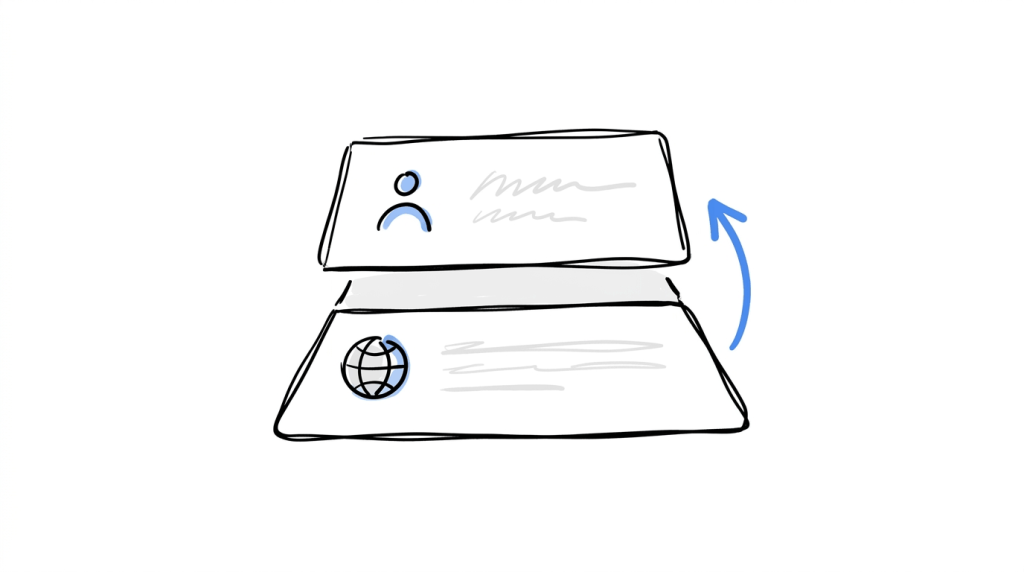
Localization should come first, followed by personalization. A headline tailored to someone’s interests loses its impact if the visitor struggles to read the language or encounters prices in an unfamiliar currency. Setting up the market-specific details gives each personalized experience a suitable foundation.
Here is how to put both practices into action:
- Configure each locale: Set the appropriate language, currency, date formats, and payment methods for every market you serve.
- Create audience segments: Within each locale, group visitors using information such as their traffic source, browsing behavior, or company profile.
- Prepare localized message variants: Give each segment a reviewed version of its headline, supporting evidence, and CTA in the relevant language.
- Roll out the combinations with enough traffic to test: Expand to other segments and markets as you collect more data.
A worked illustration
This is a hypothetical scenario for a B2B invoicing product, shown to make the layers concrete.
| Visitor A | Visitor B | |
|---|---|---|
| Arrives from | Ad about invoicing | Comparison article |
| Locale layer | English page, Ghanaian cedi prices, mobile money shown first | French page, euro prices, card shown first |
| Personalization layer | Invoicing headline, case study from a similar business | Comparison headline, feature table against alternatives |
Serving four audience segments across five markets means managing twenty different page variations, and the workload increases as more segments or markets come into play. Dynamic landing pages make this easier by using a shared template that changes specific content blocks for each audience and location, saving the team from building separate pages for every combination.
Pro-Tip: With CROLabs, marketers can make these adjustments through a visual editor without writing code, including changing a single block for a specific segment in a particular market.
Mistakes to avoid when combining them
- Translating copy and leaving prices in the old currency. Visitors read the price before the headline.
- Personalizing before localizing. The audience message lands in the wrong language or beside the wrong payment options.
- Building every segment and market pair at the start. Variants multiply faster than traffic does.
- Changing both layers in one test. The result cannot be traced to either change.
- Treating geo-IP as certain. A switcher gives visitors a way to correct the guess.
Testing Both Without Muddying the Results
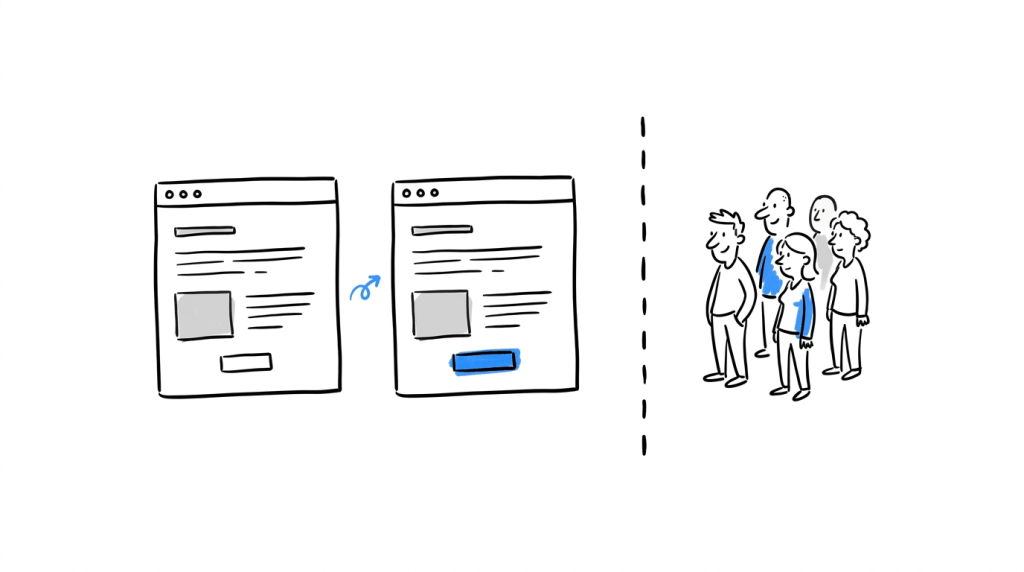
Each layer deserves its own test. If a variant changes the payment order and the headline together, a lift in conversions has two possible causes and no way to separate them. A/B testing one layer at a time keeps the answer readable, and multivariate testing fits once each layer has proven itself on its own.
A few habits keep the data clean:
- Report results per locale. An average across markets hides a win in one country and a loss in another.
- Check sample size per market. A small market needs a longer run than a large one.
- Keep a holdout group. Abmatic cites Forrester guidance that a 5 to 10 percent holdout gives the cleanest proof of causal lift on personalization programs.
- Let each test finish. Our guide on when to stop an experiment early covers the signs that justify cutting one short.
A starting plan could run four tests in sequence:
- Locale test: local payment method first versus card first, in one market
- Audience test: an ad-matched headline versus a generic one, inside one locale
- Proof test: an industry-matched case study versus a general one
- Combined test: the winning locale setup with the winning audience message, against the original page
Behavior data from analytics and heatmaps shows where visitors in each market drop off, which tells you which test to run first. This fits the wider loop of conversion rate optimization, where each result informs the next change.
Conclusion
Personalization adapts a page to the visitor, and localization adapts it to the market. They draw on different data, answer different questions and get measured differently. A page that applies the market layer first and the audience layer second gives each visitor something readable, payable and relevant, in that order.
If you want to try this on your own site, CROLabs brings audience personalization, ad-to-page personalization, A/B testing and analytics into one platform, with a 14-day free trial.
Put personalization and localization to the test
Find out which page changes help visitors move closer to conversion. CROLabs brings audience personalization, ad-to-page personalization, A/B testing, and analytics together in one platform, giving you the tools to test changes and measure their impact.
FAQs
Is localization a type of personalization?
Localization can be described as personalization at the market level, which is why the terms overlap. Teams usually manage them separately because the inputs, owners and metrics differ.
Which should I do first?
Start with localization if you sell in several markets and see drop-offs tied to language, currency or payment options. Start with personalization if most of your traffic comes from one market and your audiences differ by source or industry. Your analytics, broken down by country and by campaign, will show which gap is larger.
What is the difference between localization and translation?
Translation converts text from one language to another. Localization includes translation and also covers currency, formats, payment methods, imagery and legal requirements for the market.
Does personalization require visitors to log in?
Personalization works on anonymous traffic by using signals such as the ad clicked, the referring page or the pages viewed in the session. Logged-in data adds depth, and our comparison of zero-party data and behavioral personalization shows how the two kinds of signal differ.
How do I measure each one?
Measure localization with conversion rate and checkout completion broken down by locale. Measure personalization with segment-level results such as click-through, demo requests and revenue per session, compared against a holdout group that sees the default page.