On This Page
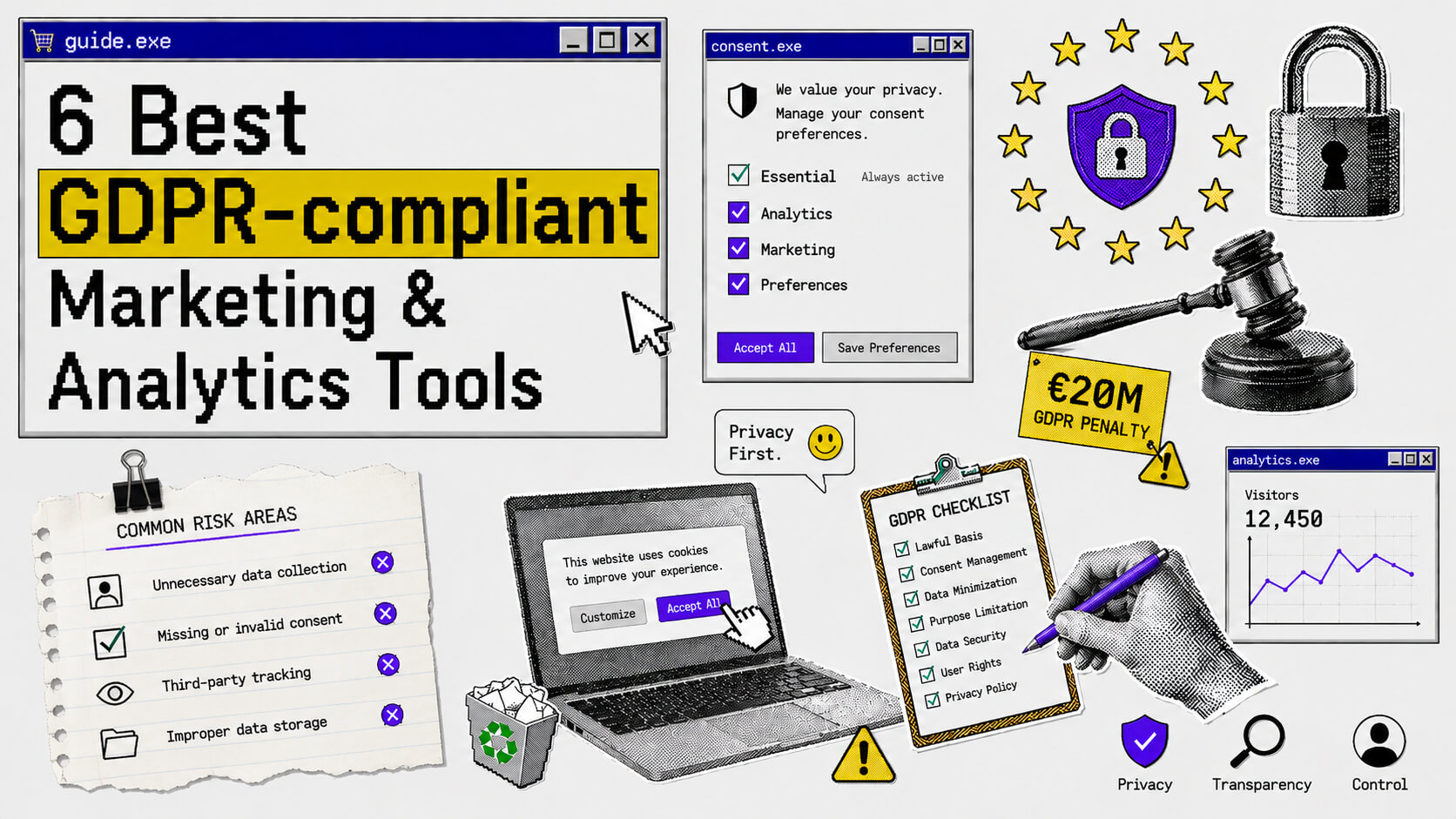
You want to track your website visitors, but you also want to avoid a €20 million GDPR penalty.
That’s the catch every marketer will have to deal with. The GDPR has been updated and now comes with a more aggressive approach. Marketers need to be more careful when it comes to data privacy. Any misstep could prove costly. Whether it’s a misconfigured consent banner or an unnecessary piece of data, these small errors could result in hefty fees.
Fortunately, there are solutions designed specifically for the purpose of providing marketers with the insights they need without the hassle of compliance.
We’ve rounded up 6 GDPR-friendly marketing and analytics tools that actually provide real, valuable insights.
Each of the following platforms handles the various aspects of tracking, consent, attribution and data governance in a compliant manner so you can focus on growing your business without legal trouble.
What Makes a Tool GDPR-compliant?
So, what exactly makes a marketing or analytics tool GDPR-compliant?
Built Cookie Free or Consented
The tool either refrains from using cookies altogether or acquires user consent prior to employing them.
IP Anonymization or Cookieless Tracking
The tool anonymizes IP addresses and/or features cookieless tracking mechanisms to prevent user re-identification across different sessions.
Alternatively, Data Stored in EU-Based Data Centers with Standard Contractual Clauses
The tool either provides IP Anonymization or Consent to Use of Cookies or has data storage within the EU with clear transparency on data processing, in addition to including standard contractual clauses or similar agreements for international data transfers.
Easy Opt-Out & Data Deletion upon Request
Above all else: does it collect only the data it needs?
What you really want to ask is: Are you still using Google Analytics without Consent Mode v2 yet? If so, you’re gambling. If your forms are collecting company size, annual revenue, phone number etc and you only need an email address? You are collecting too much data.
The tools below have been developed with privacy as a top priority from concept to completion.
1. CROLabs – Best All-In-One CRO & Analytics Platform
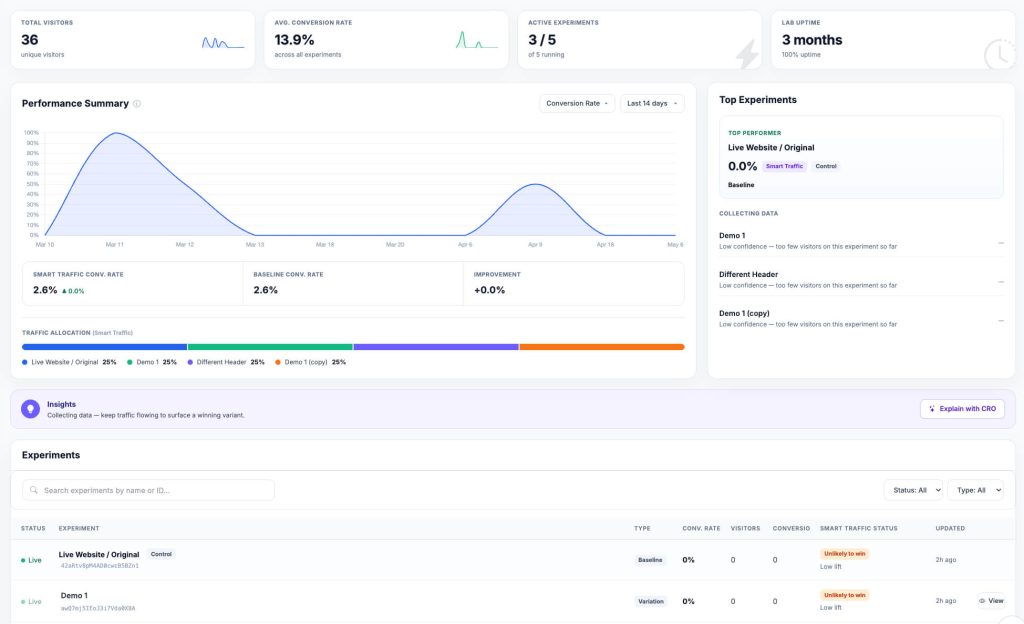
What it does:
CROLabs combines features from conversion rate optimization, behavioral analytics, and friction detection into one platform. Often, marketers know what visitors are doing but not why. CROLabs changes that by offering a comprehensive view of visitor behavior, highlighting drop-off points and offering solutions to improve conversion rates.
Why it’s GDPR-compliant:
CROLabs was built with privacy in mind. The platform utilizes a cookieless design with no need for a cookie banner, requires consent for all relevant uses, and ensures that all data is stored on infrastructure that is compliant with European data protection standards. The result is a platform that helps marketers to understand user behavior and improve their marketing efforts without exposing them to legal risks.
Best for:
Conversion rate optimization teams, SaaS companies, and e-commerce brands that need to understand drop-off points and measure the impact of changes.
Real-world example:
A SaaS founder used CROLabs to gather insights into visitor behavior and discovered that 40% of visitors were leaving after landing on their pricing page. The company’s pricing page was missing an FAQ section that was generating lots of engagement throughout the site. After adding an FAQ, visitor conversion rate increased by 28%. All change management, including copy update and design change, was managed by marketing and didn’t require input from engineering.
Pricing:
Free trail available. Paid starts at €99.
Get the insights you need & find the conversion opportunities while staying GDPR-Compliant.
2. Matomo – Best for Teams That Want Full Data Ownership
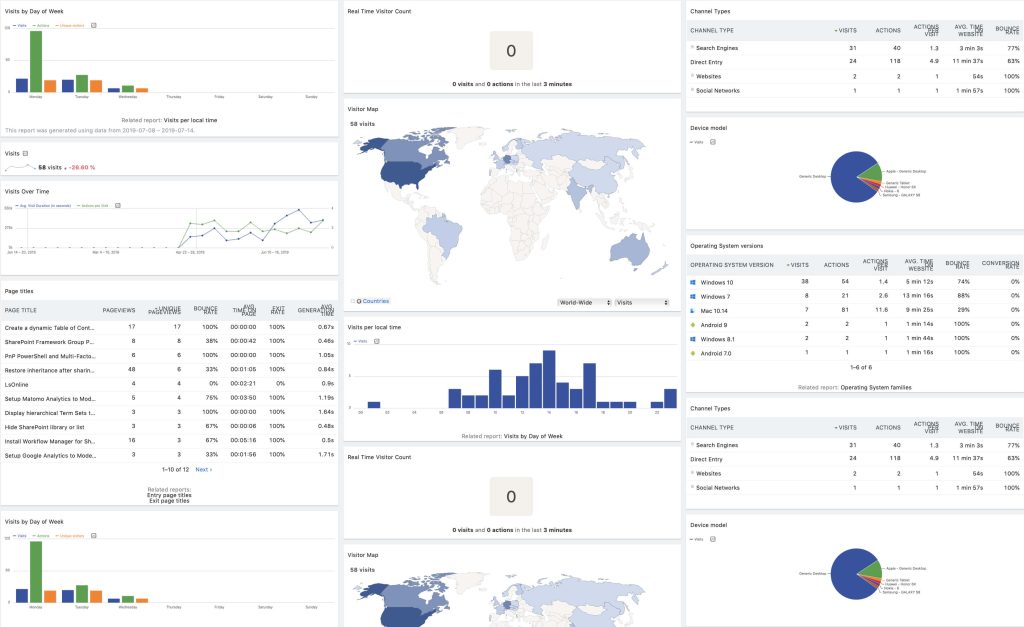
What it does:
Matomo is the industry standard for privacy-first analytics. It’s been around since 2007, originally as an open-source project. It’s approved by the French Data Protection Authority (CNIL), which is as rigorous as it gets.
And it offers the same depth of analytics as Google Analytics (custom events, goals, funnels, cohort analysis, heatmaps and more). Except with Matomo, you control who owns and accesses your data. You can self-host on your own servers or opt for Matomo Cloud. Either way, you know where your data lives.
Why it’s GDPR-compliant:
Matomo’s certified as compliant with GDPR, CCPA, HIPAA, PECR and other major laws. With self-hosting, you have zero data transfer, as well. With Matomo Cloud, all data is stored on EU servers, and the service can be approved by data authorities as a no-consent-needed analytics tool.
Best for:
Enterprise teams, e-commerce stores, and heavily regulated industries such as healthcare, finance, and legal. And for anyone who needs total control over their data.
Real world example:
After completing a compliance audit, a financial services firm was advised against using Google Analytics due to data transfer risks. In Matomo Cloud, the firm was able to switch from Google Analytics without losing any tracking capabilities, while removing compliance risks.
Pricing:
Free plan available. Paid starts at €22 on Cloud & €275 on On-Premise.
3. Plausible Analytics – Best for Simplicity
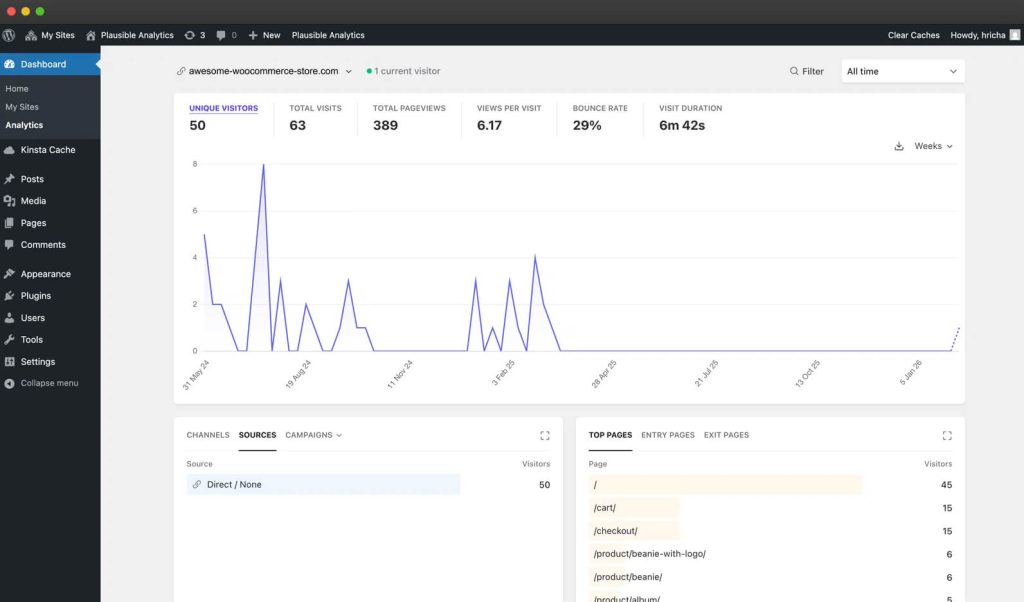
What it does:
Plausible analytics reduces the amount of data you collect to what really matters: traffic, page views, bounce rate, and where leads are coming from. The clean dashboard eliminates the unnecessary noise and complexity that comes with most analytics tools.
Because of its streamlined approach to data collection, Plausible is also one of the fastest loading analytics tools and has a smaller script size than Google Analytics. As an open-source tool, Plausible offers the flexibility to customize analytics for personal use and also supports self-hosting.
Why it’s GDPR-compliant:
Utilizes a cookieless design with no cookies to require a consent banner. IP and user agent information is hashed on a daily basis, with the salt deleted afterwards, so the data can never be re-identified.
Best for:
Bloggers, small businesses, startups, and marketers who only need website traffic analytics as opposed to product analytics. Best for those who value simplicity.
Case Study:
Small marketing agency handling analytics for multiple clients switched from GA4 to Plausible. Now, their client data is fully GDPR-compliant, the dashboard loads almost instantly during video calls, and the cost is much lower than GA4.
Pricing:
Free trial available. Custom paid plans
4. Fathom Analytics – Best for EU-Isolated Data
What it does:
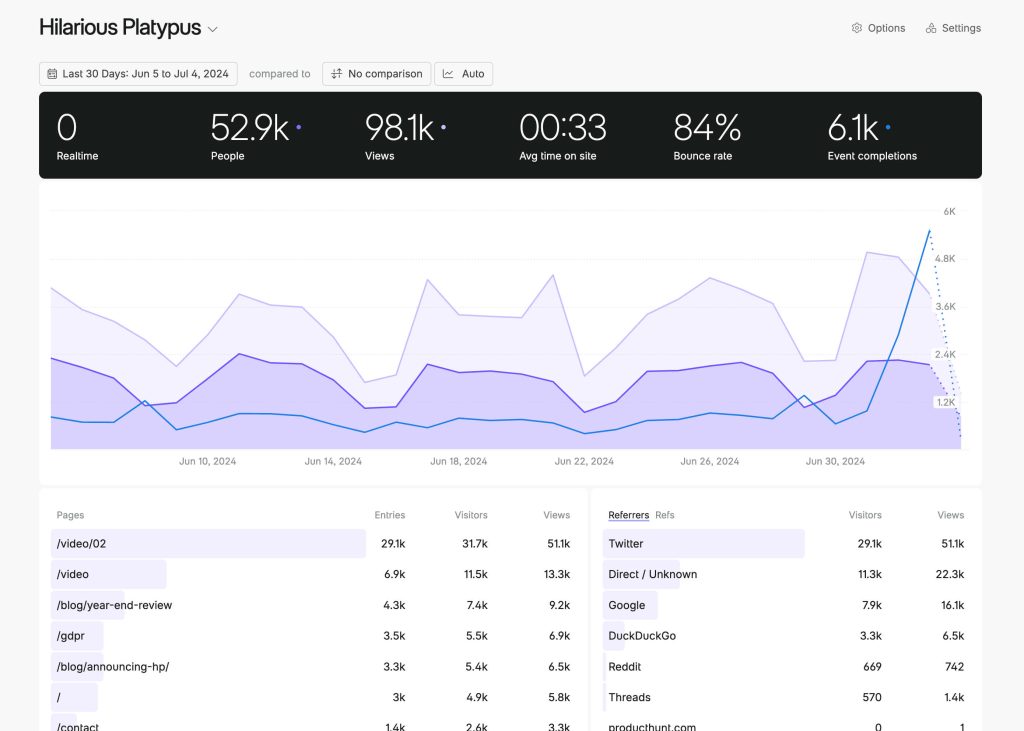
Made by Jack Ellis, one of Fathom’s co-founders, Fathom is a privacy-first alternative to Google Analytics. It presents visitors, page views, referrers, and goals in a single-page dashboard.
Fathom uses EU Isolation, a feature that stores data from EU visitors on servers in the EU and never transfers it to other countries. This eliminates the need for a consent banner since there is no cross-border transfer of data.
Why it’s GDPR-compliant:
Fathom’s Canadian entity has GDPR adequacy status. They store anonymized logs and collect no personal data. They have also undergone SOC 2 Type II auditor review. Fathom is automatically compliant with GDPR, CCPA, PECR, ePrivacy, and other laws.
Best for:
Businesses and organizations in Europe and the EU. Also an excellent choice for marketers who want to migrate away from Google Analytics without having to think about compliance.
Case Study:
A SaaS business in Germany switched to Fathom and was able to get rid of their consent banner altogether. No GDPR issues, and the site loads quickly.
Pricing:
Free trial available. Starts at $15 per month.
5. Usermaven – Best for AI-Powered Product Insights + Compliance
What it does:
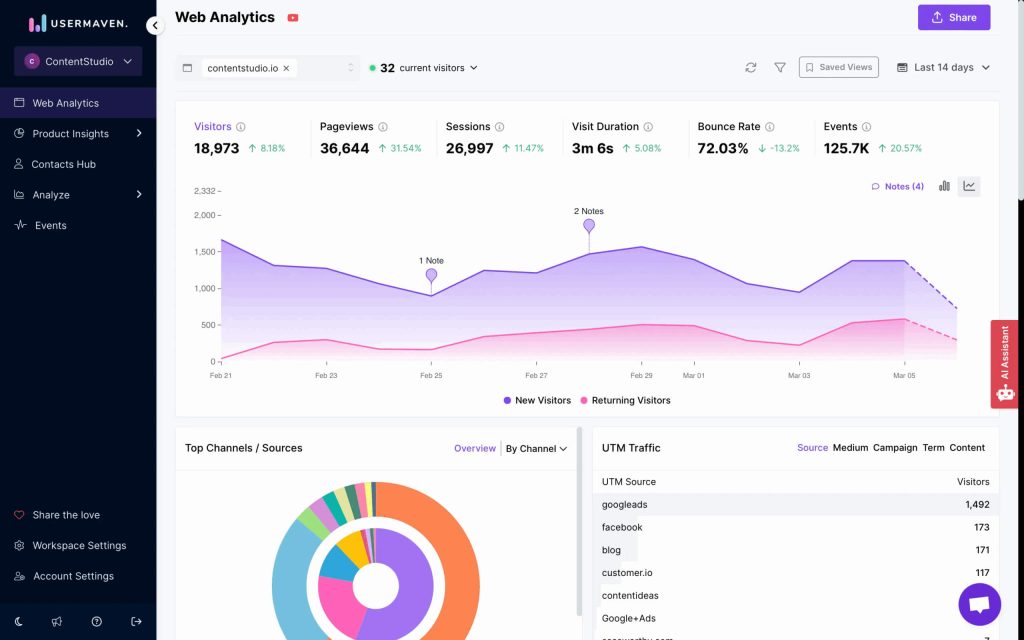
Usermaven is a just-launched tool that mixes website and product analytics. It works automatically and lets you see user journeys, funnels, attributions, and events with no setup required. The tool even has an AI that learns about your app and gives you recommendations for what to investigate, and it can keep all this up and accurate 99% of the time even if your users have ad blockers turned on.
Why it’s GDPR-compliant:
Usermaven uses cookieless tracking technology. So it doesn’t collect personal data through cookies. That means there are no consent forms for the user to fill out, which makes compliance a breeze. Usermaven is fully compliant with GDPR, CCPA, LGPD and other privacy laws.
Best for:
Fast-growing SaaS and product companies that want to get behavioral insights for their marketing and product teams without having to hire developers to code custom events into Mixpanel or Amplitude. Teams who serve a mixture of users in the US and Europe should also check out Usermaven.
Real World Example:
A B2B SaaS team switched from Mixpanel to Usermaven. Their implementation time went from 6 weeks to just 3 days. The tool’s AI recommendations have also helped their product managers uncover new user behaviors they didn’t even realize needed tracking.
Pricing:
Free trial available. Custom paid plans.
6. Secure Privacy – Best for Integrated Consent + Compliance Intelligence
What it does:
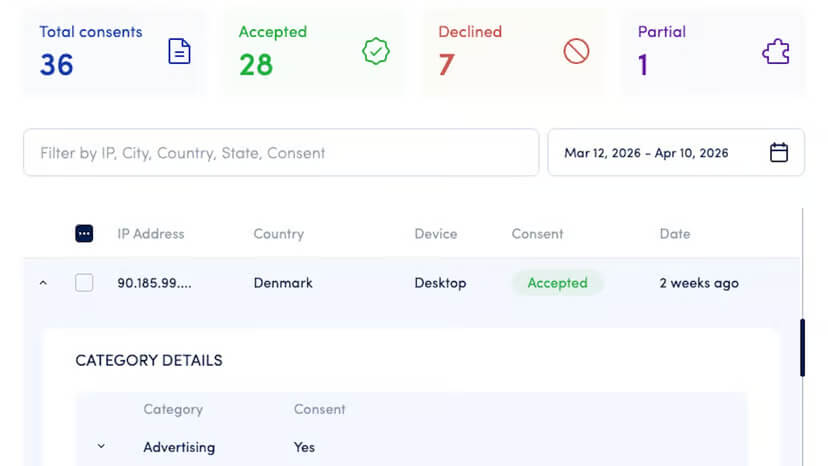
A Google-certified consent management platform (CMP) integrated with privacy-first analytics and live multi-jurisdiction compliance intelligence.
Why it’s GDPR-compliant:
Secure Privacy is Google Certified, meaning it meets all of the consent requirements. In addition, it manages consent, analytics, and compliance all from one centralized location. No more piecemeal solutions with multiple vendors.
Best for:
Mid-market and enterprise businesses with global operations. If you’re sick of trying to put together consent + analytics + compliance from three different vendors, this is for you. Instead of just ticking checkboxes, you’ll actually be able to see compliance in action.
Case study:
This e-commerce business corrected their consent distribution configuration after discovering through Secure Privacy’s real-time compliance monitoring feature that they were only receiving consent from 40% of valid EU visits. The small fix had a huge return on investment.
Pricing:
Free plan available. Paid starts at $15 per month.
Conclusion
If you’re just starting out, I’d recommend pairing CROLabs (for conversion insights) with Fathom or Plausible (for basic traffic). It’s simple, affordable, and covers your compliance exposure.
If you’re a larger team, pair CROLabs with Matomo instead for deeper analysis.