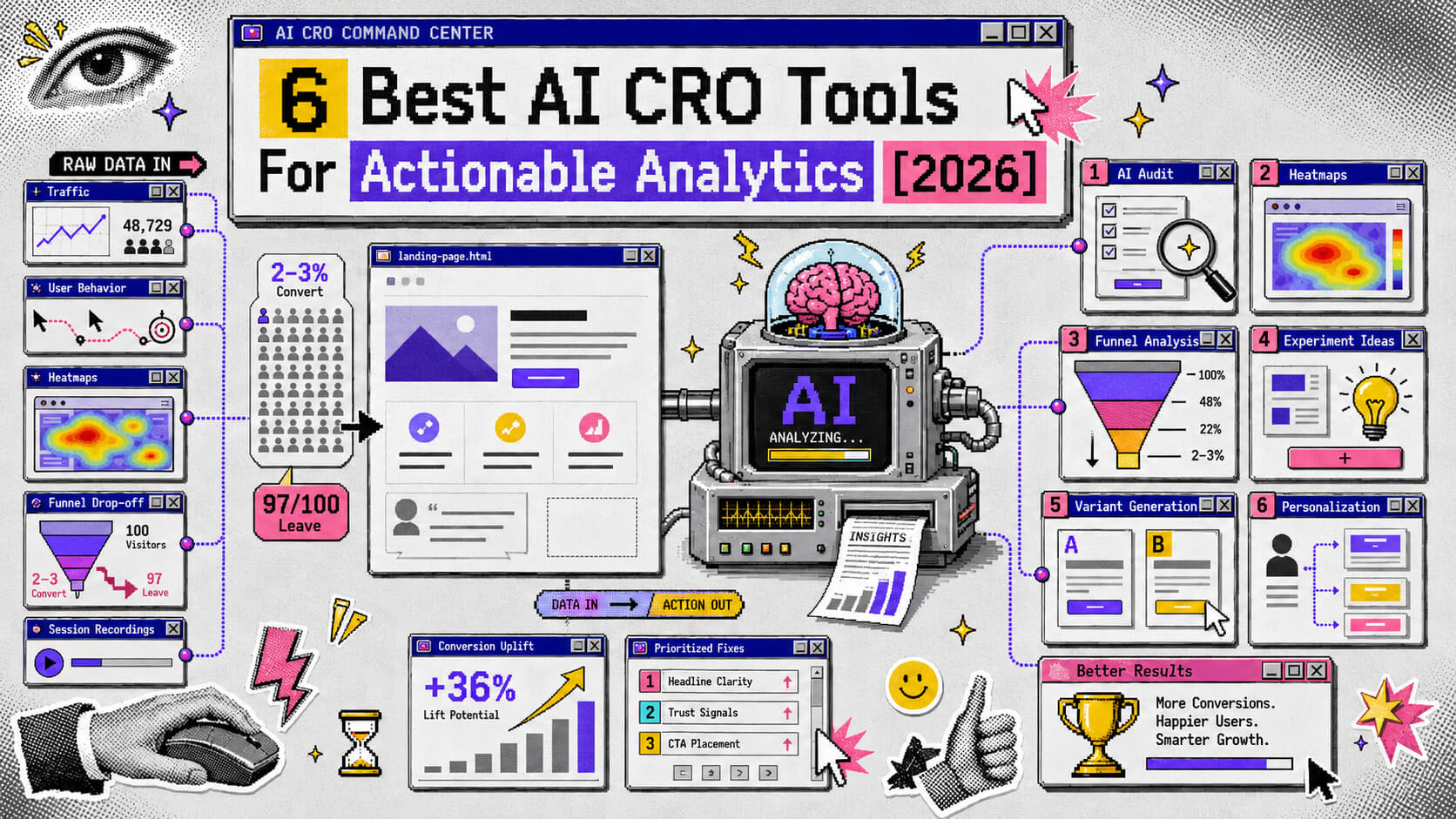
The average website converts at around 2-3%. That means for every 100 people who land on your page, roughly 97 of them leave without taking any action on your page.
Traditional conversion rate optimization (CRO) hasn’t been as helpful as it should because the analytics you get aren’t actionable, meaning they mostly consist of raw data without prescriptive insights.
But with the incorporation of AI in CRO over the past couple of years, the gap is closing faster. AI CRO tools now read your traffic data, flag the specific elements costing you conversions, and in some cases build and launch the fix themselves.
We went looking for the tools actually doing this well and here’s what we found.
On This Page
How We Chose These Tools
As a CRO platform ourselves, we’ll be upfront with you and tell you that we included ourselves on this list, but that’s because we know this space well.
We held every tool, including CROLabs, to the same bar. Here’s what we looked for:
Genuine AI:
The tool needs to use AI to analyze behavior, generate hypotheses, prioritize fixes, or personalize experiences automatically. Just having “AI Insights” as a checkbox feature didn’t count.
Actionability:
Good CRO analytics tells you what to test next and (ideally) lets you launch that test without waiting on a developer.
Real usage data:
We leaned on verified reviews, pricing transparency reports, and forum threads over vendor marketing copy.
Range of use cases:
Some teams need lightweight A/B testing and dynamic landing pages while others need enterprise-grade experimentation or account-based personalization. So we picked tools that cover different budgets and different jobs.
Pricing clarity:
We noted where pricing is transparent and where it isn’t, especially because we know how expensive CRO software can get.
With that out of the way, let’s get into the tools.
1. CROLabs
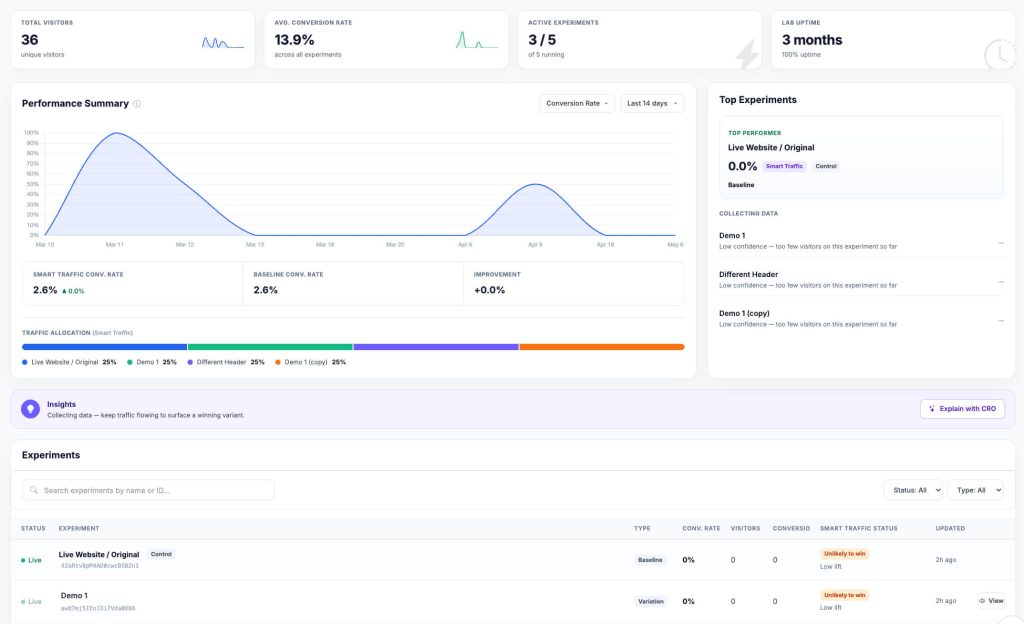
CROLabs is an AI-native A/B testing and website optimization platform. It’s built around the idea that most teams don’t need more data, they just need to know what to do with the data they already have.
The AI Advisor crawls your pages and compares them against CRO best practices. Then, it returns a prioritized list of what’s actually costing you conversions, which it ranks by estimated impact. Once you get the list, you can turn any recommendation straight into an experiment inside the visual editor without touching code.
CROLabs has a free trial, transparent monthly pricing, and setup that takes about five minutes with a single script tag.
Key features:
- AI Advisor that audits pages and prioritizes fixes by estimated impact
- A/B and multivariate testing with a no-code visual editor
- Built-in conversion tracking (clicks, form submissions, scroll depth, time on page)
- Personalization by device, screen size, and referrer
- Privacy-first analytics that doesn’t collect PII, so it’s GDPR-friendly out of the box
Pricing:
Free trial available. Paid plans start at €99/month for 3 domains and 200 AI Advisor credits per month, scaling up to €359/month for larger traffic and 10 domains. Custom enterprise pricing is available for dedicated infrastructure and support.
2. VWO
VWO has been one of the default names in A/B testing for over a decade, and in January 2026 it merged with AB Tasty. Just like CROLabs, it pairs testing with a strong analytics layer.
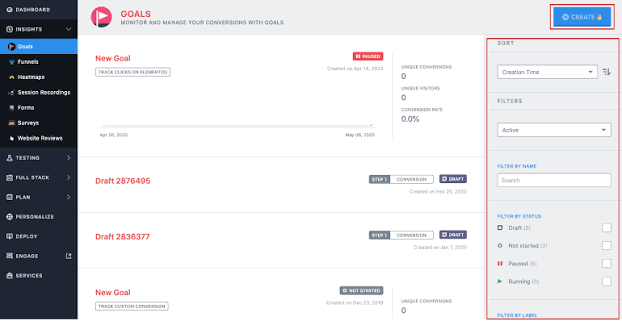
VWO gives its users heatmaps, session recordings, funnel exploration, and on-page surveys all live in the same place. VWO Copilot, its AI layer, generates test hypotheses, drafts variations, and surfaces insights from your data instead of leaving you to dig through reports manually.
The very big tradeoff with VWO (and it’s a big one based on what buyers report) is pricing. VWO doesn’t publish real numbers for anything above its entry Starter tier, and the free plan that used to make it approachable has been phased out.
Reviewers consistently rate it easier to use than Optimizely, but plenty of threads on pricing forums describe the sales process as opaque, with quotes that balloon once you add Insights or Personalize as separate modules.
Key features:
- VWO Copilot for AI-generated test ideas and variation drafts
- Bayesian statistics (SmartStats) that show the probability a variant beats control
- Heatmaps, session recordings, and on-page surveys bundled as VWO Insights
- FullStack for server-side testing across mobile and backend services
- Audience-based personalization through the VWO Personalize add-on
Pricing
Starter begins around $314/month for up to 10,000 monthly tracked users, testing only. Growth and Pro require a custom quote, with real-world contracts commonly landing between $8,000 and $40,000+ per year depending on traffic and which modules you bundle in.
3. Optimizely
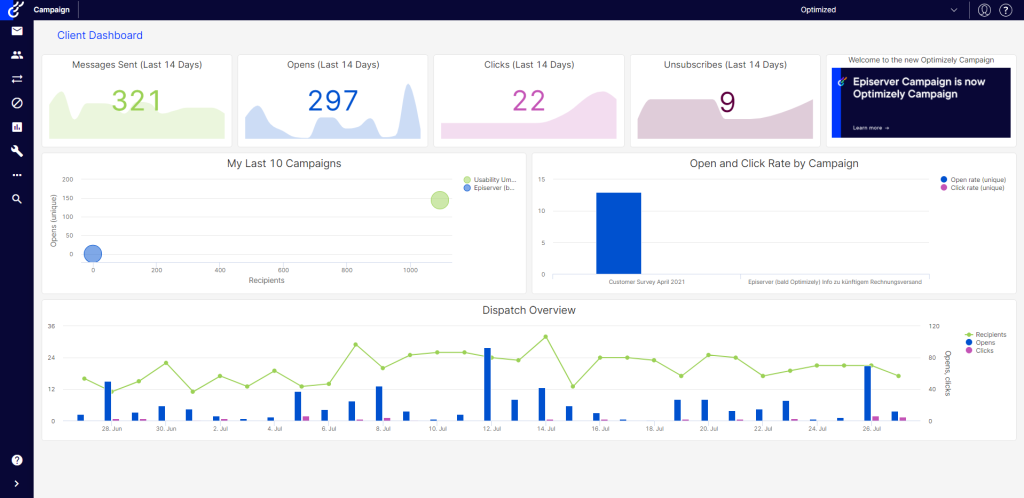
Optimizely is a CRO tool that is heavily developer-dependent, which means you need an engineering team to make and run tests. It’s more of an experimentation operating system with its feature flags, server-side testing, and an Opal AI layer that helps generate and prioritize experiment ideas across web, apps, and backend services.
Its Optimizely Data Platform adds NLP-based content matching for real-time personalization, which is a level of sophistication most CRO tools don’t attempt.
That power comes at enterprise pricing and an enterprise learning curve. Full-stack Opal packages commonly run well past $36,000 a year, and multiple comparisons note that Optimizely genuinely requires developer resources to get real value out of it, unlike more marketing-led platforms.
Key features:
- Optimizely Opal AI for experiment ideation and prioritization
- Feature Experimentation with cross-platform SDKs for server-side and app testing
- Sequential statistical testing developed with Stanford statisticians
- Optimizely Data Platform for cross-channel personalization
- Deep integrations across enterprise marketing and data stacks
Pricing:
Custom enterprise pricing only. Full-stack packages with Opal AI commonly exceed $36,000-$50,000+ per year, and some deployments run considerably higher depending on traffic and modules.
4. Mutiny
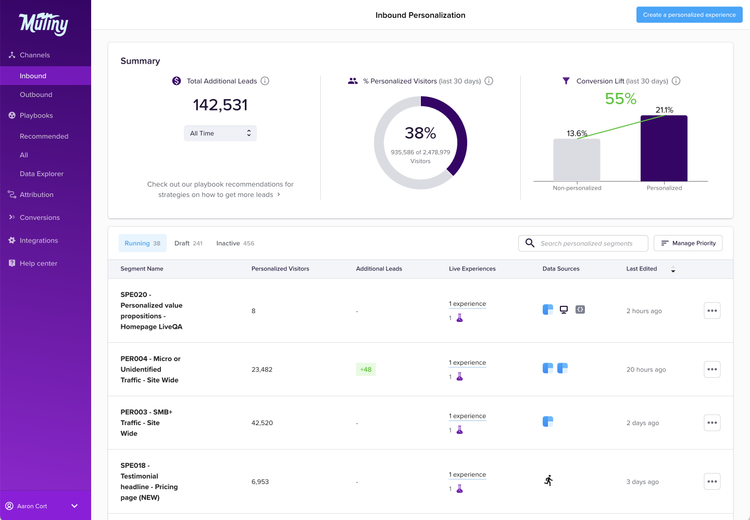
Mutiny takes a completely different angle than the testing platforms above. It’s built specifically for B2B go-to-market teams who want to personalize their website by account, not by traffic split.
It resolves a visitor’s company through firmographic data (Clearbit or 6sense), then automatically serves a tailored headline, logo wall, or CTA based on that company’s industry or size. Its newer AI layer goes further, drafting entire landing pages and business cases for specific target accounts in minutes.
Mutiny’s customer success motion gets consistently strong marks in reviews but it’s not cheap, and it’s not really an A/B testing tool. We would describe it as a premium personalization layer, with renewal quotes that regularly land in the $25,000 to $60,000 a year range and a habit of creeping upward at renewal time.
Key features:
- Account-level personalization based on firmographic visitor datas
- AI Copilot for drafting personalized landing pages and business cases
- Automatic hold-out testing to measure personalization impact
- Pre-built integrations with Clearbit, 6sense, Marketo, and Salesforce
- Segment recommendation engine that suggests which audiences to personalize for
Pricing:
Free plan available. Paid starts at $50 per month. For custom enterprise pricing, median reported contracts sit around $37,800/year, with real-world deals ranging from roughly $25,000 to $60,000+ depending on traffic and integration depth.
5. Webflow Optimize (formerly Intellimize)
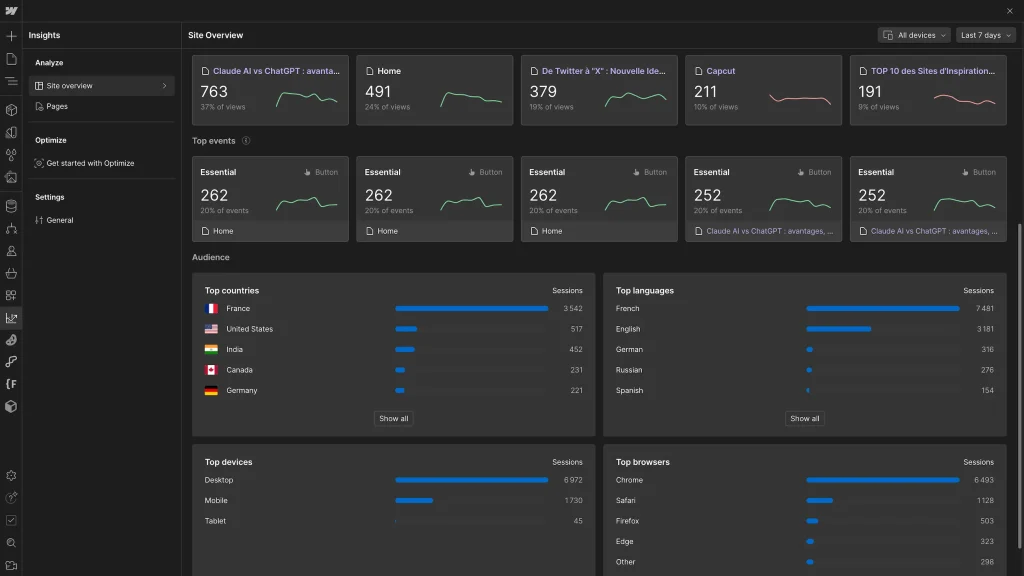
Webflow acquired Intellimize in 2024 and folded it into Webflow Optimize. It’s a tool built almost entirely around dynamic landing pages.
Instead of running a fixed A/B test, its AI continuously adjusts headlines, images, and layout in real time based on who’s visiting and what’s converting. It’s essentially running thousands of micro-experiments at once instead of one static A vs. B comparison. For teams running a lot of paid traffic to landing pages, that kind of always-on optimization can meaningfully boost landing page conversion rate without constant manual test setup.
The rebrand hasn’t been smooth, though. Several reviewers flag a rougher user experience since the Webflow integration, along with forms that are harder to swap out without breaking something. It’s also tightly coupled to the Webflow ecosystem, so if your site lives elsewhere, this isn’t the tool for you.
Key features:
- AI-driven dynamic landing pages that adjust content per visitor in real time
- Automatic traffic allocation to the highest-converting variant
- Built for paid traffic and landing page programs specifically
- Native integration with the Webflow CMS and design environment
- Real-time performance reporting by segment and traffic source
Pricing:
Starts at $299/month billed annually (around $379/month at 25,000 monthly page views), and requires an active Webflow site to use.
6. Contentsquare
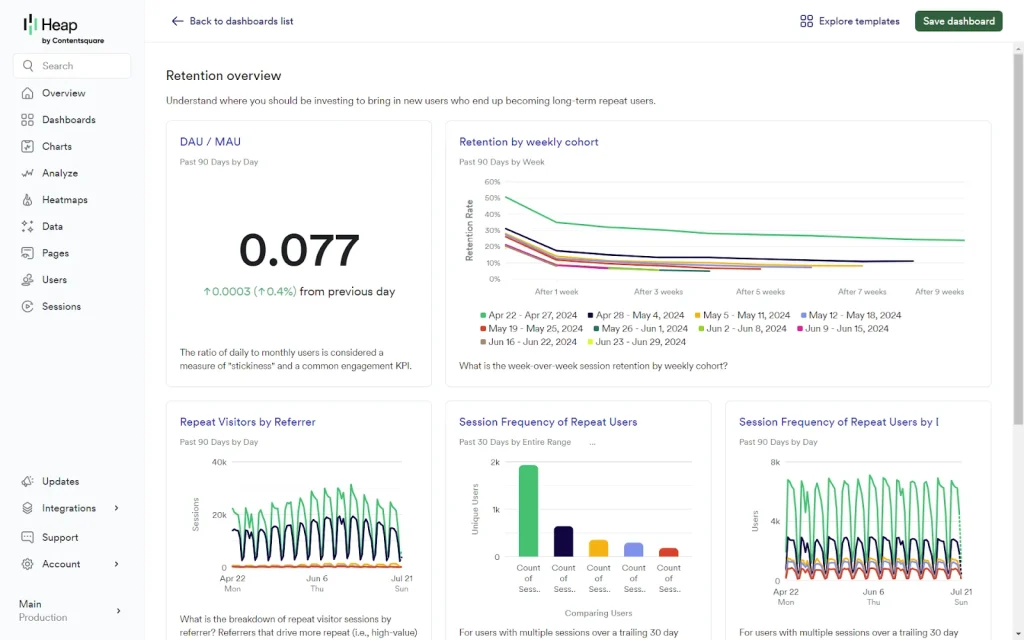
Contentsquare sits closer to the analytics end of the spectrum than the testing end, and it earns its spot here because of how much its AI layer, Sense AI, changes the actual workflow.
Instead of a CRO manager scrubbing through thousands of session recordings by hand, Sense AI lets anyone on the team ask a plain-language question and get an answer pulled straight from behavioral data. The data includes where users hesitate, what they rage-click, etc. It’s the clearest example on this list of AI turning raw analytics into something a non-analyst can act on immediately.
It’s built for scale, and the pricing reflects that. Mid-market deployments commonly run $50,000 to $150,000 a year, and enterprise contracts with high session volumes can climb past $200,000. This isn’t a tool for a small site trying to improve landing page conversion rate on a shoestring budget; it’s for teams that already have serious traffic and need to make sense of it fast.
Key features:
- Sense AI for plain-language querying of behavioral data
- Zone-based heatmaps and session replay
- Struggle and rage-click detection tied to revenue impact
- Journey analysis across web, app, and multi-domain properties
- AI-generated, prioritized recommendations mapped to specific page elements
Pricing:
Free plan available. Paid plans start from $39 per month. Custom, usage-based pricing tied to monthly sessions and number of properties. Mid-market deployments typically fall between $50,000 and $150,000/year; large enterprise contracts can exceed $200,000-$500,000/year.
Conclusion
AI has transformed the data in conversion rate optimization to a more actionable one. So pick the AI-powered CRO tool that fits your traffic, your budget, and your team’s technical comfort, and run the experiments it suggests.
Every Visitor Is a Conversion Opportunity
Don’t let valuable traffic go to waste. Use AI-powered audits, experimentation, and personalization to uncover what’s holding your pages back and improve results.
FAQ
What makes a CRO tool “AI-powered” versus just having AI features bolted on?
A genuinely AI-powered CRO tool uses machine learning or generative AI to do part of the analysis or optimization work for you. It prioritizes what to fix, generates test variations, or automatically routes traffic to the best-performing version. If the “AI” only summarizes a report you could’ve read yourself, it’s a feature, not a foundation.
Do I need a developer to run AI-driven A/B testing?
Not with most modern tools. Platforms like CROLabs and VWO use visual, no-code editors, so marketers can launch tests without engineering help. Tools like Optimizely and Webflow’s server-side testing lean more heavily on developer involvement, especially for anything beyond front-end changes.
How much traffic do I need before AI CRO tools become useful?
It depends on the tool, but as a rule of thumb, you want at least a few hundred visitors per variant before a test produces a reliable result. Behavioral analytics tools like Contentsquare need meaningful session volume to make their AI insights statistically solid, which is part of why they’re priced for larger sites.
Can AI CRO tools actually boost landing page conversion rate on their own?
They can get you most of the way there, but they’re not fully hands-off. AI is excellent at spotting friction points and generating hypotheses faster than a human could manually. But someone still needs to decide which experiments matter most to the business and interpret results in context.
What’s the difference between personalization and A/B testing?
A/B testing finds the single best version of a page for all visitors while personalization shows different versions to different segments based on who they are, like their industry, device, or traffic source. Many of the tools on this list, including CROLabs and Mutiny, do both, but they lean in different directions depending on your use case.
Is it worth paying for an enterprise CRO tool if I’m a small team?
Usually not. Enterprise platforms like Optimizely and Contentsquare are built for the scale, governance, and integration needs of large organizations, and the pricing reflects that. Smaller teams generally get more value, faster, from tools with transparent pricing and lighter setup, like CROLabs or VWO’s entry tier.