Updated Sep 2026
Imagine a scenario where two people visit your product page within thirty seconds of each other.
The first has been searching for noise-cancelling headphones under $200. They’ve opened several tabs, compared prices, and are trying to decide which pair to buy. The second clicked a retargeting ad after leaving something in their cart last week. They already know what they want and are checking whether there’s a discount available.
In this scenario, your website greets both visitors with the same headline, the same product recommendations, and the same call to action.
You can see how that might create a problem. Each visitor arrives with a different set of questions, and the page has to work for both of them.
This is where A/B testing and personalization can work together. One helps you find out which changes improve conversions. The other lets you adapt the experience to people who have different needs or behaviors. When teams bring these activities into the same optimization process, they can make more informed decisions about what to show visitors and how well those changes perform.
Here’s how the two approaches work, how to combine them, and what to watch out for when you start testing smaller audience segments.
On This Page
What A/B Testing and Personalization Mean
A/B testing: Finding out what works
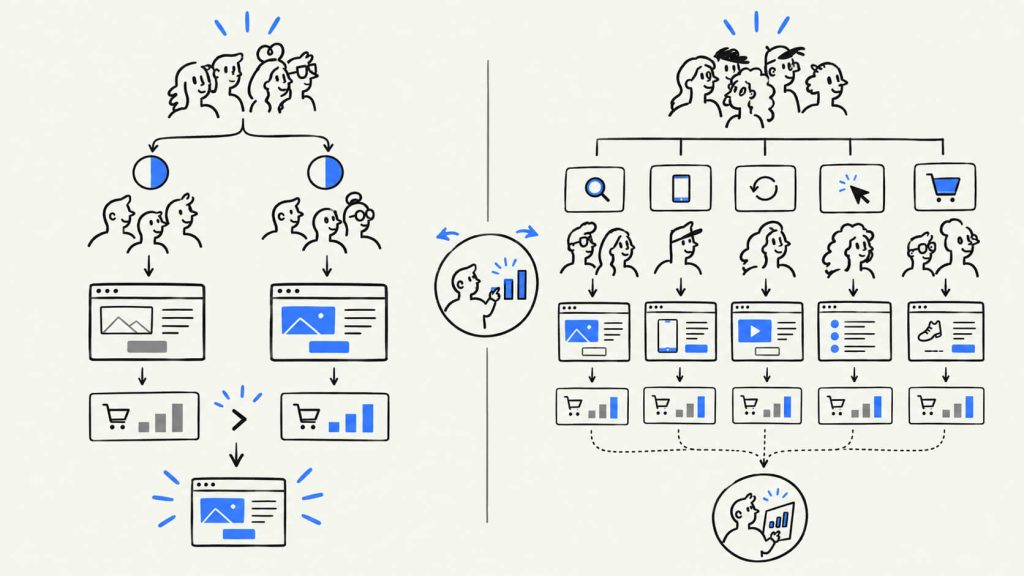
A/B testing, sometimes called split testing, lets you compare two versions of a webpage, email, or app screen with real users.
You divide your traffic between the existing experience and a variation you’ve created. Then you track how each version performs against a specific goal. That might be a purchase, a newsletter signup, or a booked demo.
The existing version is your control. The new version is the variant.
Imagine your checkout process has a single page, and you’re considering moving it to a two-step format. You could build the alternative, direct a portion of your visitors to it, and measure how many people complete their purchase.
With enough data, you’ll have evidence to help you decide which checkout experience to use.
Teams that run tests regularly build up a broader understanding of their visitors. Over time, each experiment gives them information they can use to shape future decisions. That’s the foundation of an experimentation program.
Personalization: Adapting the experience to visitors
Personalization changes what people see based on information about them or their behavior.
A returning customer might see products related to a previous purchase. Someone arriving through an ad for running shoes could land on a page featuring running gear, while a visitor who searched for waterproof hiking boots sees content focused on hiking.
The idea is to make the experience more relevant to the person viewing it.
Personalization can use information such as a visitor’s traffic source, browsing history, location, customer status, or previous interactions with your website. The details depend on what your business collects and what your tools allow you to use.
The goal is to serve an experience that fits the visitor’s circumstances.
A/B testing helps you evaluate changes to an experience. Personalization lets you tailor that experience to different audiences. Using both gives you a way to investigate which tailored changes help each audience convert.
| A/B Testing | Personalization | |
| Question it answers | Which version works best for everyone | Which version works best for this group |
| How traffic is split | Randomly, across variants | By identity, behavior, source, or segment |
| Best used when | You don’t know which idea is stronger | You already have reason to think a segment behaves differently |
| Risk if used alone | The “winner” is really an average that fits no one in particular | Segments and content get chosen on instinct, with no proof they help |
Why Combine A/B Testing and Personalization?
Personalization involves decisions about what different visitors might respond to. Teams often make those decisions using customer research, analytics, or ideas from people who know the product well.
Those sources can point you in a useful direction. Testing gives you a way to check whether your assumptions hold up when people interact with the page.
A/B testing also benefits from a closer look at audience behavior. Your visitors arrive through different channels, use different devices, and have varying levels of familiarity with your brand. Their reasons for visiting can shape how they respond to the same page.
When you test a change across your entire audience, the result represents the combined behavior of everyone in that test. That can make it harder to spot improvements that matter to a particular group.
Optimizely’s analysis of more than 127,000 experiments found that personalized experiments delivered 41% more expected impact than experiments without targeting.
McKinsey has also reported that companies growing faster than their competitors generate 40% more revenue from personalization than slower-growing companies.
These findings point to the commercial potential of tailoring digital experiences. Your own results will depend on your audience, the changes you make, and how well you measure their effects.
Consider the headphone shoppers from the introduction. A first-time visitor comparing several brands might respond to a detailed product comparison. Someone returning to complete a purchase could respond to a reminder about the item they left in their cart.
Testing these experiences within the relevant audiences gives you a clearer view of how each change performs. You can then use those findings to guide future optimization work.
Find out what works for each audience
Your personalization ideas deserve a proper test. Use CROLabs to experiment with tailored website experiences and see how they affect conversions.
Cancel anytime.
How To Combine A/B Testing and Personalization
The process starts with understanding your audience. From there, you can decide which experiences to create, test them against an appropriate baseline, and use the results to plan your next experiment.
1. Identify the audience segments that matter
Start with the information you already have about your visitors.
Your analytics platform may show where people come from, which devices they use, whether they’ve visited before, and how they interact with your website. If your business tracks customer accounts or purchase history, you may also have information about previous orders and product interests.
Look for groups whose behavior gives you a reason to create a different experience.
For example, visitors arriving from paid search may behave differently from people who reach your site through an email campaign. New visitors could have different questions from returning customers who already know your product.
Start with segments that have enough traffic to support testing. You’ll also want evidence that their behavior differs in a way that could affect conversion.
A segment should give you something useful to investigate. Creating separate experiences for groups that behave almost identically can add work without producing much value.
2. Write a hypothesis for each segment
Once you’ve identified an audience, decide what you want to change and why.
A useful hypothesis connects the audience to a specific change and an outcome you can measure.
For example:
“Returning visitors who abandoned their carts within the past seven days will complete more purchases if the homepage hero displays the product they left behind.”
This gives you a clear idea to test. You know which visitors you’re targeting, what they’ll see, and which behavior you’re trying to improve.
You can then choose a primary conversion metric, such as completed purchases, and decide which supporting metrics might help explain the result.
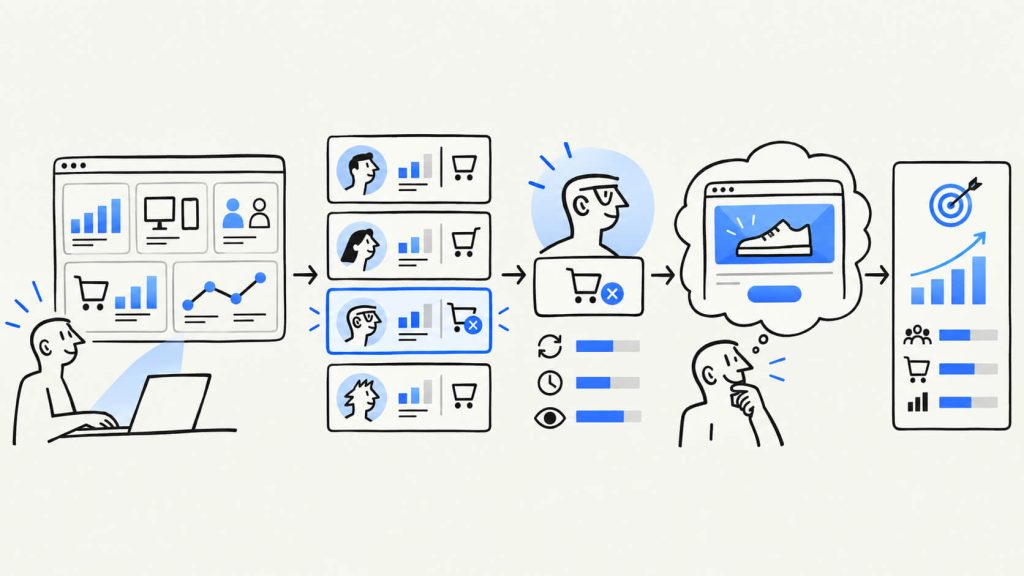
Your hypothesis should come from something you’ve observed or learned about your customers. Analytics data, user research, customer feedback, and session recordings can all help you develop an idea worth testing.
3. Compare the personalized experience with the existing one
This is where the experiment comes in.
Suppose you’ve built a personalized homepage for returning visitors who abandoned their carts. You could show that version to a randomly selected portion of the eligible audience while the remaining visitors continue to see your existing homepage.
The existing experience gives you a control group. The personalized version is your variant.
Track how each group performs against the conversion goal you chose.
This comparison helps you estimate the effect of the change under the conditions of your experiment. If both groups experience a seasonal traffic spike, for example, the control group gives you a reference point for understanding what happened during the same period.
You’ll also want to keep other changes under control while the experiment runs. A pricing update or major campaign launched halfway through could affect the results and make them harder to interpret.
Once you have enough evidence, you can decide whether the personalized experience should reach more of that audience.
4. Allow enough time and traffic for a reliable result
A test needs enough observations to distinguish a meaningful effect from random variation.
The number of visitors you need depends on factors such as your current conversion rate, the size of the improvement you’re trying to detect, and the statistical confidence you want to achieve.
Segment-level experiments can take longer because they draw traffic from a smaller audience.
Imagine your website receives 40,000 visitors each month. Dividing them into five traffic-source groups would give you an average of 8,000 visitors per group, assuming traffic is distributed evenly.
Now divide those groups by device type and whether visitors are new or returning. Some of the resulting segments could receive only a few hundred visitors each month.
That leaves less data for your experiment to work with. A test that reaches its required sample size quickly across the entire site might need several months within a smaller audience.
Before launching, estimate how much traffic the test will receive and how long it may take to reach your required sample size. Choose a testing window that accounts for your traffic patterns, including differences between weekdays and weekends.
5. Roll out the result and plan the next experiment
When your test reaches its planned endpoint, review the results against your original hypothesis.
If the personalized version improves conversions and the evidence supports the change, you can roll it out to the eligible audience. Keep an eye on performance after launch so you can spot changes that weren’t visible during the experiment.
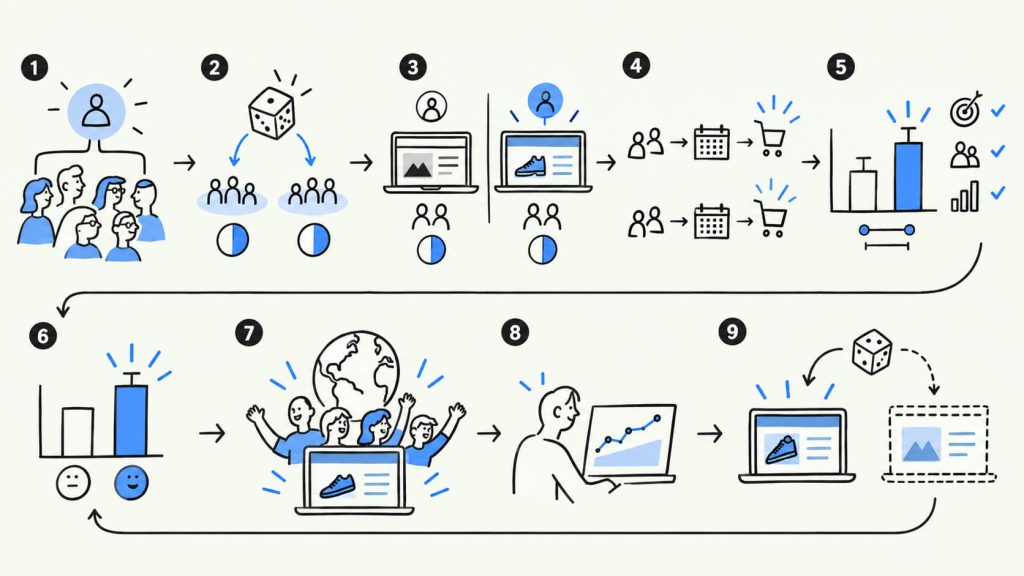
The winning version can then become the control for a future test.
You might explore a different headline, change the product information displayed, or investigate another part of the visitor journey. Each experiment gives you more information about how that audience responds.
Customer behavior also changes over time. A segment that responds well to a particular experience during one season may behave differently during another, especially when product demand or purchasing conditions shift.
Keep reviewing your segments and testing priorities as your business grows.
Test Personalized Experiences Without The Guesswork
Cancel anytime.
The Segment-Sizing Problem Nobody Warns You About
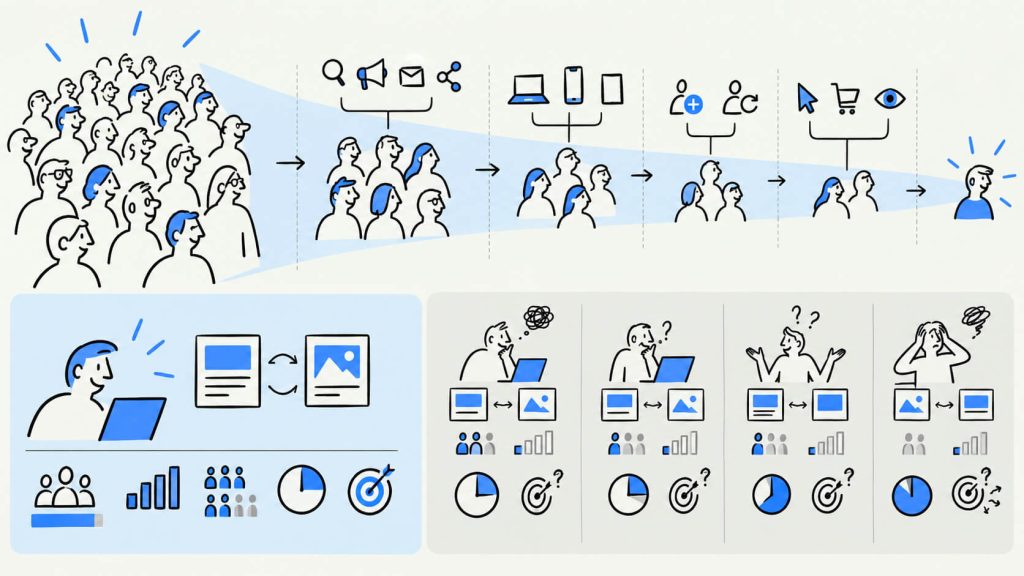
Personalization can get complicated as you create increasingly specific audience groups.
Every additional condition divides your traffic further. A segment based on traffic source might have thousands of visitors. Add device type, customer status, and a particular browsing behavior, and the eligible audience can shrink considerably.
That creates a practical problem for experimentation: you may have a promising idea for a group that doesn’t generate enough traffic to support a reliable test.
Let’s return to the website receiving 40,000 monthly visitors.
After dividing visitors by acquisition source, you might have roughly 8,000 people in each of five equally sized groups. If you then split those groups by device and visitor status, some combinations could end up with only a few hundred visitors per month.
A test with that level of traffic could take months to reach its required sample size. Depending on the conversion rate and the improvement you’re trying to detect, it might never collect enough data to give you a useful answer.
Here are some ways to manage the problem.
Start with segments that have enough traffic
Prioritize the largest audiences that show meaningful differences in behavior.
You might begin with three or four major segments and investigate how they respond to different experiences. Once you’ve learned more about those groups, you can decide whether smaller segments deserve further attention.
A highly specific audience can sound appealing, especially when you have a clear idea of what its members need. Check the available traffic before investing time in building and testing a separate experience.
Consider sequential or Bayesian testing
Traditional fixed-sample tests generally require you to decide on a sample size and testing approach before collecting data.
Sequential methods allow for planned analysis at multiple points during an experiment. Bayesian methods use probability distributions to update what you know as observations accumulate.
These approaches can be useful when traffic is limited, provided the testing method is designed and interpreted correctly.
They don’t remove the need for enough information. You’ll still need to choose suitable assumptions, define how you’ll make decisions, and account for the risks of drawing conclusions from limited data.
Use multi-armed bandits for suitable experiments
A multi-armed bandit approach can allocate traffic dynamically between different variants as performance data comes in.
As the system learns which versions are performing well, it can direct more visitors toward those experiences. This can help teams reduce the amount of traffic sent to weaker variants during an experiment.
Bandits are useful for certain optimization goals, especially when you want to adapt traffic allocation while a campaign is running.
They serve a different purpose from a conventional A/B test, though. If your priority is estimating the effect of a change with a clearly defined experimental design, a bandit approach may not provide the same kind of answer.
Choose the method that fits the question you’re trying to answer.
Set a minimum traffic threshold
Decide how much traffic a segment needs before you commit to a formal experiment.
If a group is too small to reach your required sample size within a reasonable period, consider gathering more qualitative information first.
Session recordings can show you where visitors struggle. Customer support conversations may reveal recurring questions, and direct feedback can help you understand why people hesitate before converting.
These signals can guide changes to the experience. You can then return to formal testing when the audience has grown enough to support it.
The important thing is to account for traffic limitations before you build a large collection of personalized experiences. Otherwise, you could end up maintaining pages and campaigns without enough evidence to evaluate their performance.
Real Examples of Testing and Personalization Working Together
True Botanicals: Building a structured CRO program
True Botanicals, a skincare brand, developed a conversion rate optimization program in 2022 that combined website redesigns, qualitative research, and structured experimentation.
The program reported a 66% test win rate and a site-wide conversion rate of 4.9%, exceeding its original goal. The company also reported an estimated increase of more than $2 million in ROI during the first year.
The case illustrates how research and testing can support broader conversion work. Teams can use customer insights to identify opportunities, then evaluate changes through experiments and apply what they learn to subsequent work.
The reported results belong to True Botanicals’ program, and individual businesses should assess their own starting points and testing conditions when setting expectations.
Pets Deli: Creating targeted Black Friday promotions
Pets Deli, a European direct-to-consumer pet food brand, wanted to run personalized Black Friday promotions while reducing its dependence on developers for every campaign change.
Using Contentful’s personalization tools, the team created promotional content and pricing for different audience segments. It launched the campaign within six weeks.
Compared with its standard promotions, the campaign reported a 51% increase in conversion rate and a 10% decrease in bounce rate.
The example shows how a business can use audience data to tailor a campaign and measure its performance against an existing experience. The reported improvement provides a useful illustration of the potential impact of targeted promotions, although the results may not transfer directly to other businesses or campaigns.
Putting A/B Testing and Personalization Into Practice
If you’re introducing this approach to your website, begin with a segment you understand and have enough traffic to test.
Look at how that audience behaves, identify a specific problem, and decide what experience could help. Then compare the personalized version with your existing page before rolling out the change.
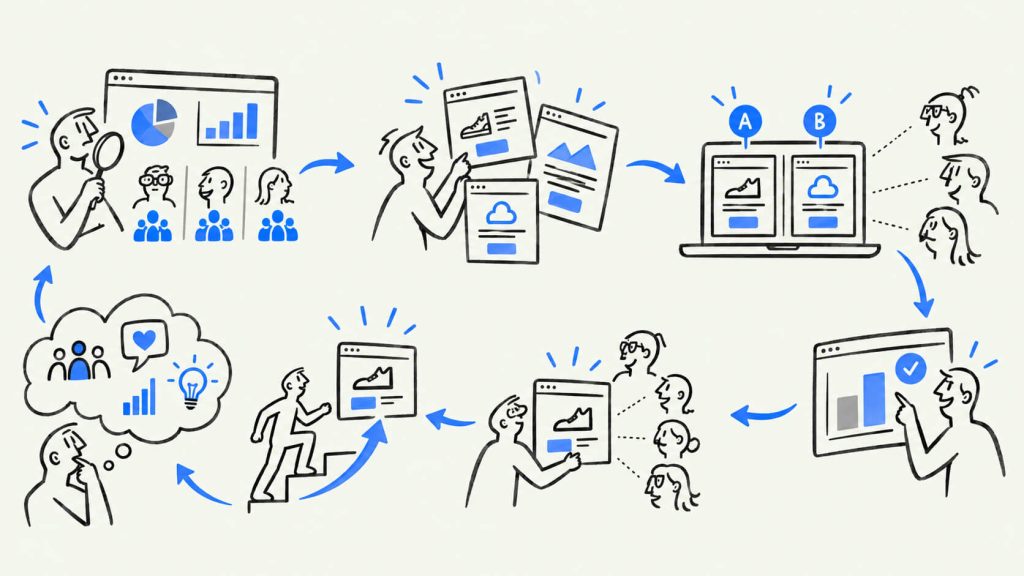
You can manage this workflow with a platform such as CROLabs, which brings A/B testing and audience personalization into the same environment. That can make it easier to build and evaluate targeted experiences without managing separate tools for each part of the process.
As you collect results, use them to guide your next experiments. You may discover that one segment responds to a different message, that another needs more product information, or that a proposed change has little effect on conversions.
The aim is to build a process that helps your team make informed decisions about the experiences visitors receive. With a clear hypothesis and a sound test, personalization becomes something you can evaluate and improve as your audience changes.
Turn your personalization ideas into experiments
Find out which website experiences help your visitors convert. Build and test variations with CROLabs, then use what you learn to guide your next optimization.
Cancel anytime.
FAQs
What’s the difference between A/B testing and personalization?
A/B testing compares different versions of an experience to see how they perform against a specific goal. Personalization adapts the experience based on information about the visitor or their behavior.
A/B testing helps you evaluate changes, while personalization lets you tailor those changes to particular audiences. Using both gives you a way to test whether a tailored experience improves conversions for the people who receive it.
Can you personalize a website without running A/B tests?
Yes. You can use customer research, analytics, or behavioral information to decide what different visitors should see.
Testing gives you a way to measure whether those changes improve performance. Without a comparison group or another suitable evaluation method, it’s harder to determine how much the personalized experience contributed to your conversion results.
How long should an A/B test inside a personalized segment run?
The duration depends on the segment’s traffic, its current conversion rate, and the size of the effect you’re trying to detect.
A small audience may need weeks or months to collect enough observations. Estimate the required sample size before launching and allow enough time to account for normal variations in visitor behavior.
Do small businesses need both A/B testing and personalization?
Small businesses can start with A/B testing on high-traffic pages and introduce personalization as they learn more about their audiences.
If your website receives limited traffic, begin with experiments that use a larger share of your visitors. As your data and audience grow, you can investigate whether specific segments would benefit from tailored experiences.
What makes a good audience segment for personalization?
A useful segment has enough traffic to support your planned evaluation and shows behavior that gives you a reason to tailor its experience.
Traffic source, device type, new versus returning visitors, and customer status can be useful starting points. Your analytics and customer research can help you decide which groups deserve further investigation.
Does personalization always improve conversions?
Personalization can improve conversions when the experience addresses something that matters to the visitor. Its impact varies by audience and by the change you’re making.
Some segments may respond positively, while others show little difference. Testing helps you understand those responses and decide where further personalization work makes sense.