Updated Oct 2026
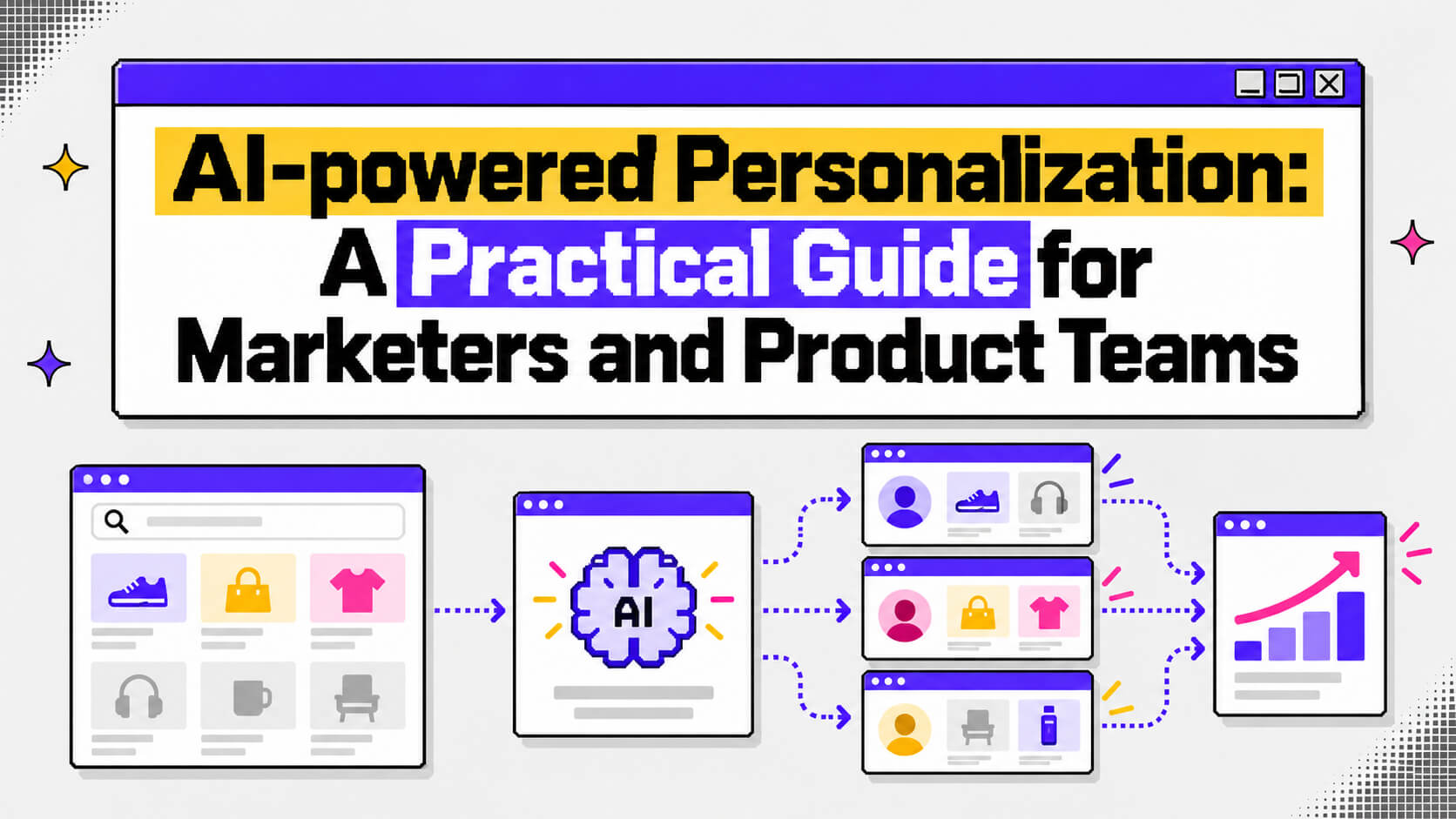
Snoonu is a delivery app in Qatar that sells food, groceries, electronics, and pharmacy items. It ranked products by popularity at first, so every user saw the same top sellers. In 2024 the team moved to an AI recommendation model, and it now retrains that model daily. Add-to-cart events from cart recommendations in its grocery vertical rose by 1,600%, according to an AWS case study.
That number belongs to one company with a large product catalog, and a smaller site will see a different result. It does show the basic mechanism, which is a model that changes what each person sees based on what that person just did.
This guide explains how AI personalization works and what the research says about revenue and trust. After that it goes through the places teams apply it, with examples taken from published case studies and surveys. Two sections cover situations that get little attention elsewhere: personalizing with little data, and checking whether any of it works.
On This Page
What Is AI Personalization?
AI personalization uses machine learning to decide what each visitor, customer, or user sees. The decision draws on data about that person, and the content can be a product recommendation, a headline, an email subject line, an onboarding step, or a lesson inside an app.
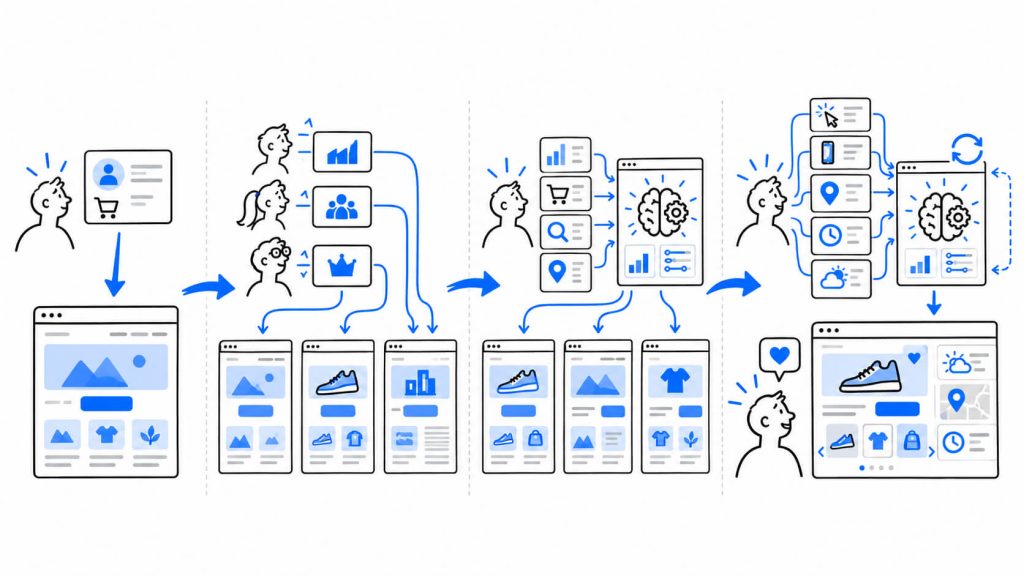
A rule-based setup follows instructions that a marketer writes by hand, such as “if the visitor came from this ad, show banner B.” A machine learning model learns from behavior which page, offer, or message gets a response from which kind of visitor. It keeps updating that learning as new data arrives, and that is why the same site can look different to two people on the same day.
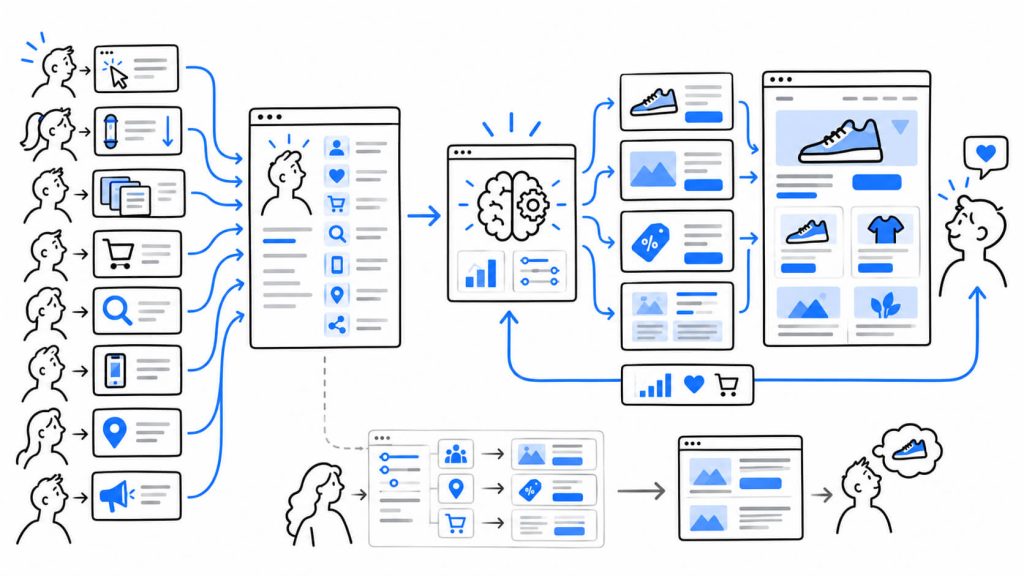
The process runs in four steps:
- Collect signals. Clicks, scroll depth, pages viewed, purchases, search terms, device, location, and the ad or email that brought the visitor all count as signals.
- Build a profile. The system groups those signals into a live view of the person or the session. First-party data, meaning information you collect directly through on-site behavior and form answers, feeds this step.
- Predict. A model estimates what this person wants next, whether that is a product or a feature.
- Deliver and learn. The page, message, or app screen changes. The system records whether the person responded, and the model adjusts.
Want to put personalization into practice?
CROLabs lets you personalize website experiences based on audience signals without building a personalization system from scratch. Start free and see what you can change.
AI Personalization Statistics
The figures below come from McKinsey, Gartner, Adobe, Twilio Segment, and Thoughtspot. They cover different years and different groups of respondents. Twilio Segment, Adobe, and Thoughtspot also sell products or services connected to the topic, which is worth knowing when you weigh their numbers.
Demand and revenue
| Statistic | Source |
| 71% of consumers expect personalized interactions, and 76% get frustrated when they don’t receive them | McKinsey, 2021 |
| Faster-growing companies get 40% more of their revenue from personalization than slower-growing companies | McKinsey, 2021 |
| 56% of consumers say they become repeat buyers after a personalized experience | Twilio Segment 2023, via RetailWire |
| Customers who saw personalization in a recent purchase were 1.8x more likely to pay a premium | Gartner, 2025 |
| Only 20% of retailers were prepared to offer real-time personalized experiences, and 75% of companies cannot act on their data in real time or hit obstacles when they try | Adobe |
Trust and side effects
| Statistic | Source |
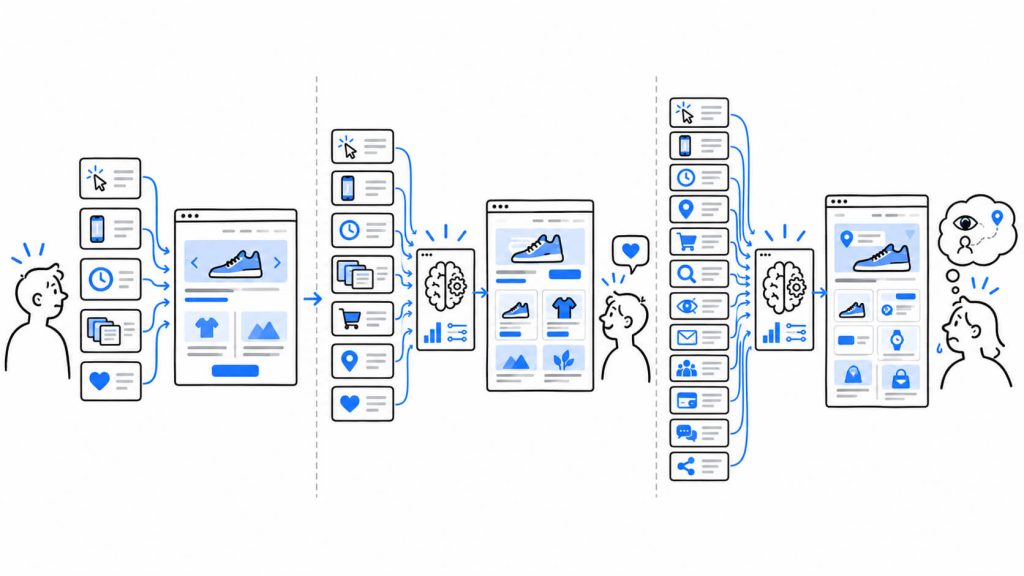
| 53% of customers had a negative experience with personalized marketing, and those customers were 3.2x more likely to regret a purchase and 44% less likely to buy again | Gartner, 2025 |
| Customers who saw personalization were 2x more likely to feel overwhelmed by the volume of information and 2.8x more likely to feel time pressure | Gartner, 2025 |
| 38% of customers say they would stop doing business with a company whose personalization they found creepy (2,500+ respondents) | Gartner, 2019 |
| Content is 3.6x more likely to feel creepy when marketers use ten data dimensions instead of one | Gartner, via CX Dive |
| 91% of consumers find at least one form of personalization intrusive (4,800+ respondents in the US and UK) | Thoughtspot, via CX Dive |
| 51% of consumers trust brands to keep their personal data secure and use it responsibly | Twilio Segment 2023, via RetailWire |
The Gartner survey that found the willingness to pay a premium is the same one that found the overwhelm and the time pressure. Both sets of numbers come from customers who went through a personalized purchase, so a team that reads only the first table has half of the result.
AI and Hyper-Personalization
Hyper-personalization is AI personalization with live data and a separate decision for each person. Braze describes it as tailoring content, offers, timing, and channel to each individual and updating them as behavior changes. IBM adds context such as weather and time of day to the data it draws on.
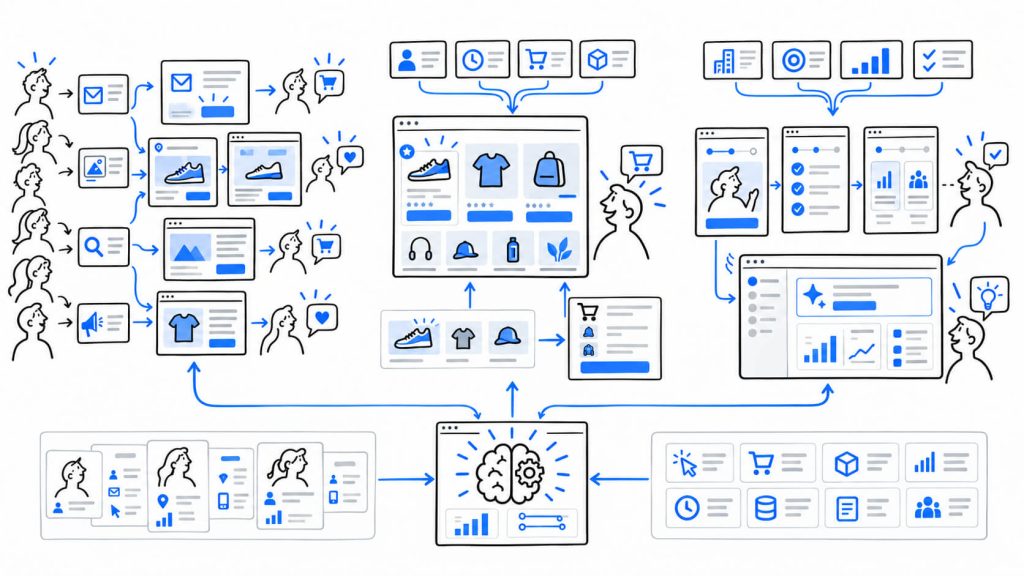
The table below sorts the levels by what data they use and how often they update.
| Level | Data used | When it updates | Example |
| Basic personalization | First name, past purchase | When someone edits the campaign | An email that opens with the customer’s first name |
| Segmentation | Group attributes such as industry or plan | When someone changes the segment rules | A pricing page variant for agency visitors |
| AI personalization | Behavior history for the individual | On each scheduled retrain, such as daily | Product ranking retrained daily, as Snoonu does |
| Hyper-personalization | Live behavior, location, device, and time | During the session | A homepage that reorders while the visitor browses |
Konnect Insights names fragmented customer identity and disconnected channel data as the bottleneck for hyper-personalization, and it places the AI model itself lower on the list. Adobe’s figure of 75% of companies struggling to act on data in real time points the same way.
Before a team moves up a level, four things need to be in place:
- One ID that follows a visitor across the website and email
- Event tracking on the actions that matter, such as sign-ups and add-to-cart clicks
- A way to change page content without a developer ticket
- A test setup that can compare a personalized page with a generic one
AI Personalization in Digital Marketing
In marketing channels, AI personalization makes decisions about content and timing. Three places show it clearly.
Email and lifecycle messages
Braze describes two jobs in the process: a model that writes or picks the content, and a second model that decides who receives it, over which channel, and when. Send time is a workable first test because it changes when the existing email goes out and leaves the copy alone. A winback email, for example, can reach one customer at 7 a.m. and another at 9 p.m., based on when each of them opened past emails.
Paid ads with personality-matched creative
The BBC reported on Cheil UK, an advertising agency that works with a startup called Spotlight. Their system uses large language models to infer an individual’s personality, then rewrites ad text to match that person’s tone, phrasing, and pace. It also picks music and colors to fit. According to the BBC’s account, the tool reads public posts, search history, and what people type into ChatGPT.
Jacob Teeny of Northwestern’s Kellogg School led a study in which ChatGPT wrote iPhone ad text tailored to a reader’s scores on four personality attributes. The tailored text persuaded better than untailored text, and participants did not mind that an AI wrote it. Teeny told the BBC that AI targets well today and is early at writing creative that matches a psychological profile.
Critics in the same article see it differently. Alex Calder of Jagged Edge argues that deepening the relevance of a mass-reach idea beats producing one-to-one ads that a single person sees and forgets. Ivan Mato of Elmwood raises the surveillance question. The article also cites the figure that 15% of digital ad spend goes unseen, which is the waste that personalized ads aim to cut. The approach sits at the uncomfortable end of the range covered in a later section.
Landing pages that match the ad
An ad click carries information: the keyword, the audience, and the promise in the creative. Ad-to-page personalization uses that information to change the headline and proof points on the page, and no profile of the visitor is needed for it to work. The setup below shows the idea with two hypothetical ads.
| Ad promise | Page headline | Proof point shown |
| “Invoice software for freelancers” | Send your first invoice in two minutes | A testimonial from a freelance designer |
| “Invoice software for agencies” | Bill 40 clients from one dashboard | A case study from an agency with 15 staff |
Make your landing pages match the traffic you paid for.
With CROLabs, you can create personalized page experiences for different audiences and test whether the change actually improves conversions.
AI Personalization in Ecommerce
Ecommerce sites hold product catalogs that no person can sort by hand for each shopper. Recommendation models do that sorting.
Snoonu: from popularity ranking to daily retraining
The AWS case study gives a clear account of how one team moved through the levels in the table above.
- Popularity ranking. Every user saw the same top products, which led to low engagement with recommended items and left long-tail products undiscovered.
- One global model. A single model covered the whole platform and produced daily recommendation lists. The lists went stale as inventory and user behavior changed during the week.
- One model per vertical. Snoonu built separate models for Marketplace, Food, and Groceries, because a customer ordering lunch behaves differently from a customer planning weekly groceries.
- Faster retraining. The training cycle went from three weeks to weekly to daily, based on experiments the team ran.
The team also added filters that exclude items already in the basket and that follow the category a user is browsing. Someone searching for laptops sees related electronics.
What the results looked like:
- 1,600% increase in add-to-cart events from cart recommendations in the Groceries vertical
- Gross merchandise value 47 times the total model investment over six months
- QR 2.6 million (about USD 715,000) in incremental gross merchandise value tied to recommendations
- A 30% contribution to basket size in orders that included at least one recommended product
What a smaller store can take from this:
- Filter out products the shopper already put in the cart
- Write separate recommendation logic for different shopping missions, such as a quick reorder and a browsing session
- Refresh recommendations when stock changes
- Check data quality first, since Snoonu named it as a critical success factor
What store owners on Reddit mention
A roundup of r/ecommerce threads by the social-media tool Superpower names Algolia Recommend and OptiMonk as the personalization tools that founders praised for lifting conversions without adding to their workflow. The roundup is a secondary source, so read the original threads before you pick a tool.
AI Personalization in SaaS
A person who signs up for a SaaS product arrives with a job to do. Personalization in SaaS shortens the path from sign-up to the first useful action.
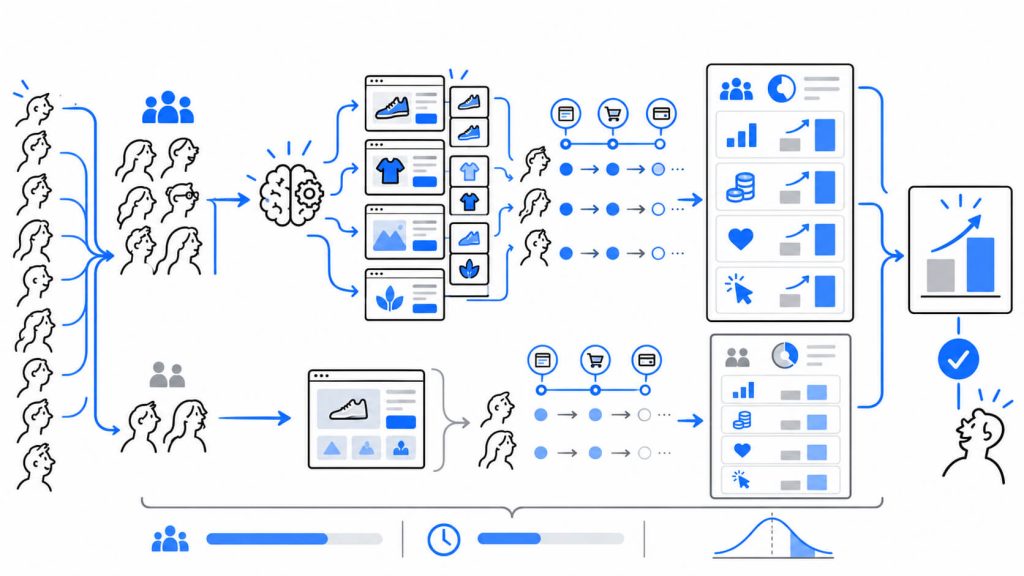
Onboarding that reads the signals a new user gives
A guide from xMarble recommends building the profile from the signals in the table below, in this order.
| Signal | Where it comes from | What it changes |
| Company data | The email domain, passed to an enrichment provider that returns company size, industry, revenue band, and tech stack | The examples and plan suggestions the user sees first |
| Stated intent | One question at sign-up, such as “What’s your role?” or “What will you use this for?” | The first task in the product |
| Behavior | Events such as a first action or a connected integration | Which nudge appears next |
| Trial stage | Days since sign-up and the last milestone reached | Timing and content of in-app and email prompts |
Canva uses the stated-intent pattern. According to DesignRevision, it asks new users “What will you design?” and offers choices such as social media and presentations. Chameleon’s onboarding guide puts the 2025 median SaaS activation rate at 37.5% and calls a welcome survey that routes users into role-specific flows the change with the most leverage. Both sources are vendors of onboarding tools, so treat the figures as directional.
Personalization inside the product: Duolingo
Duolingo shows what personalization looks like once a user is past onboarding. Each course has a fixed structure with a set order of lessons and a pool of exercises for each lesson. According to Duolingo’s engineering team, a model called Birdbrain decides which exercises from that pool a given learner sees, based on the learner’s level of knowledge. The company says its A/B tests found that lessons built at the right difficulty helped learners learn more and return more regularly.
For a SaaS team, the pattern translates directly. Keep the structure of the product fixed, and let a model choose the order and emphasis of the steps inside it. An onboarding checklist can keep the same six steps while the model moves the most relevant one to the top for each role.
The Cold Start Problem: Personalizing With Little Data
A new visitor has no history, and a model has nothing to learn from. Data scientists call this the cold start problem. It shows up on the first visit of every user, and stricter privacy rules have made it a bigger topic. Comcast NBCUniversal’s LIFT Labs describes the challenge as personalizing for users when less data is available.
Its profile of the startup Crossing Minds offers one answer: base recommendations on behavior and skip personally identifiable information. Knowing the last three movies a person watched or paused tells you more than their age or location, according to the article. The company’s CEO, Alexandre Robicquet, says the same person behaves differently on a Tuesday morning and a Saturday evening, and differently again when buying a gift on Black Friday.
Signals that exist on the first visit:
- The ad, keyword, or email link that brought the visitor
- Device and time of day
- The first pages the visitor opens
- The answer to a single question, such as a role or a goal
Gartner’s research supports keeping the list short. It defines “tailored help” as a message that offers valuable assistance using as few data dimensions as possible, and it found that this style raised the predicted commercial benefit by 20%. In the same survey, 88% of consumers reported that they had not received tailored help.
Until the model has learned enough, a strong generic page carries the visitor. Personalization then takes over as the signals build up.
Where Personalization Gets Uncomfortable
Gartner’s 2019 survey found that more than half of customers would unsubscribe from a company’s communications and 38% would stop doing business with a company if they found its personalization creepy. The 2025 survey covered above adds the regret and overwhelm figures.
Thoughtspot’s survey of more than 4,800 people found that 91% consider at least one form of personalization intrusive. The tactics named most often were tracking behavior across other websites or apps, recommending products too frequently, and using real-time location. Three-quarters of respondents said retailers collect too much data, and 5% disagreed.
Privacy policies carry weight too. McKinsey research cited by LIFT Labs found that 85% of consumers say understanding a company’s data privacy policies is crucial when they decide what to buy, and nearly half would switch brands if a policy was unclear.
Five habits keep personalization on the comfortable side of those numbers:
- Start with signals the visitor produced on the current visit
- Limit each message to one or two data points, in line with the Gartner finding on data dimensions
- Set a frequency cap on recommendations
- Leave out location unless it changes the answer, as with store hours or shipping
- Add a short line that explains the reason, such as “Because you viewed this jacket”
How To Tell If Personalization Is Working
Personalized pages produce numbers that look good in a dashboard. A holdout group tells you whether the personalization caused them. The holdout is a share of traffic that keeps seeing the generic experience, and the difference in results between the two groups is the lift.
The Agile Brand Guide suggests reserving between 5% and 20% of traffic for the holdout, depending on traffic volume and the expected effect. The Pedowitz Group notes that a comparison without a baseline overestimates the impact.
- Set the baseline. Record conversion rate and revenue per visitor for the generic experience over the same period.
- Split the traffic. Send most visitors to the personalized experience and keep a fixed share on the generic one.
- Run a full buying cycle. Pedowitz gives 2 to 6 weeks for short-cycle retail and a longer window for seasonal or high-ticket products.
- Compare the groups. Use the formula from Amplitude: treatment results minus control results, divided by control results.
Amplitude also gives a sample size to plan around, which is at least 1,000 people per group to detect a 10% lift with confidence. A site with 500 visitors a month needs about four months to fill two groups of that size.
CROLabs has a separate guide on combining A/B testing and personalization, and its Audience Personalization feature changes pages by audience segment.
Conclusion
AI personalization changes what each person sees, based on data that ranges from a first name to live behavior. The research shows two results side by side: McKinsey found that faster-growing companies get 40% more of their revenue from personalization, and Gartner found that 53% of customers had a negative experience with personalized marketing. Both results apply to the same practice, and the difference lies in how much data a team uses and how carefully it measures.
The examples in this guide give a starting sequence. Match landing pages to the ads that bring the traffic. Add recommendations once a catalog or a content library has enough items to sort. Shape onboarding around one question and the behavior that follows. Keep a holdout group through all of it, so each change has a number attached.
To try audience personalization and ad-to-page personalization on your own pages, CROLabs offers a 14-day free trial with no credit card required.
Ready to test personalized experiences on your website?
Try CROLabs free for 14 days with no credit card required. Personalize pages for different audiences, test your changes, and find out what actually moves conversions.
FAQs
How is AI personalization different from segmentation?
Segmentation sorts people into groups by attributes such as industry or plan and shows each group a fixed experience. AI personalization scores individuals from their behavior and updates as new data arrives. Segments are a good place to begin, since they need less data.
How much data do I need to start?
The first visit already provides the referring ad, the device, the time, and the pages opened, and you can add one question on top of that. The AWS write-up on Snoonu lists starting small and scaling fast as a key learning, with data quality as the first investment.
What should I personalize first?
Start with the landing page that receives paid traffic, because the ad already tells you what the visitor wants. Move to on-site recommendations after that page shows a measured lift.
Can a low-traffic site test personalization?
Yes, with a longer test. Using Amplitude’s guideline of 1,000 people per group for a 10% lift, a site needs 2,000 visitors to test one change. Larger expected lifts need smaller groups, so a low-traffic site gets more from testing bigger changes, such as a full headline rewrite, than from small tweaks.
How long before results show?
Pedowitz gives 2 to 6 weeks for short-cycle retail decisions. Seasonal and high-ticket categories need longer. Snoonu reported its results over a six-month window.