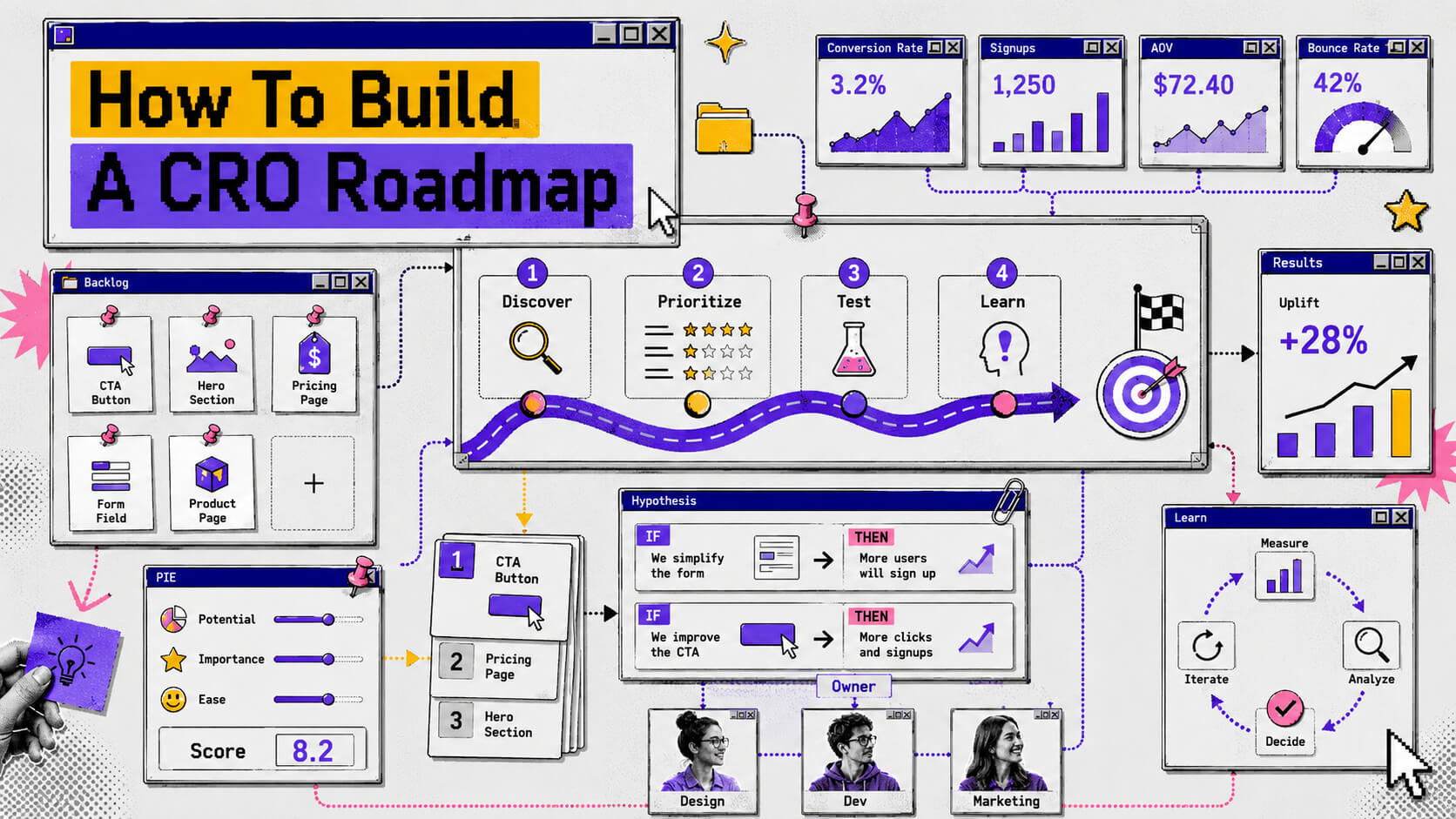
Most teams don’t do too well at conversion rate optimization because they have too many ideas and no order to run them in.
A CRO roadmap is the fix for that. It’s a document that tells you what to test, in what order, and why. We’ll look at what that actually looks like, and how to build one that doesn’t collect dust in a Google Drive folder.
On This Page
What Is A CRO Roadmap?
A CRO roadmap is simply a prioritized plan of the experiments you’re going to run to improve website conversion rate. It’s tied to specific business goals and sequenced so each test builds on what the last one taught you.
We say specific because it’s based off the website data you collect, so in practice, it’s the difference between “we should probably test our CTA at some point” and “we’re testing the homepage CTA in week 2 because our CRO audit showed a 40% drop-off right after the hero section, and here’s the hypothesis and what we expect to see”.
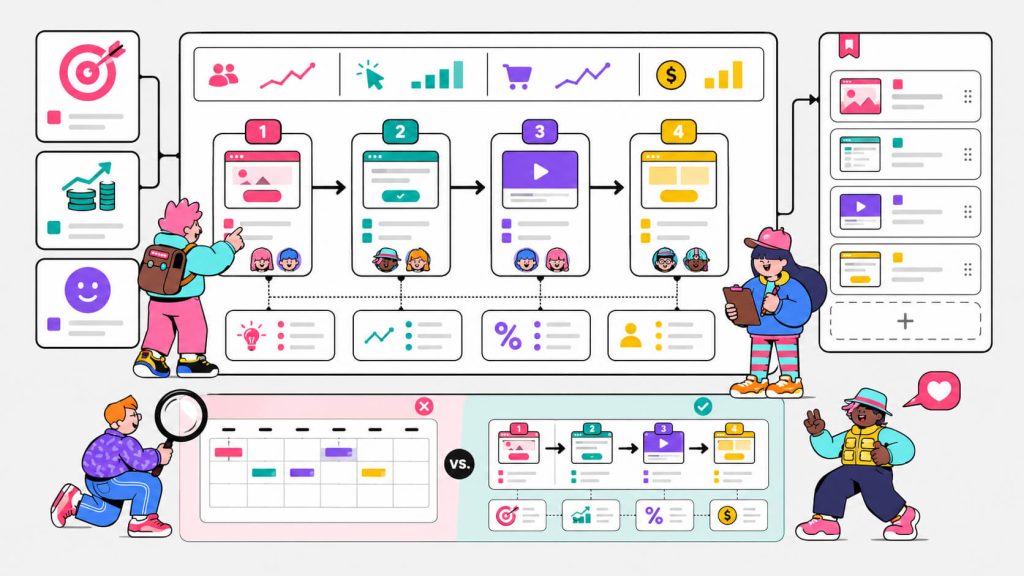
A roadmap isn’t the same as a testing calendar, even though people use the terms interchangeably. A calendar tells you when while a roadmap tells you why this test, why now, and why before the other five ideas in your backlog.
It usually includes:
- The business goal it ladders up to, e.g more signups, higher average order value, lower bounce rate, etc. (specific is the name of the game here)
- A prioritized backlog of test ideas, usually scored with a framework like PIE (Potential, Importance, Ease) or ICE (Impact, Confidence, Ease)
- Hypotheses for each test, written in an “if we do X, then Y will happen because Z” format
- The CRO metrics you’re tracking to judge success
- Who owns what, because CRO touches design, dev, and marketing, and someone needs to actually build the variant
How To Build A CRO Roadmap
As a platform in the CRO space, here’s a step-by-step of how we’d build a CRO roadmap. We’re not going to pretend every business needs the exact same version of this (for example, a two-person startup and a 200-person ecommerce team will build very different roadmaps) but the underlying logic holds up regardless of size.
1. Start with the business goal
You may think it’s the test idea first before anything, but you need a foundation for everything else (including the tests) to be built on.
Creating a campaign/business goal is that foundation. Even though it has to be one of the most overused first steps, it’s overused for a reason. So before you touch a single page, write down the actual business outcome you’re chasing.
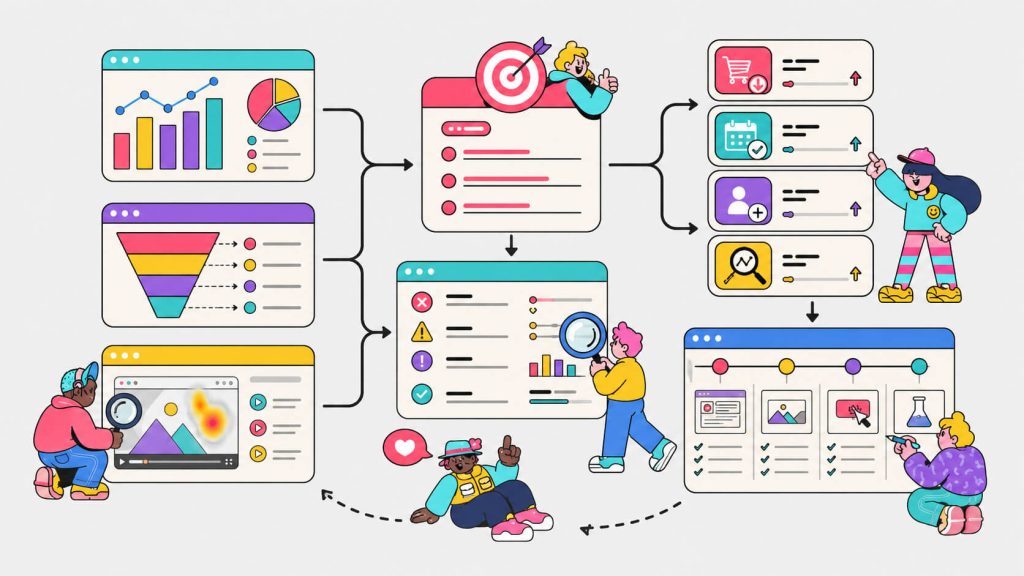
Remember that specific is the name of the game here so we’re not using phrases like “improve conversion rate” (too vague). Instead, we’ll go for something like “reduce cart abandonment by 15% this quarter” or “increase demo bookings from the pricing page”. This is known as a SMART goal because it’s Specific (hello again 👋), Measurable, Achievable, Realistic, and Timely.
If you can’t tie a test back to this goal in one sentence, it doesn’t belong on the roadmap yet. It might be a good idea but it’s just not this quarter’s problem.
2. Run a CRO audit
You need data on where things are actually breaking before you can prioritize what to fix. Fortunately, you have a CRO audit for that. You can use a CRO tool to run an audit or manually perform one by going through your analytics, session recordings, and funnel reports to find real drop-off points.
In the case of CRO tools, GA4 is a free option you can use to show you where people leave. If you want more concrete and insightful data, CROLabs is an AI-powered platform that can speed up your CRO audit further by crawling your site and flagging friction points against industry benchmarks. In addition to these, you can also use a session recording tool like Hotjar to show you what they were doing right before they left.
Whatever combination you use, the goal is to turn your guesses into data-backed observations.
Find the Biggest Conversion Leaks Faster
Run an AI-powered CRO audit to identify drop-off points, usability issues, and optimization opportunities without spending hours digging through analytics.
3. Build and score your backlog
Now you’ll have more test ideas than you know what to do with. That’s normal, but here lies the problem of picking which ones to run first.
This is where you introduce a scoring framework. PIE (Potential, Importance, Ease) and ICE (Impact, Confidence, Ease) both work by giving each idea a rough score across a few dimensions, then ranking the backlog by total. It’s not scientific in a strict sense since you’re still making judgment calls, but it forces you to weigh effort against payoff instead of testing whatever’s your team’s loudest guess for that week.
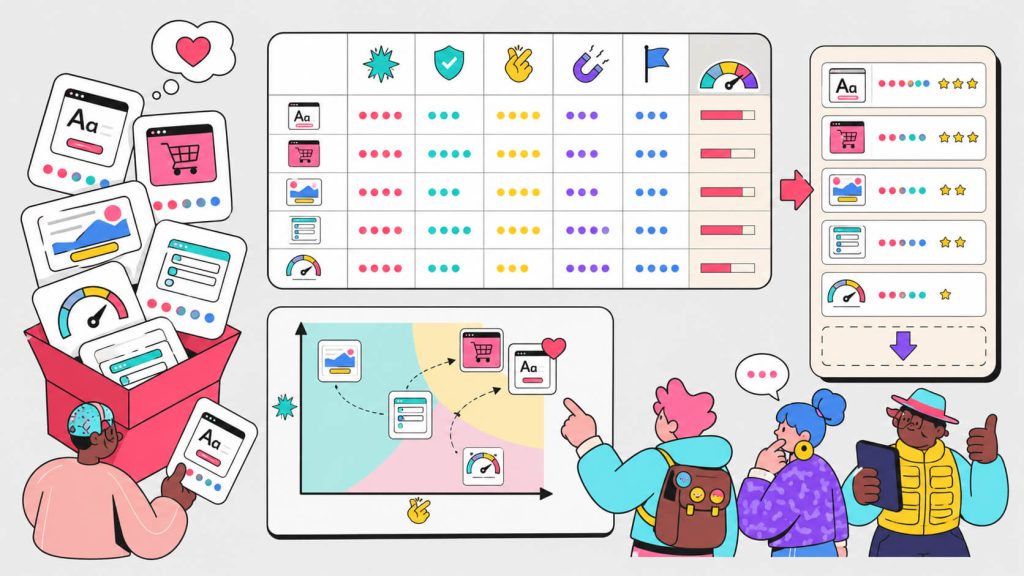
For example, you may have two ideas you want to test, redesigning your entire checkout flow and changing the CTA copy. Redesigning your entire checkout flow might score high on impact but low on ease, since it needs design and dev resources for weeks. Changing your CTA copy from “Learn More” to something benefit-driven scores lower on impact but far higher on ease. You can usually run the second one this week and the first one next quarter.
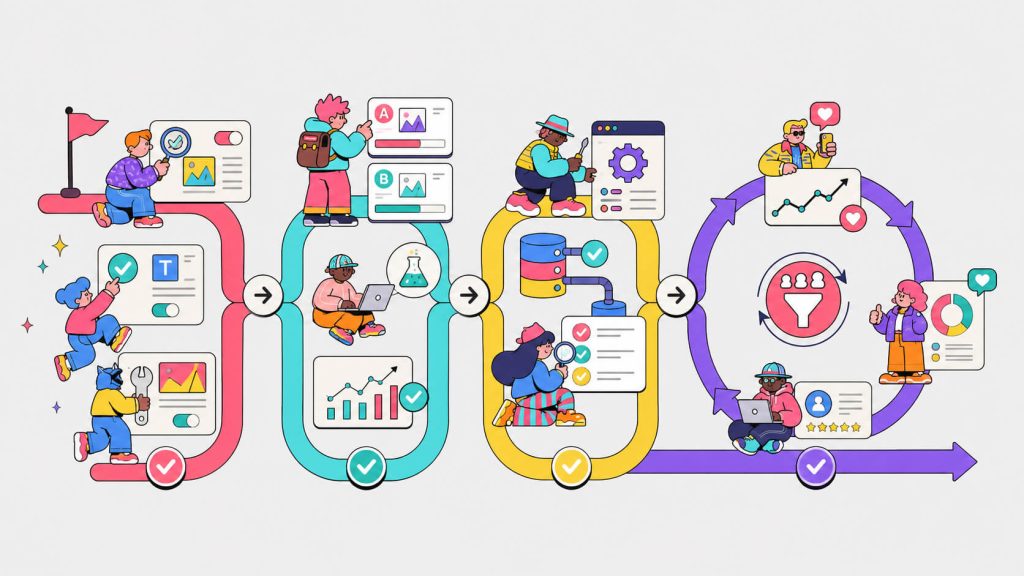
4. Sequence the roadmap in phases
CRO teams that have been at this a while tend to structure roadmaps in phases rather than a flat backlog, mostly because different work competes for different resources and time horizons.
A useful structure looks like:
- Quick wins first: Low-effort, evidence-backed fixes (clearer form labels, fixing a broken CTA, tightening a headline). These build momentum and buy you credibility with stakeholders before you ask for bigger resources.
- The testing engine: Once quick wins are shipped, move into structured A/B testing on higher-stakes pages, with proper hypotheses, sample sizes, and QA.
- Platform and data fixes: Sometimes testing surfaces deeper problems like broken tracking, slow load times, a checkout that can’t be modified without engineering. These go on a separate technical roadmap, but the CRO process is what surfaces them.
- Continuous optimization: You keep reviewing funnel data, retiring weak tests, documenting what worked, and feeding new ideas back into the backlog.
5. Write real hypotheses
Every test needs a hypothesis in this shape: “If we [change], then [result] will happen because [reason]”. For example: “If we reduce our signup form from seven fields to three, checkout completion will increase because users experience less friction”.
This matters more than it sounds. A vague hypothesis (and subsequently, test) like “let’s try a different button color” tells you nothing when it fails. A specific hypothesis tells you exactly what assumption was wrong, which makes your next test smarter.
6. Pick your CRO metrics before you launch
Decide upfront what “success” looks like. Conversion rate is the obvious one, but depending on the test, you might also watch bounce rate, average order value, or scroll depth.
If you decide your CRO metrics after the test, you’ll end up rationalizing whatever the data happened to show, which is how teams convince themselves a losing test actually “won” on a technicality.
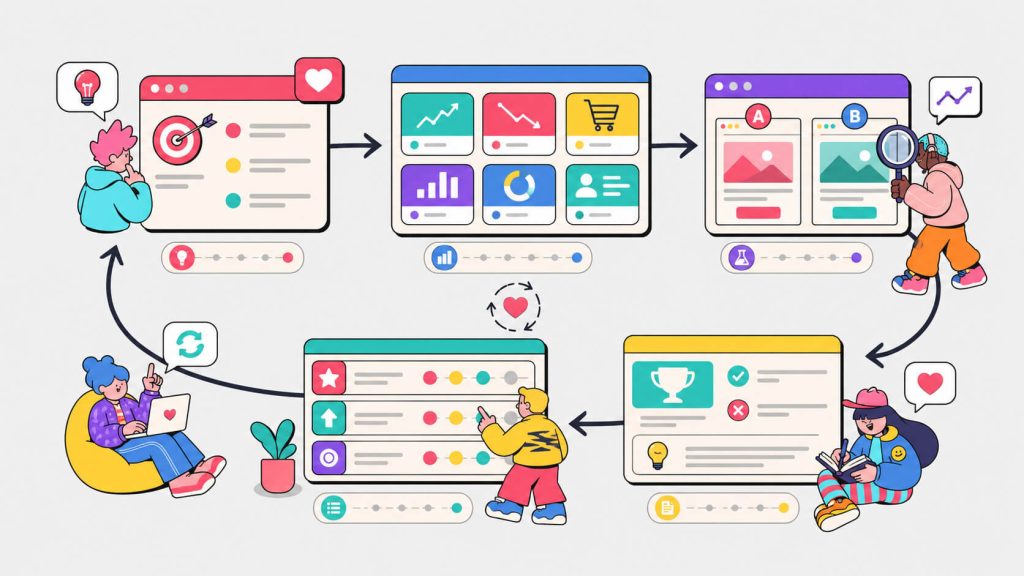
7. Review, document, and feed learnings back in
A roadmap isn’t a one-time document. After every test, log the result (win, loss, or inconclusive) and what you learned, especially from the losses. A test that disproves your assumption about users is often more valuable than a small lift you can’t explain. Feed that learning back into your backlog, re-score what’s left, and keep the cycle moving.
Conclusion
A CRO roadmap won’t make every test a winner. Some of your best-reasoned hypotheses will still flop, and that’s fine, it’s part of how experimentation works. What a roadmap actually gives you is a system: a way to know why you’re testing what you’re testing, in what order, and what you’ll do with the result either way.
If you’re just starting out, don’t overbuild this. A simple spreadsheet with a prioritized backlog, clear hypotheses, and a place to log results will beat an elaborate roadmap nobody updates. Start there, run your first CRO audit, and let the data tell you where to go next.
A little tip for you before you leave, you can use an AI-powered tool like CROLabs to do most of the work for you.
Ready to Build a Smarter CRO Roadmap?
Whether you’re planning your first experiment or managing an ongoing optimization program, CROLabs helps you uncover opportunities, prioritize tests, and improve conversions faster.
FAQ
How often should I update my CRO roadmap?
Most teams re-prioritize monthly, especially early on when you’re still learning what drives conversions for your audience. As the program matures, this can shift to quarterly with lighter monthly check-ins.
What’s the difference between a CRO roadmap and a testing calendar?
A calendar schedules when tests run while a roadmap explains why those tests exist, how they were prioritized, and what business goal they serve. You need both, but the roadmap comes first.
Do I need a CRO tool to build a roadmap?
No, but it helps. You can build one in a spreadsheet with data from free tools like GA4. A dedicated CRO platform primarily speeds up the audit and testing phases once you’re running multiple experiments at once, but you can do these and most of the work of building a CRO roadmap with an AI-powered tool like CROLabs.
How many tests should be on my roadmap at once?
Fewer than you think. Too many concurrent tests on overlapping traffic muddies your results. Most teams do better with two or three well-designed tests at a time rather than ten half-finished ones.
What if a test on my roadmap fails?
Log it anyway. A failed hypothesis still tells you something true about your users. The point of experimentation isn’t to be right every time, it’s to learn faster than you would by guessing.