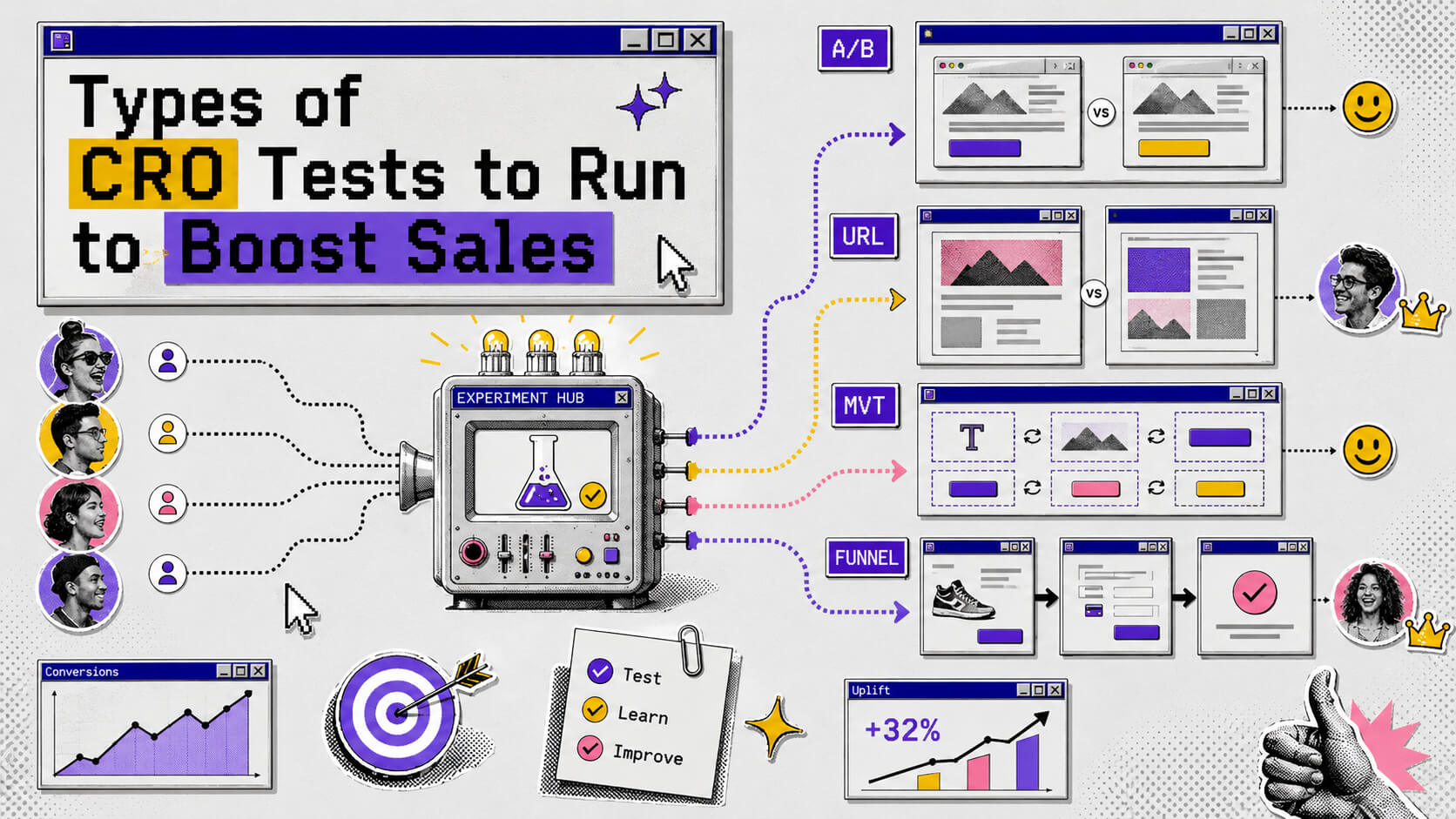
About 77% of companies worldwide now conduct A/B tests, a type of CRO test, on their websites. This means that if you’re serious about any aspect of growing your business, from attracting to retaining customers/users, you can no longer leave your website visitors’ experience to guesswork.
To be among the top companies that are improving their conversion rates with this method, it also means you have to run tests effectively. And how do you do that without knowing what type of test to run when necessary?
In this article, we’ll break down four formats a CRO test can take, how to figure out what’s actually worth testing before you build anything, and the tools that make running these experiments possible (without pulling a developer into every single variant).
On This Page
What Is A CRO Test?
A CRO test is a controlled experiment you run on your website to find out whether a specific change increases conversions.
Because it’s a controlled experiment, you don’t need to assume what change brought about that increase in conversion. You’re isolating one variable (or a few), showing different versions to different segments of your traffic at the same time, and measuring which version drives more of the action you care about. That could be a purchase, a signup, a demo booked, or whatever counts as a conversion for your business.
This is also the foundation of conversion rate optimization: you form a hypothesis (e.g “visitors aren’t converting because the value prop isn’t clear above the fold”), build a test around it, and let actual visitor behavior decide if you were right.
How To Decide What To Test
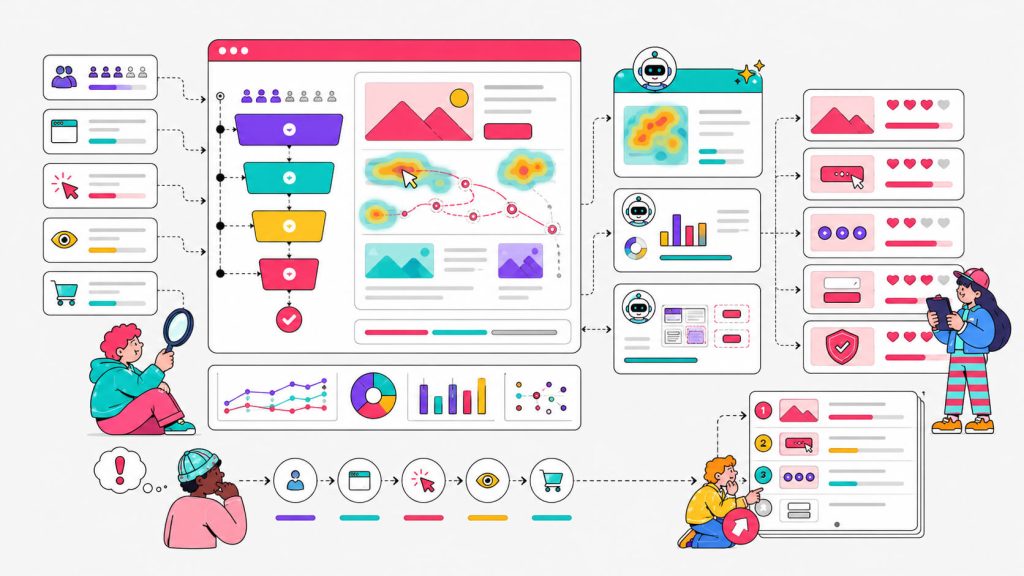
There’s data on almost everything these days, so start with the data. Before you build a single variant, you need to know where visitors are dropping off and why (aka the data), which is what a CRO audit is for.
A CRO audit is a structured look at your funnel that flags where conversions are leaking. To conduct a thorough CRO audit, you need a CRO tool.
Tools like CROLabs, which has Analytics and Conversion Tracking features, show scroll depth, click behavior, and drop-off points against the goals you’ve defined, so you’re prioritizing the page or step that’s actually costing you sales.
Since AI-powered CRO tools give you actionable analytics, you can use the AI Advisor to crawl your site. It flags friction points against industry benchmarks, then hands you a ranked list of what you should be testing first.
Once you know what to test, the Visual Editor lets you build the variant without pulling a developer into a two-week sprint.
Types of CRO Tests
Here are the four formats worth knowing, roughly in order of how often you’ll reach for them.
1. A/B Testing (Split Testing)
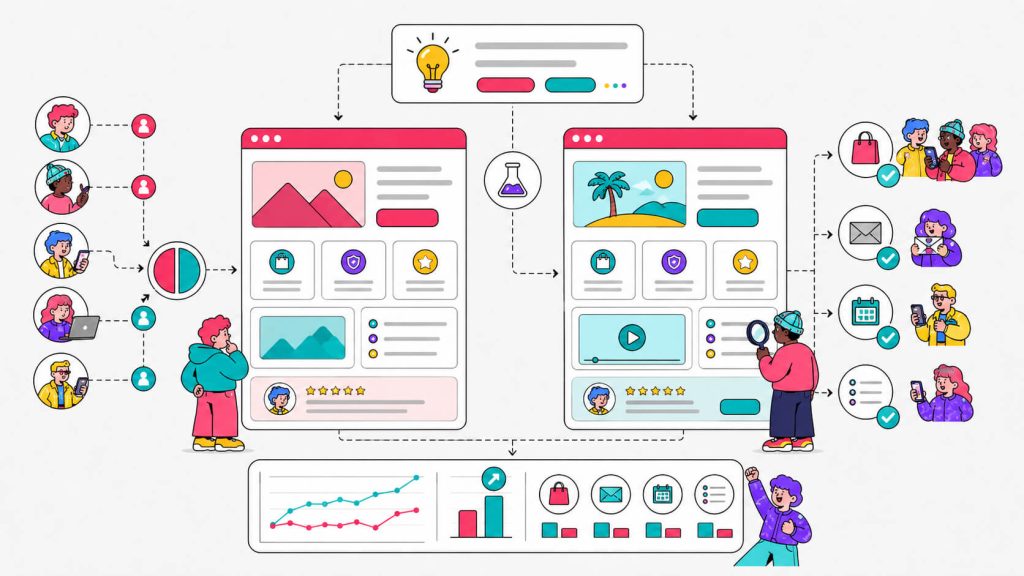
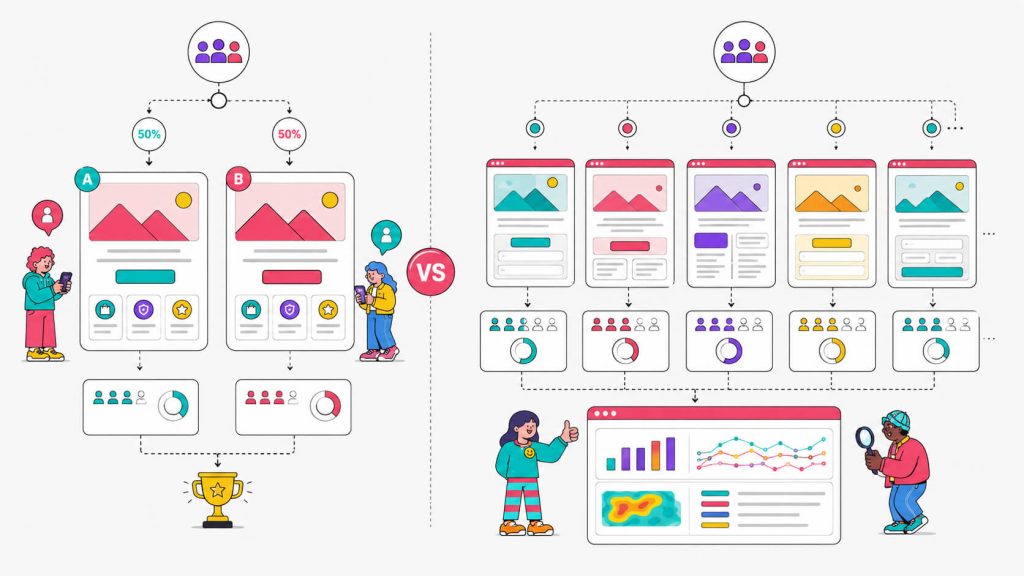
A/B testing, also called split testing, is the simplest and most common type. You take one element (a headline, a CTA button, a hero image, etc) and pit two versions against each other. Half of your traffic sees version A (the control) and half sees version B (the variant). Whichever one drives more conversions becomes the winner of the experiment.
A/B testing is the right call when you have a specific, isolated hypothesis. Say you think “Start Your Free Trial” will outperform “Get Started” as a CTA on your pricing page. This hypothesis is specific and calls for a clean, single-variable test, which is easy to set up and easy to read.
The tradeoff though is scope. You’re only ever answering one question at a time, which makes A/B testing better suited to quick wins than to understanding how multiple elements interact.
2. Multivariate Testing (MVT)
Multivariate testing takes the same idea and multiplies it. Instead of testing one element in isolation, you test several at once and the result shows which combination performs best.
For example, in your desire to optimize a landing page, you decide to test two different elements on that page. You can have a test running for headline variations (version A and version B) and another for hero image (version A and version B of the hero image).
A multivariate test will create every possible combination for these elements, therefore you’ll have variants with headline A and hero image A, headline A and hero image B, headline B and hero image A, headline B and hero image B.
This matters because elements interact and they do so in unpredictable ways. A headline that wins on its own might actually underperform when paired with a certain image, and multivariate testing catches that in a way three A/B tests never would.
Unlike A/B testing, the catch for multivariate testing is traffic. With three elements and two variations each, you’re already testing eight combinations, and each one needs enough visitors to produce a reliable result. Low-traffic pages just end up with inconclusive data and a longer wait.
3. Split URL Testing
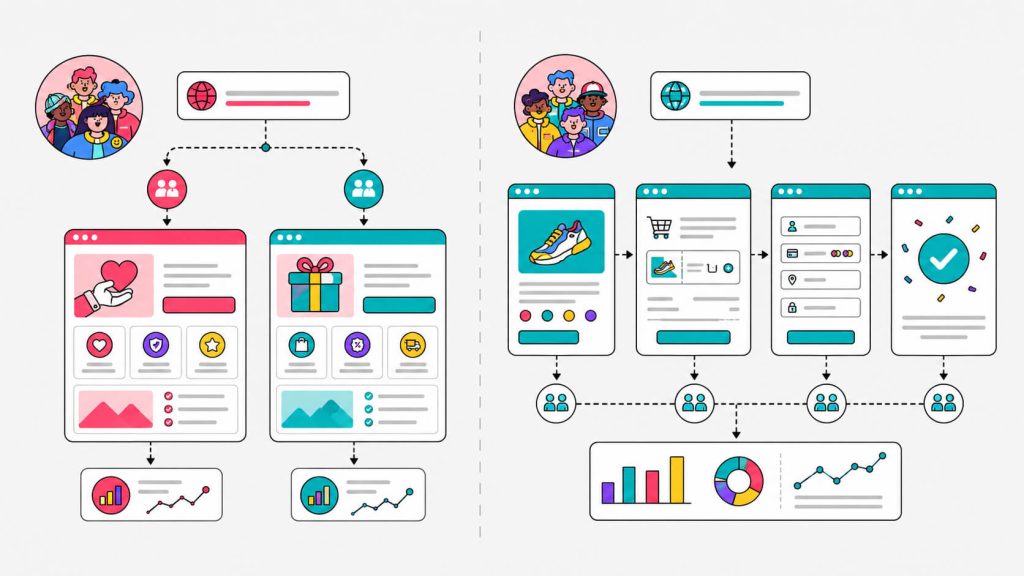
Not to be confused with split testing (which is just another name for A/B testing), split URL testing compares two or more completely separate URLs rather than two versions of the same page.
It’s the right tool when the change is too drastic for a simple element swap. Basically, if you want to test a full redesign, a different page structure, or a landing page built around a different value proposition, split URL testing is your guy.
An example scenario, maybe you’re not sure whether a long-form, story-driven landing page converts better than a short, benefit-bullet version. Trying to build both as “variants” of one page gets messy fast.
Split URL testing sends a portion of your traffic to each separate URL and tracks conversions independently, so you can compare two different approaches without forcing them into the same template.
4. Multi-Page Testing (Funnel Testing)
Multi-page testing, or funnel testing, extends the experiment across more than one step (your product page, cart, and checkout, for example) instead of a single isolated page. It’s built for situations where a change at step one only makes sense if step two and three reinforce it.
Say you’re testing a new pricing structure. You can’t just change the pricing page and leave checkout alone, the messaging has to stay consistent or you’ll confuse visitors right before they’re about to pay. Funnel testing tracks the entire path as one connected experiment, which is more complex to set up.
But it catches problems single-page tests miss completely. For example, you might have a winning headline that quietly tanks conversions two steps later.
Tools To Run Tests
To conduct a CRO test, you need a CRO tool or two.
If your budget is tight, Google Analytics 4 is free and still useful for the basics. Set up funnel exploration and you’ll at least know where to start looking.
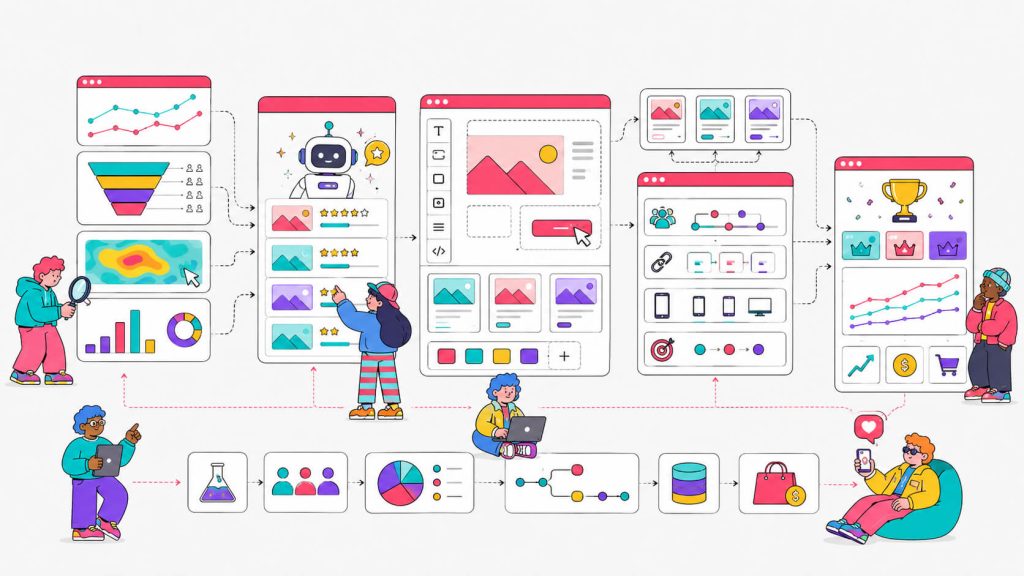
Whereas most affordable CRO tools offer only A/B testing, CROLabs handles that in addition to multivariate testing and split URL testing. You can build tests all through the Visual Editor so you’re not stuck waiting on engineering to ship a variant.
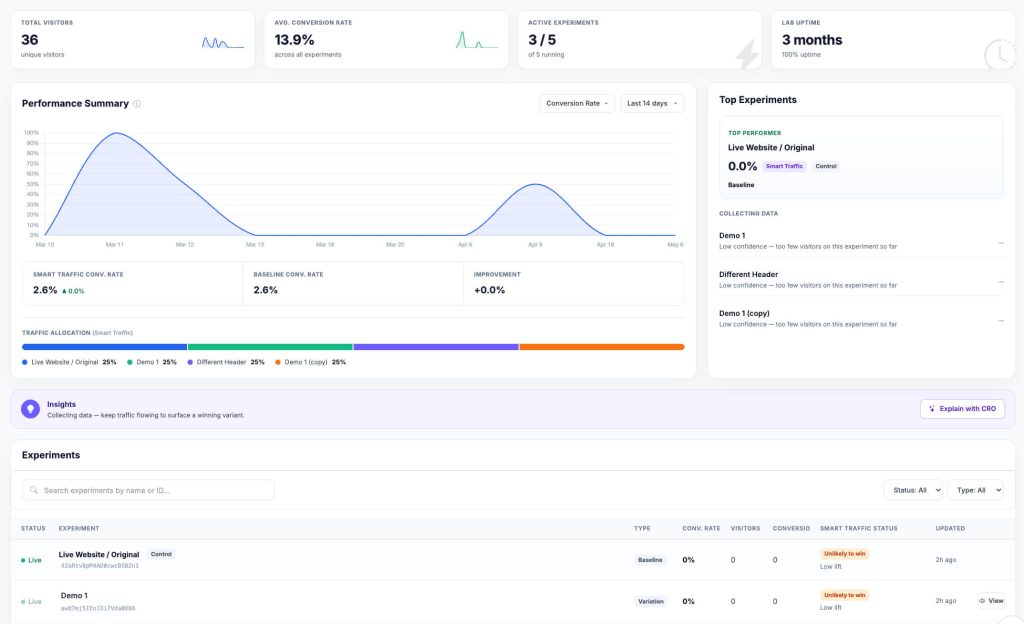
Pair that with the AI Advisor to flag what’s worth testing in the first place, and Conversion Tracking to make sure you’re measuring the goal that actually matters, not just clicks
Know What to Test Before You Test It
Let the AI Advisor crawl your site, benchmark it against industry standards, and hand you a ranked list of what’s actually worth testing first.
If you’re running experimentation at enterprise scale, Optimizely is one of the most established CRO platforms. Like CROLabs, it supports A/B testing, multivariate testing, feature experimentation, and personalization, but you’ll need a developer to build and launch most of these.
The tradeoff is cost and implementation complexity, which is why it’s typically better suited to larger organizations than startups or SMBs.
Conclusion
None of this works if you treat testing like a one-off project. There’s a large conversion gap between average and optimized experiences because even though more businesses are testing, only the teams that run tests constantly grow their conversion rate over time.
So if you want to improve your website’s conversion rate, let a CRO audit and proper analytics tell you where the real friction is, then pick the test type that matches the question you’re asking.
Always keep in mind that small, compounding wins beat one big redesign you’re not even sure worked.
Small Wins Compound. Start Today.
Join the winning team with CROLabs.
FAQ
What’s the difference between a CRO audit and a CRO test?
A CRO audit is the diagnostic step i.e reviewing your analytics, user behavior, and funnel to find out where visitors are dropping off and why. A CRO test is what you run afterward to confirm whether your fix for that problem works.
How long should a CRO test run?
Long enough to reach statistical significance, and at least one business cycle, usually two to four weeks depending on your traffic volume. Don’t cut a test short because an early lead looks promising.
How much traffic do I need to run a CRO test?
It depends on the test type and how big a difference you’re hoping to detect. A/B tests need the least traffic, since you’re only comparing two versions. Multivariate and funnel tests need considerably more, since you’re splitting visitors across more combinations or more steps.
Can I run more than one CRO test at a time?
Yes, as long as the tests aren’t interacting in a way that muddies your results.