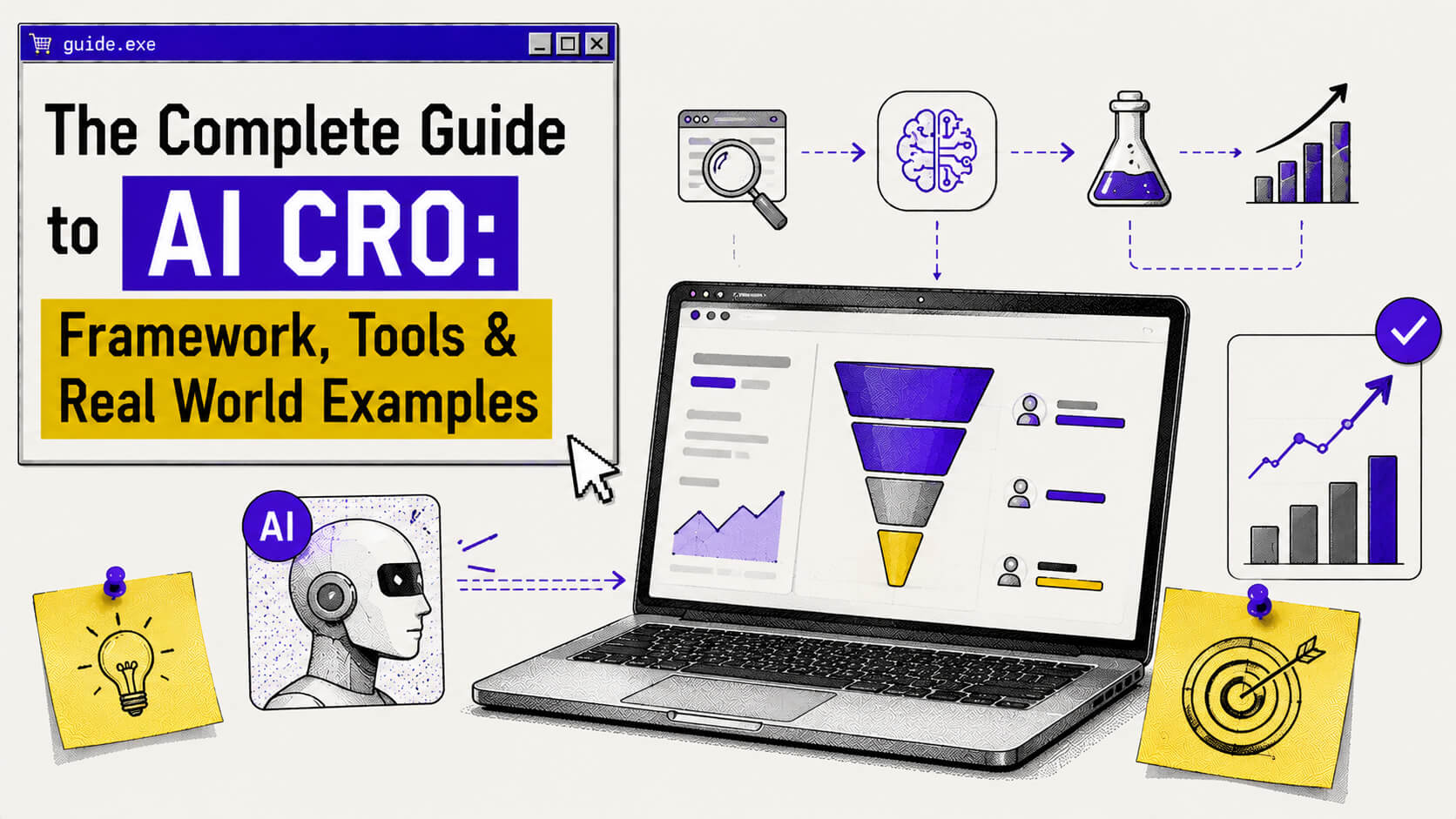
It takes roughly 3 weeks for most teams to get a single A/B test to statistical significance, assuming they even have enough traffic to begin with. The odd part is that most tests, as well as the elements being tested, are too simple for the lengthy amount of time it takes.
Meanwhile, the visitor who built a $340 cart sat on the checkout page for four minutes and closed the tab without anyone on the team noticing.
This is one of the problems with conversion rate optimization as most businesses still practice it. It’s reactive and slow, meaning it tests one idea at a time while the rest of the funnel keeps leaking revenue in the background.
This guide covers what AI CRO actually is, where it genuinely beats traditional methods (with real before-and-after numbers), and which tools are worth your time, whether you’re running CRO for a SaaS trial funnel or an ecommerce checkout.
On This Page
What Is AI CRO?
AI in Conversion Rate Optimization (AI CRO) is the process of using AI or AI-powered tools to figure out why visitors don’t convert, predict what will actually move them, and test or deploy those changes faster than traditionally possible.
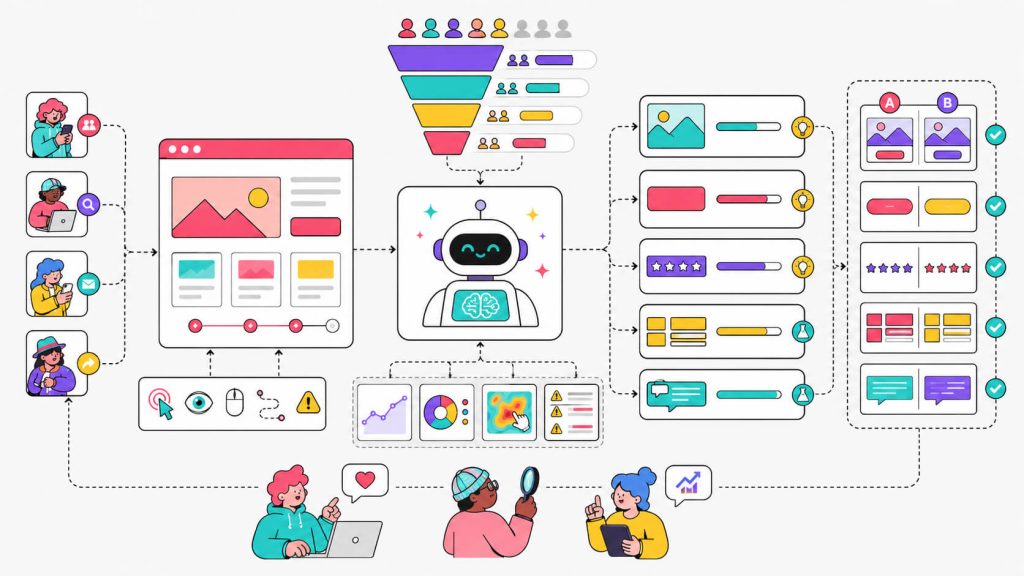
AI CRO is closer to a layer sitting on top of (or replacing parts of) the traditional CRO stack. A standard CRO audit, the kind where a consultant manually writes up a report after reviewing your website and analytics, can easily eat a week. An AI-powered audit, like the one CROLabs’AI Advisor runs, crawls your site, checks your numbers against industry benchmarks, and returns a prioritized list of what’s actually costing you conversions, often within minutes.
Of course, none of this makes traditional CRO obsolete. Experimentation, hypothesis-testing, and understanding your customers still matter. AI just compresses the distance between noticing a problem and fixing it.
See What’s Costing You Conversions
Get an AI-powered audit that uncovers the biggest conversion leaks on your website and shows you exactly what to fix first.
No credit card required · Cancel anytime
AI vs Traditional CRO
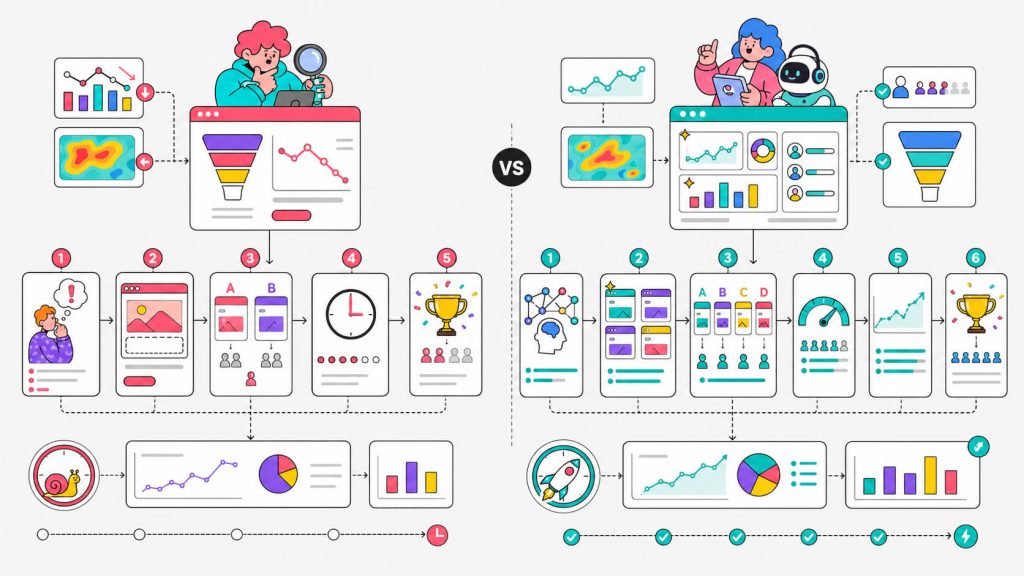
On paper, traditional CRO and AI CRO follow a similar loop. They notice a problem, form a hypothesis, test it, ship the winner, and repeat. But the difference is in everything that happens inside that loop.
In traditional CRO, someone reviews analytics and session recordings, and picks one variable to test (a headline, a button color, a form field, etc). They go ahead to build two versions, split traffic 50/50, and wait (usually two to four weeks) for the test to reach statistical significance. Then someone analyzes the result, and the cycle restarts with the next item on the backlog.
In AI CRO, the system or AI-powered CRO tool constantly ingests behavioral data and generates multiple variants. Depending on the tool, it shifts traffic toward whichever is winning while the test is still live, and surfaces the next opportunity before the current one even wraps.
To help you get a clearer picture of what that gap looks like, let’s look at some real-world before-and-after numbers.
Generic offers vs. AI-personalized offers: Too Good To Go
Too Good To Go, the app connecting people with surplus food from local restaurants and shops, ran into a familiar wall. With location-specific, limited-supply inventory, one generic offer (a flat discount blasted to everyone) often missed the mark entirely.
Before: blanket discount messaging, regardless of what was actually available nearby or what a given user cared about.
After: AI-driven multivariate testing comparing discount-led messages against value-add notifications (nearby availability, themed campaigns) tailored to individual behavior and live supply data.
Result: message conversion rates doubled, and purchases attributed to CRM campaigns increased by 135%.
Fragmented generic messaging vs. AI-personalized recommendations: 24S
24S, LVMH’s online luxury retail platform, was running triggered emails, mobile messaging, and product recommendations through three separate, disconnected tools, none of which talked to each other or to what a given customer had actually done on the site.
Before: generic back-in-stock alerts and abandoned-cart emails, built on fragmented systems with no personalization layer behind them.
After: AI Item Recommendations pulling four personalized product suggestions per customer into back-in-stock alerts, plus urgency-triggered abandoned-cart messages built around live inventory data, all consolidated into a single system.
Result: the abandoned-cart, low-stock campaign drove a 35% increase in purchase conversion rate over a 3-day window. The AI-personalized back-in-stock campaign added a 7% increase in add-to-cart rate on top of that. 24S’s CRM manager, Carla Rota, said consolidating onto one system cut technology costs and integration time while still delivering the kind of personalized experience their luxury customers expect.
Manually-timed sends vs. AI-timed sends: BUGECE
BUGECE, a music and events platform, was juggling four separate tools just to manage communications before consolidating onto one AI-driven platform.
Before: a small team manually guessing at send times across disconnected channels, with inconsistent engagement to show for it.
After: AI-powered intelligent timing that learned each user’s behavior patterns and queued messages for their actual peak engagement window (post-work hours, for most ticket buyers) instead of one blanket send time for everyone.
Result: email open rates rose 63%. Signup conversion via in-app messaging rose 32%.
None of these brands threw out CRO fundamentals to get there, they were still testing hypotheses and still making judgment calls about what to test. Rather, using AI, they removed the bottleneck of doing it one variable, one segment, and one multi-week cycle at a time.
Benefits of Using AI in CRO
So what do you actually get for swapping the traditional CRO process for an AI-assisted one? A handful of things, and they compound.
Speed
AI-driven experimentation can compress testing cycles that used to take weeks into days (and sometimes hours). It does this by reallocating traffic toward winning variants while a test is still running instead of waiting for a fixed end date.
Scale
A human CRO team can realistically manage a handful of concurrent experiments before things get messy. However, with AI systems, you can run dozens of micro-variants across a funnel at once, which means you stop having to choose between testing your headline this month or your checkout flow next month.
Personalization that doesn’t require a research team
Traditional personalization meant bucketing visitors (new vs. returning, mobile vs. desktop) and hoping the bucket was specific enough to matter. But with AI, personalization works closer to 1:1, adjusting offers, copy, and layout based on live signals instead of a static segment.
Less guesswork, more prediction
Predictive analytics tells you what happened when visitors landed on your website, as well as forecasts what’s likely to happen next, which is the difference between catching a customer who’s about to abandon their cart and only finding out after they’ve already left.
It frees up the humans on your team
The real value of AI CRO is that it eliminates the busywork, manual data pulls, basic test setup, sifting through hundreds of open-text survey answers, so people (read: strategists) can spend time on the things AI can’t do well. These are understanding why your specific customers behave the way they do and what story your brand should be telling them.
That last point also marks where AI CRO has real limits. It’s very good at finding patterns in data you already have, but it’s not great at telling you something it has zero data on yet.
It also can’t make the judgment call on whether a “winning” variant actually fits your brand. So to get the most out of AI CRO, use AI for speed and scale while keeping a human on the final call.
Stop Guessing and Start Optimizing
Discover where visitors are dropping off and get AI-generated recommendations to improve your conversion rate faster.
No credit card required · Cancel anytime
How Has AI Improved CRO [With Real-world Examples]
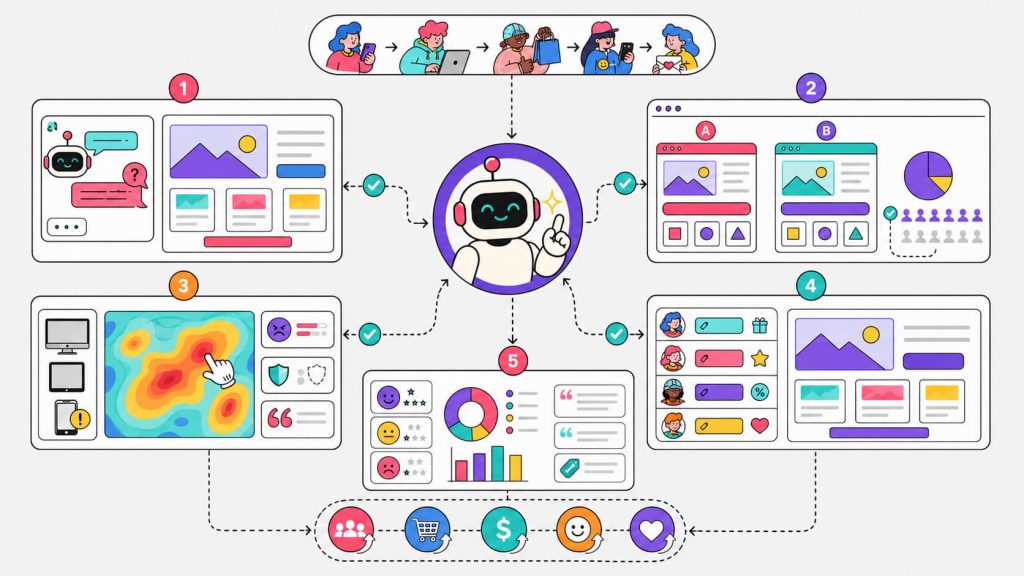
CRO has always rested on a handful of core levers. Some of those levers are how you talk to visitors, how you test ideas, how you understand behavior, how the experience actually feels, and how closely you listen to what customers say.
AI has made each one faster and sharper. Let’s see what that looks like across five areas.
AI in Chatbots
If you’ve ever tried to purchase something online, you know that most times you (like most visitors) abandon the product because you have an unanswered question and nobody’s there to answer it at the moment.
This makes the case for AI chatbots pretty straightforward. Industry-wide, AI chatbots are associated with conversion lifts in the 10–25% range during early deployments, mostly because they close that gap between hesitation and help.
Real-world Examples:
The more interesting numbers come from specific implementations.
ZipChat, an AI chatbot built for ecommerce, reports an average chat-to-sale conversion rate of 12.3% across its merchant base. One standout customer, an Australian supplement retailer called Optimus, hit a 32% chat-to-sale conversion rate, roughly 10 to 15 times higher than a typical ecommerce conversion rate. A merchant in the automotive parts niche reportedly generated over $600,000 in additional revenue within four months, largely because the AI could answer highly specific product questions a generic FAQ page never could.
Glassix ran a broader study and found websites using their AI chatbot saw a 23% increase in conversion rates compared to sites without one. One SaaS client used the chatbot specifically for lead qualification and saw lead conversion rates climb 28%, freeing up the sales team to focus on conversations that actually needed a human.
You should note that a chatbot that hallucinates answers or can’t see real inventory does the opposite of all this. The lift only shows up when the bot is actually wired into your product data.
AI in A/B Testing
Traditional A/B testing has a structural problem that isn’t usually found in AI-powered A/B testing. Traditional A/B testing assumes that customer behavior stays roughly stable for the two to four weeks your test needs to reach significance.
But AI-powered experimentation, sometimes built on multi-armed bandit algorithms instead of a rigid 50/50 split, reallocates traffic toward better-performing variants while the test is still running, instead of waiting for a fixed endpoint.
Real-world Examples:
Panera Bread used this approach during the largest menu transformation in the brand’s history, introducing more than 20 new items without losing loyal guests in the process. Using AI-driven decisioning to match offers and timing to individual customer segments (sandwich lovers saw sandwich launches, frequent drink buyers got Sip Club nudges), the campaign delivered a 2X lift in purchase campaign conversions and 2X more loyalty offer redemptions, while saving the team over 50 hours of manual campaign-building work.
Tonies, the children’s audio brand, used AI-driven lifecycle testing to redesign both onboarding and upsell flows, experimenting with how and when to introduce paid content to free users. The result was a 117% year-over-year increase in free-to-paid conversions, a metric that matters just as much for a SaaS free-trial funnel as it does for a kids’ tech brand.
The pattern in both cases here is that the system got smarter because it could test, learn, and reallocate continuously instead of in fixed two-week blocks.
Find Your Biggest Revenue Opportunities
See how AI can identify friction points, prioritize experiments, and turn more of your existing traffic into customers.
No credit card required · Cancel anytime
AI in Analytics
Heatmaps and session recordings have been around for over a decade, but reviewing them manually scales terribly.
Nobody’s actually watching ten thousand session recordings, hence the terrible scaling. AI, though, changes the math by processing that volume automatically and surfacing the friction (rage clicks, dead clicks, hesitation zones) that a human reviewer would need weeks to find by hand.
Real-world Examples:
The North Face is a useful example of what this looks like applied to attention data specifically.
Using AI-driven predictive analytics paired with a voice-powered shopping assistant that factored in real-time weather data and individual preferences, the brand personalized product guidance based on what its own behavioral data showed customers actually responded to. The result was a 60% increase in click-through rates on those personalized recommendations.
We can see that AI-driven analytics helps typical analytics to stop being a monthly report someone builds and start being a live feed that flags problems, and opportunities, as they happen.
AI in UX
User experience (UX) is where AI CRO gets the most visible, and arguably the most fun.
Real-world Examples:
Sephora is the textbook case here. In 2016, the brand launched Virtual Artist, an AR-powered tool built with ModiFace that lets customers try on makeup shades through their phone camera using real-time facial tracking. By 2018, it had logged over 200 million virtual shade try-ons.
Sephora’s e-commerce net sales grew from $580 million in 2016 to over $3 billion by 2022, roughly a 4x increase over six years that tracked closely with the rollout of Virtual Artist and the rest of Sephora’s AI-driven UX investments.
Not every brand has Sephora’s budget or beauty-specific use case, but the underlying lesson is general: AI-driven UX works best when it removes a specific point of uncertainty. For Sephora, that uncertainty was “will this shade actually look right on me?” For a SaaS product, it might be “will this plan actually fit how my team works?”.
AI-personalized onboarding flows, smart product configurators, and adaptive interfaces all aim to shrink the guesswork that stops someone from finishing the action.
AI in User/Customer Surveys
AI in surveys is solving the problem of getting people to actually fill them out, and then making sense of hundreds of open-ended answers without burning a week tagging them by hand.
Real-world Examples:
On the input side, AI-personalized quizzes are quietly becoming one of the highest-converting forms of “survey” in ecommerce.
Andie Swim, a swimwear brand, built a personalized pre-purchase quiz that guided shoppers toward the right style and fit for their body type instead of leaving them to guess. The quiz drove a 296% increase in conversions and a 96X return on investment, mostly by replacing decision paralysis (a major driver of cart abandonment rate in categories like swimwear, where fit anxiety runs high) with a guided, low-friction recommendation.
On the analysis side, AI-powered feedback platforms like Chattermill can process thousands of open-text surveys and support responses automatically, surfacing root causes instead of surface-level complaints. One Chattermill customer case study reported a 37% reduction in ticket volume after using AI to identify and fix the actual root causes buried in customer feedback. This freed up the equivalent of two to five full-time employees who’d previously been tagging responses by hand.
A survey really only matters if someone, or something, actually acts on the answers. AI is what makes that happen at a volume no human team could keep up with manually.
AI-Powered CRO Tools
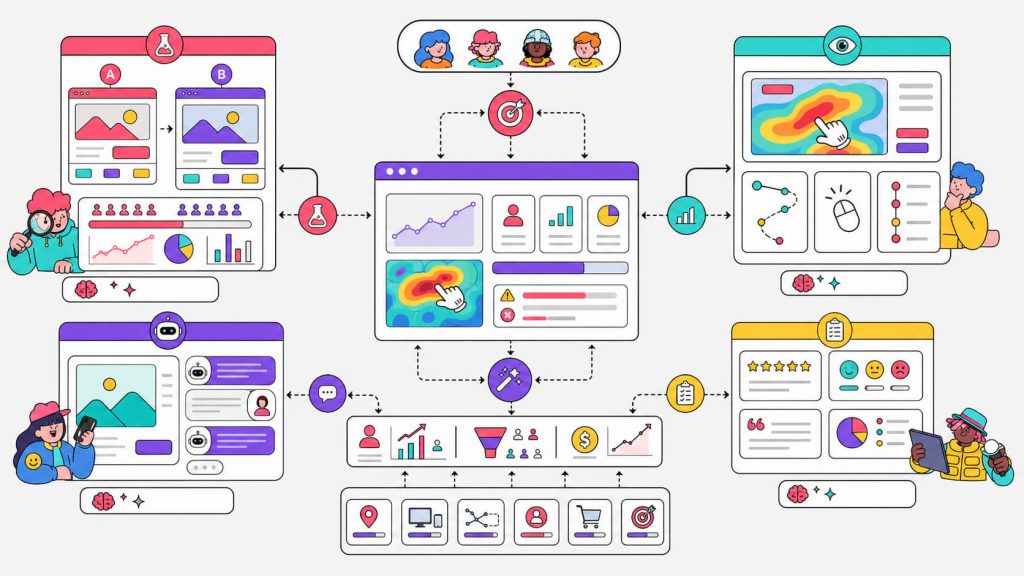
You may be surprised to learn that AI CRO tools span experimentation platforms, behavioral analytics, chatbots, and survey tools. A chatbot that answers objections and a survey tool that explains why people leave are both doing CRO work, even if they don’t market themselves that way.
Experimentation & AI-Driven A/B Testing
- CROLabs: CROLabs is an AI-native conversion platform that analyzes, tests, and personalizes landing pages to increase revenue from existing traffic. The AI Advisor audits your page, identifies conversion blockers, and prioritizes what to fix first. From there, CROLabs can generate variants, launch experiments, and personalize pages based on campaign intent, traffic source, or visitor context, without needing developers for every change. Try CROLabs for Free →
- VWO: One of the longest-running CRO suites, now with AI-assisted test design bundled in.
- Optimizely: Enterprise-grade experimentation with feature flagging and machine-learning-powered personalization.
- AB Tasty: Combines A/B and multivariate testing with AI-powered personalization and on-site engagement widgets.
- Kameleoon: Pairs experimentation with predictive targeting.
- Fibr AI: An agentic personalization platform that rewrites landing pages in real time based on ad source, location, and visitor intent.
Behavioral Analytics
- Hotjar: Session recordings and on-page surveys in one place, increasingly layered with AI summarization to surface friction faster.
- Microsoft Clarity: Free behavioral analytics with rage-click and dead-click detection, a solid starting point if budget is the main constraint.
- Mixpanel: Product analytics built for tracking funnel drop-off and feature-level engagement.
AI Chatbots for CRO
- Intercom (Fin): An AI agent that resolves customer questions across channels and escalates only what genuinely needs a human, which keeps hesitating buyers from stalling out mid-purchase.
- Tidio: Its Lyro AI layer handles common ecommerce questions automatically and is one of the faster tools to set up for smaller Shopify and WooCommerce stores.
- Gorgias: Built specifically around ecommerce workflows, with AI Agent Actions that can look up orders, process returns, and handle account changes directly in the conversation.
- Zendesk AI: Enterprise-scale conversational AI with strong reporting, suited to teams running support and conversion-focused chat through the same system.
Surveys & Voice of Customer
- Typeform: Conversational, one-question-at-a-time surveys with AI-suggested questions and adaptive follow-ups. Built to keep completion rates higher than a standard form.
- SurveySparrow: Similar conversational format with logic jumps and AI-generated summaries of response trends.
- Qualtrics: A heavier-duty platform for enterprise voice-of-customer programs, with AI-driven sentiment and theme detection built in.
- Chattermill: Purpose-built for analyzing open-text feedback at scale, pulling from surveys, reviews, and support tickets to surface what’s actually driving churn or hesitation.
- Zonka Feedback: Combines survey collection with AI categorization and sentiment detection, useful for teams that want both the input and the analysis in one tool.
Conclusion
AI CRO will make improving your conversion rate easier and faster, but you still need to do strategic thinking. Using AI-powered CRO tools, you can take the parts of conversion rate optimization that used to be slow (like auditing a site, running one test at a time, reading a thousand survey responses, watching for friction in real time, etc) and compress them into something continuous instead of quarterly.
If you’re running CRO for a SaaS trial funnel or an ecommerce checkout and you’re still waiting three weeks for a single test to finish, that’s exactly the gap AI CRO closes.
Ready to Increase Conversions Without Buying More Traffic?
Get a free AI-powered CRO audit and discover the changes that could have the biggest impact on your revenue.
No credit card required · Cancel anytime
FAQ
What is AI CRO?
AI CRO (AI conversion rate optimization) is the use of AI (machine learning, predictive analytics, and natural language processing) to identify why website visitors don’t convert and to test or deploy fixes faster than manual methods allow. It spans automated CRO audits, AI-driven A/B testing, chatbots, and personalization.
How is AI CRO different from traditional CRO?
Traditional CRO tests one hypothesis at a time and waits weeks for statistical significance. AI CRO can run multiple variants simultaneously, reallocate traffic to winners in real time, and personalize at an individual level.
Will AI replace A/B testing?
Not exactly, it changes how testing happens rather than eliminating it. AI makes experimentation continuous instead of episodic, often using multi-armed bandit algorithms instead of a rigid wait-for-significance model. You still need a human deciding what’s worth testing and why.
Does AI CRO work the same way for SaaS and ecommerce?
The mechanics are similar, but the metrics differ. CRO for SaaS usually centers on trial-to-paid conversion, onboarding completion, and feature adoption. CRO for ecommerce leans more on cart abandonment, checkout completion, and average order value. AI CRO tools apply to both.
How do I start an AI CRO audit?
Most AI CRO platforms, like CROLabs, let you connect your site and run an automated audit that benchmarks your funnel against industry standards and flags the highest-impact issues first. That’s usually a faster starting point than building a testing roadmap from scratch.
Is AI CRO expensive?
It varies. Some tools, including CROLabs’ free tier or Microsoft Clarity, are either affordable or cost nothing to start. Enterprise platforms with heavier personalization and multi-channel decisioning can run into the hundreds or thousands per month. The right starting point depends more on your traffic volume than your budget.
Can AI actually lower cart abandonment rate?
Yes, and it’s one of the more measurable wins in this space. AI-powered exit-intent detection, chatbots that answer last-minute questions, and personalized quizzes that cut down decision fatigue have all been shown to meaningfully reduce cart abandonment, in some of the examples above, by double digits.