TL;DR
- Bounce rate is a measure of the number of website visitors who land on a page without taking any further action and leave immediately after.
- Bounce rate is different from exit rate. The bounce rate considers the entry page and the only page viewed while the exit rate considers the exit page and the last in a list of pages viewed.
- The bounce rate formula is:
(single page sessions / total page sessions) x 100- A good bounce rate depends on factors such as industry, page type, device type, etc.
- To discover the exact reason for a bounce, use conversion rate optimization tools like CROLabs to detect drop-off points on your page. Then match the data to the category.
- Use CROLabs as well to test what variant works best to reduce your bounce rate.
On This Page
The bounce rate is a metric, and like all other metrics, it is a symptom of a bigger issue. We need to understand more about it first, but if you’ve got that down and just want to jump right into ways you can reduce your bounce rate, go ahead.
What Is Bounce Rate?
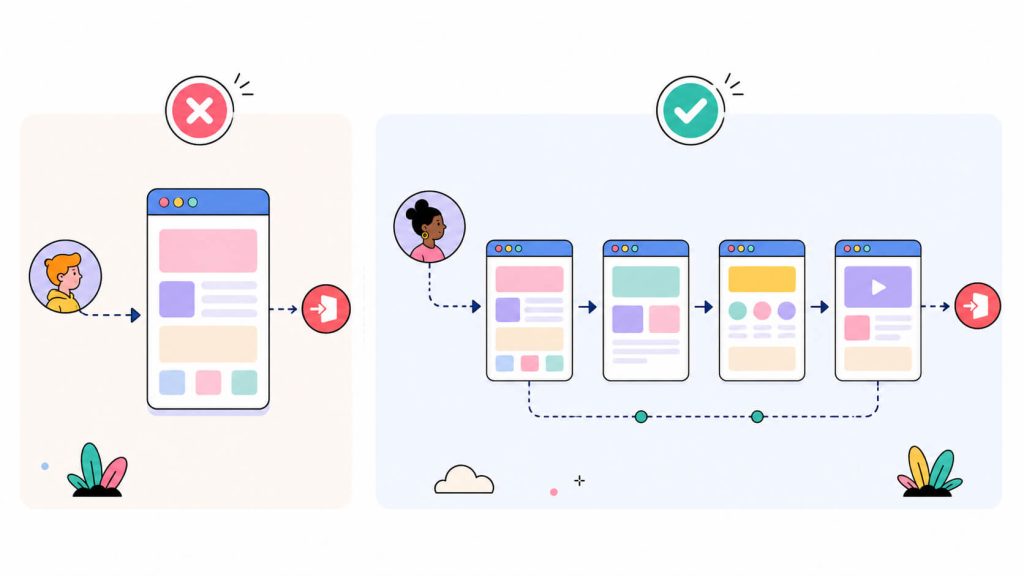
Bounce rate is the percentage of website sessions where a visitor leaves after viewing only one page on your website. It measures the number of website visitors who land on a page without taking any further action.
So if a visitor lands on one of your webpages and doesn’t go on to click a button, scroll, visit a second page, fill a form, etc before leaving, it contributes to your bounce rate.
Exit Rate Vs Bounce Rate
These two metrics get mixed up a lot.
Bounce rate measures sessions in which a visitor viewed only one page and left. It only applies to entry pages i.e the page where they started their session.
Whereas exit rate measures how often people leave from a specific page, regardless of how many pages they visited before getting there.
For example, a visitor lands on your blog post, they read it and click to your pricing page. Then they leave. That’s not a bounce on the blog post, but it is an exit on the pricing page. But if a visitor lands on your homepage and immediately leaves, that’s a bounce and an exit.
How To Calculate Bounce Rate
The bounce rate formula is
(single page sessions / total page sessions) x 100Let’s say the total number of sessions on your landing page is 700, and of those, 420 left without going anywhere else.
Using the formula,
(420 x 100) / 700 = 60% bounce rateYou can also view your bounce rate on analytics tools like Google Analytics.
What Is A Good Bounce Rate?
The “good” here really is relative. It depends on the page, the industry, traffic source and so on. A 70% bounce rate on a blog post is ordinary but a 70% bounce rate on a checkout page is a serious problem.
Generally, a bounce rate of 40% or lower is seen as good while anything from 55% is considered high.
Discover the exact reason for a bounce
Reasons Your Bounce Rate Is High and How To Reduce It
As I mentioned earlier, bounce rate is a symptom, so the actual work is diagnosing what is causing it. I’ve grouped the reasons a bounce rate runs high into five categories, along with ways to improve (or reduce, same thing in this context) said bounce rate.
| Category | Meaning | What Causes High Bounce Rate(Category Examples) | How To Reduce Bounce Rate |
|---|---|---|---|
| Expectation Mismatch | Visitors land on a page that doesn’t match what they expected from an ad, search result, or link | Misleading copy Generic landing pages for specific queries Wrong audience targeting | Align messaging with traffic source Match content to search intent Create dedicated landing pages for high-intent keywords and ad groups |
| Clarity & Value Proposition Issues | Users don’t understand what the page is about or why it matters within 3–5 seconds | 4. Vague headlines 5. Too much jargon 6. No clear above-the-fold benefit 7. Weak or invisible CTA | 4. Use conversion rate optimization tools like CROLabs to detect drop-off points 5. Run on-page surveys using tools like Mentimeter or Hotjar 6. Use clear, specific headlines 7. Show value proposition + proof above the fold |
| UX & Interaction Friction | The page is hard, slow, or annoying to use | 8. Slow page load (>2 seconds) 9. Intrusive pop-ups on arrival 10. Poor mobile experience 11. Confusing navigation 12. Visual clutter | 8. Improve Core Web Vitals (compress images, lazy load, caching) 9. Delay pop-ups until engagement 10. Optimize for real mobile devices 11. Simplify navigation and internal linking |
| Trust & Credibility Gaps | Users don’t trust the site enough to continue | 13. Thin or low-quality content 14. No testimonials or reviews 15. Poor design quality 16. Missing security signals (HTTPS, SSL certificates) 17. Aggressive or spammy tone | 12. Improve content depth and clarity 13. Add testimonials, case studies, and logos 14. Strengthen visual design 15. Add HTTPS and trust badges where relevant |
| Intent Completion (False Positives) | Bounce happens, but the user actually got what they needed | 18. Blog answers question immediately 19. Contact info found instantly 20. Pricing page provides enough info | 16. Don’t treat all bounces as negative 17. Track deeper engagement signals (scroll, time, conversions) 18. Measure assisted conversions beyond bounce rate |
1. Expectation Mismatch
This is a big driver of bounce rate. Visitors to your site bounce because what they see doesn’t match what they expected.
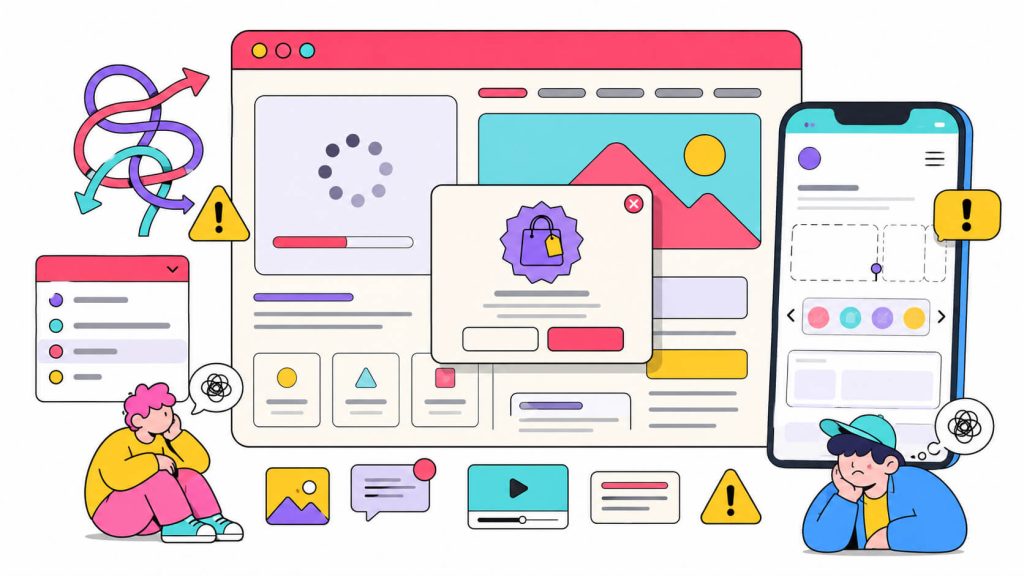
Expectation mismatch can come in the form of
a) Misleading copy
A visitor searching for “affordable pool equipment” clicks on your ad that promises “pool solutions at great prices” but your landing page is actually pushing a premium service package starting at $2,000. Even though you’re technically in the right space, the mismatch in price expectation is enough to send them back to the search results.
For organic listings, it can also be that the title and meta description of a page look like they match the visitor’s search intent but the page’s content proves them wrong. They bounce.
b) Generic landing pages for specific queries
If you’re running multiple ad groups —say, one targeting “CRM for real estate” and another targeting “CRM for e-commerce”— sending both to the same generic landing page is going to impact your bounce rate negatively.
c) Wrong audience targeting
Sometimes the problem isn’t on the page at all. If your ad targeting is too broad or is attracting the wrong intent, the visitors arriving were never going to engage regardless of how good the page is.
How to Reduce This:
a) Match your message to your traffic source
Visitors respond to pages that feel like they were made for them. Personalization at the landing page level, even something as simple as swapping the headline to match the ad they clicked, can help to improve your bounce rate.
b) Evaluate your pages’ content
Do this to make sure that they match the search intent.
c) Use specific copy and meta descriptions
Your copy and meta descriptions should be as specific as possible. Broad hooks might improve click-through rates but they cause an increase in your bounce rate if the page can’t deliver.
d) Create dedicated landing pages
Especially for your highest-volume, highest-intent ad groups and keyword clusters. This is called message match and it’s one of the highest-leverage things you can do to reduce bounce rate on paid traffic. The more specific the query, the more specific the page needs to be.
Reduce your bounce rate with data, not guesswork
Test different headlines, CTAs, layouts, and landing page variants with CROLabs to find what actually keeps visitors engaged.
2. Clarity and Value Proposition Issues
When a potential customer lands on any page of your website, it takes them 3 to 5 seconds to decide whether to stay or bounce. So in that window, if your website isn’t clearly stating what it is, who it’s for, and why it matters, these visitors will likely be compelled to bounce.
Examples of these clarity issues that contribute to a high bounce rate on your website are:
a) Using too much jargon
This one has a place and its people, but generally, using industry jargon creates a barrier that makes your visitors feel you’re not the right fit for them.
b) Your headlines are vague
A headline like “Transforming the Way You Work” sounds impressive but it says nothing. Who does it apply to? Why does it matter? Your vague headlines might feel aspirational internally but from the visitor’s perspective, they create uncertainty and that leads to bouncing.
c) No clear benefit above the fold
“Above the fold” refers to what’s visible before a visitor scrolls. If your hero section has a big background image, your company name, and a vague tagline, you’re wasting your most valuable real estate.
d) Your CTA is just weak or invisible.
If web visitors don’t know what to do next, most of them end up doing nothing. If your CTA blends into your page, well, how will it call those visitors to action?
How To Reduce This:
a) Utilize specialized tools
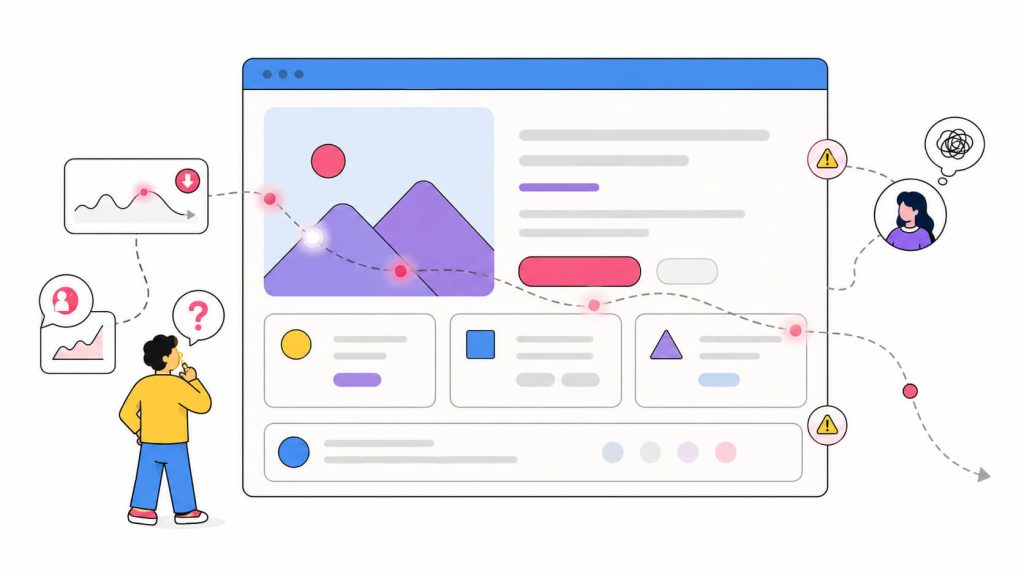
The main challenge of clarity issues is that you often don’t know which ones are contributing to your website’s high bounce rate. One way to figure it out is by using a conversion rate optimization (CRO) tool.
CROLabs, for example, can help you identify exactly where visitors are dropping off, what they’re engaging with, and what’s being ignored. The data you get enables you to make targeted improvements rather than guessing.
Another way is by using surveys. Survey tools like Mentimeter let you ask short questions on your page that reveal what’s confusing or missing. Just keep in mind that surveys only capture feedback from visitors who are already engaged enough to respond, so they won’t tell you why the bouncers left.
b) Avoid using too much jargon
If your industry has specific technical language and your audience definitely uses that same language, then jargon is fine. But if your content is aimed at buyers who aren’t deep in your domain, it’s best to lead with plain language.
c) Use specific headlines
Your headline should be specific enough that a stranger could read it and immediately understand what you do and for whom.
d) Communicate your value early
Your visitors need a reason to scroll. As a result, your above-the-fold content should communicate your core value proposition, who you serve, and ideally hint at a next step. Proof elements (a customer count, a notable client logo, a concise testimonial) that are placed above the fold can also meaningfully reduce your website’s bounce rate by building immediate credibility.
3. UX and Interaction Friction
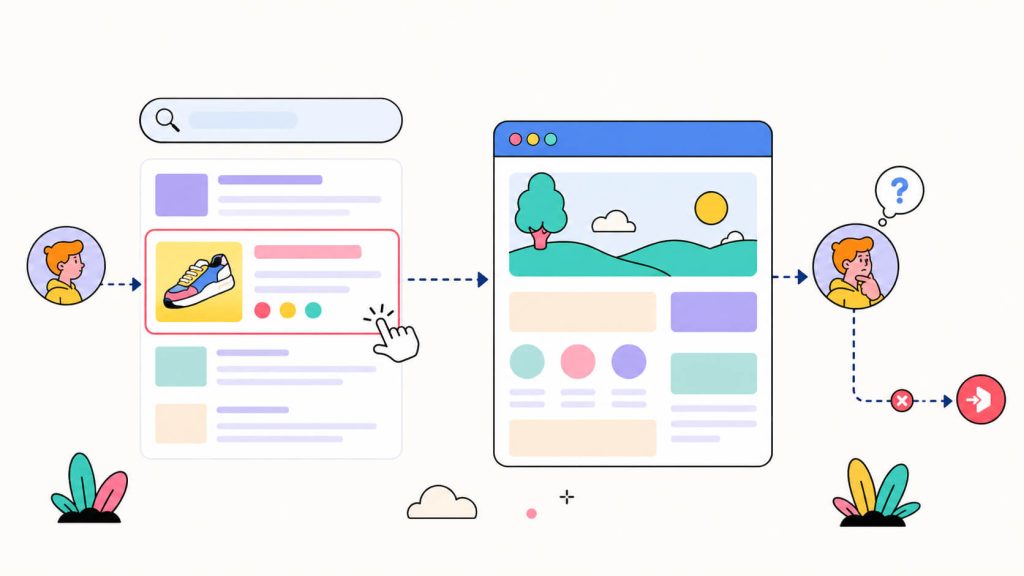
You can have a great value proposition and perfectly matched messaging yet still have a high bounce rate because the experience of using your page is frustrating.
The thing about UX friction is that it’s often invisible to the people building and maintaining a site because they’re not experiencing it the way a first-time visitor does.
a) Slow Page Load Speed
This one is well-documented and still widely underestimated. Most users expect a page to load in under 2 seconds. Every additional second significantly increases the probability of a bounce happening. On mobile, it’s even more pronounced.
b) Intrusive pop-ups
We’re all on the Internet and know how annoying pop-ups can be. A pop-up firing the moment someone lands on your page, before they’ve even had the chance to read a single word, is one way to increase your bounce rate.
c) Poor Mobile Experience
Mobile traffic now accounts for more than half of global web traffic, and mobile users have less patience for friction. Buttons that are too small to tap easily, text that requires pinching and zooming, images that break layout, or navigation menus that are hard to use on a touchscreen. All of that contributes to higher mobile bounce rates.
d) Confusing Navigation
If visitors can’t quickly figure out how to get to what they need, many of them won’t even try. Things like buried menu items, inconsistent labels or a lack of internal linking within content all make it harder for visitors to stay and explore.
e) Visual Clutter
As we saw with vague headlines, it’s easy to end up saying nothing when you think you’re being impressive. A page that’s saying too many things at once also ends up saying nothing. When your page has too many fonts and colors or auto-playing media, it creates a cognitive overload that adds to the reasons your bounce rate is so high.
How To Reduce This:
a) Reduce your page load time
Start with Google’s PageSpeed Insights or Core Web Vitals report. Common culprits include unoptimized images, render-blocking JavaScript, large CSS files, and slow server response times. Compressing images, implementing lazy loading, and leveraging browser caching are typically the highest-impact quick wins.
b) Delay pop-ups
Even well-intentioned pop-ups (newsletter signups, discount offers) create friction if timed poorly. So to be on the safe side, delay pop-ups until visitors have demonstrated engagement ( scrolled 50% down the page, spent at least 30 seconds, or are showing exit intent).
Also make your pop-ups easy to dismiss. On mobile, ensure they don’t cover the full viewport in a way that’s hard to close.
c) Optimize for mobile usage
Test your pages on actual mobile devices, not just browser simulations. Google’s Mobile-Friendly Test is a starting point, but there’s really no substitute for scrolling through your pages on a phone and noticing where it feels awkward.
d) Simplify your navigation
Use clear, descriptive labels and add contextual internal links within your content to give visitors obvious next steps. Breadcrumbs help too, especially on content-heavy sites.
4. Trust and Credibility Gaps
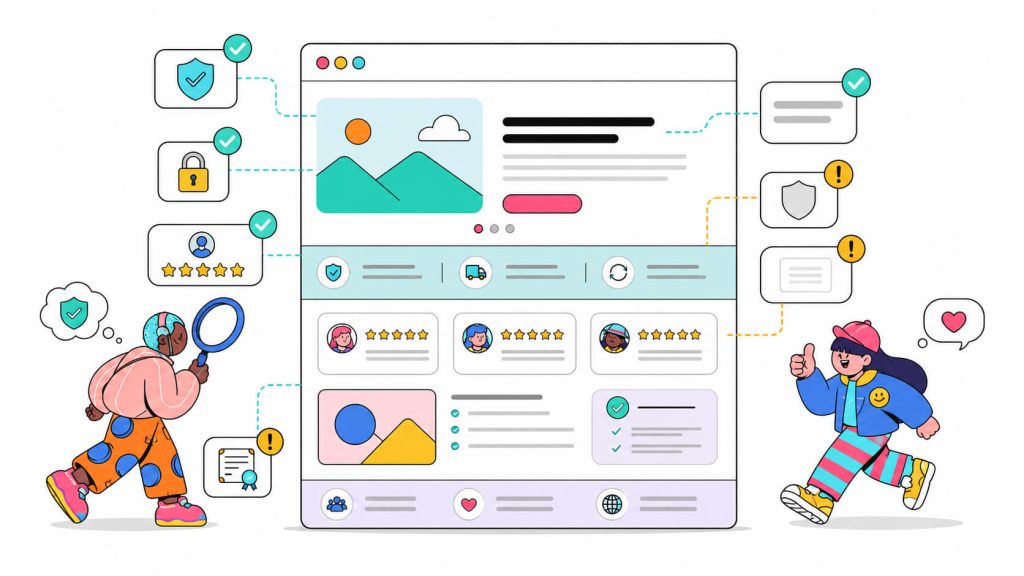
Even if your page is fast, clear, and perfectly matched to visitor intent, people still need to trust you before they’ll engage. First-time visitors are especially skeptical. If your page doesn’t signal credibility, they’ll bounce and go to a competitor that does.
a) Poor quality content
Content that’s thin, filled with obvious keyword-stuffing, has grammatical errors, or content that feels auto-generated immediately erodes trust.
b) No Testimonials or Reviews
Social proof remains one of the most powerful trust signals. If your page has no reviews, no testimonials, no customer logos, and no case studies, you’re making it difficult for your visitors to trust you. Many of them will end up bouncing.
c) Poor design quality
A poorly designed website signals that the brand behind it might not be professional, established or worth trusting with personal information.
d) Missing security signals
If your site collects any form of personal information, you should make it feel safe for your visitors to provide it.
e) Aggressive or spammy tone
Using overly salesy copy or a tone that feels pushy creates immediate distrust. Most people who’ve spent some time on the internet have a finely tuned radar for this kind of content after years of being marketed at online.
How To Reduce This:
a) Audit your content for quality
Audit your highest-traffic pages for content quality. Does every page genuinely answer the question or address the need that brought someone there? Is it accurate, thorough, and readable? Depth and genuine usefulness in your content help to reduce your bounce rate.
b) Add relevant social proof
If you have notable clients, display their logos. If you have reviews on third-party platforms (Google, G2, Trustpilot), especially ones that focus on the outcome of using your product or service, pull quotes and link to them for added credibility.
c) Include those security signals
Ensure your site is HTTPS. If you process payments, display payment security logos. These signals matter more on high-friction actions like purchases or form submissions.
5. Intent Completion
Not all bounces are bad. This one’s important and it’s easy to miss if you’re just looking at the number.
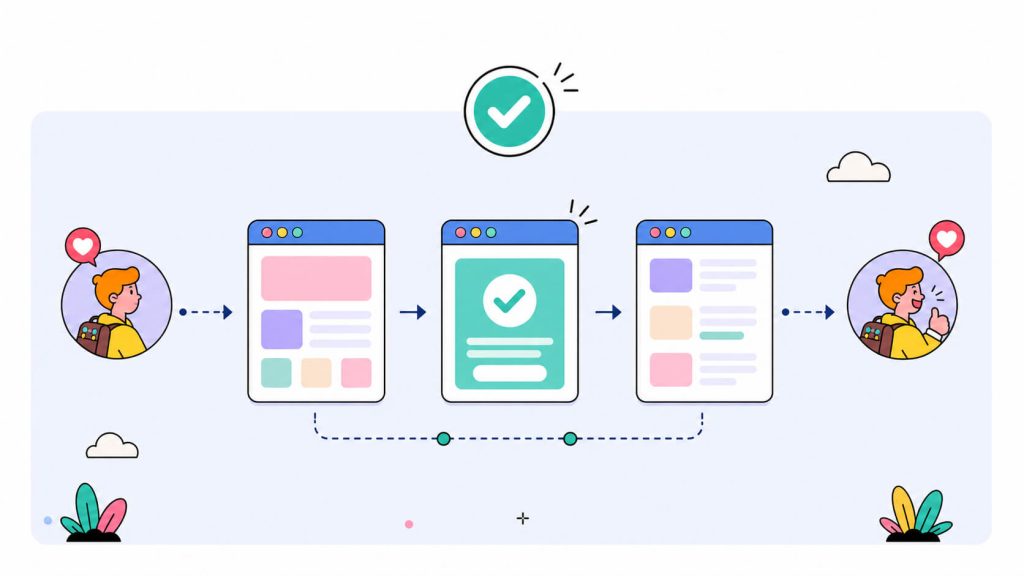
Some visitors come to your site, get exactly what they need, and leave satisfied.
a) Blog post answers their question immediately
If someone searches “what is bounce rate” and lands on your article that has the full definition in your intro, the visitor leaving after reading counts towards your bounce rate but it’s also a successful interaction. You provided value. They may come back later. They may share the article. Counting this as a failure inflates the problem.
b) Contact info is visible without interaction
A visitor finding your phone number or email address immediately after landing on your contact page will likely leave to call you. That counts as a bounce but it’s also a win. A bounce that leads to a phone call is a conversion that your analytics can’t see.
c) Pricing is clear enough without clicking further
Some visitors come specifically to check your pricing. If your pricing page communicates the cost clearly and the visitor leaves to discuss internally or compare with a competitor, that will count as a bounce but it’s also a qualified interaction.
The Bottom Line
A high bounce rate is telling you something but it’s rarely telling you one thing. The most common mistake is treating it as a single problem with a single fix.
Once you can identify the category of the problem, the solution becomes much more obvious and actionable.
If you want a faster path to diagnosis, CROLabs can help you identify exactly where your pages are losing people and tell you what to do about it, without the guesswork.
Reduce your bounce rate with data, not guesswork
Test different headlines, CTAs, layouts, and landing page variants with CROLabs to find what actually keeps visitors engaged.