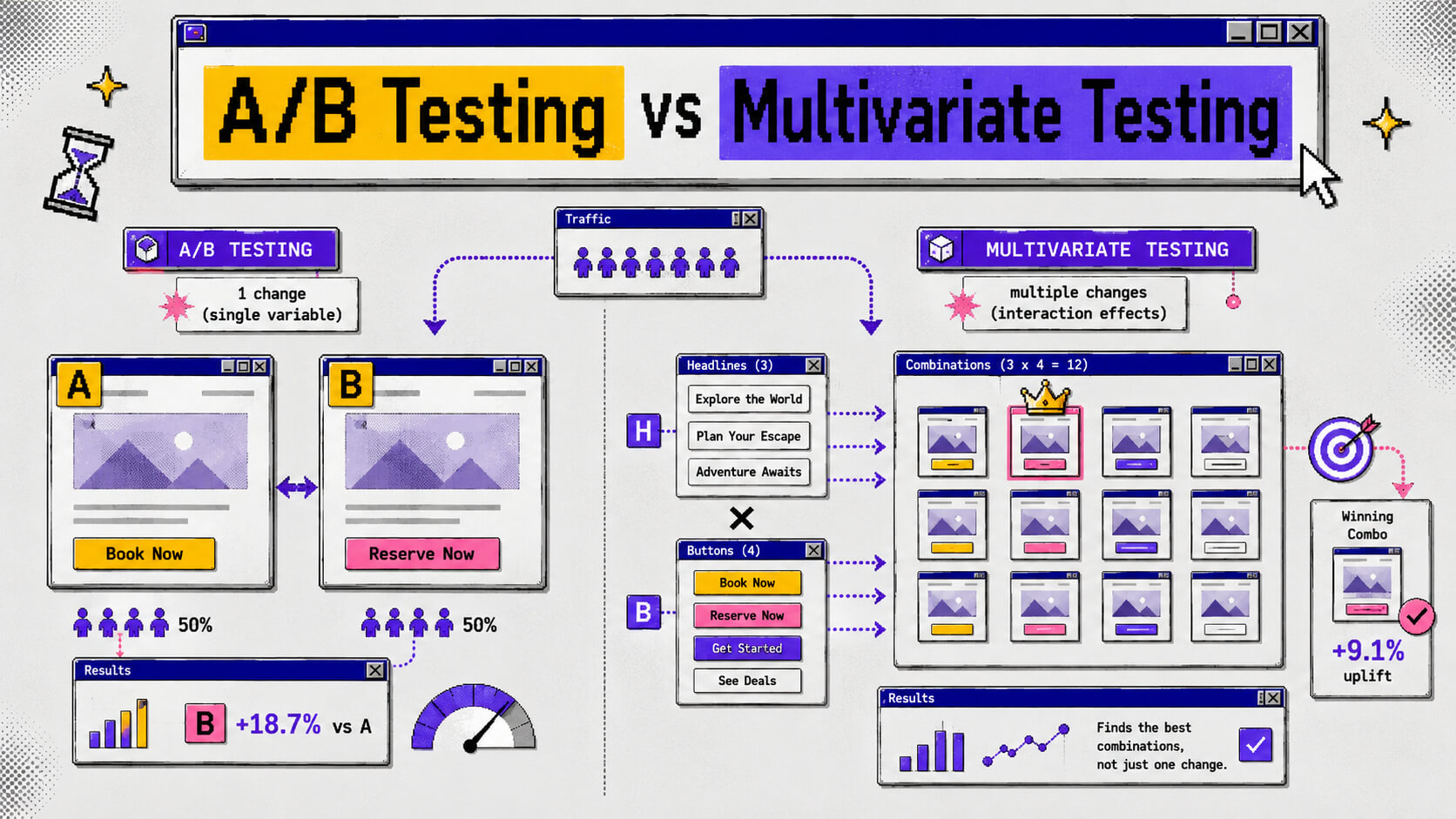
When Sabre Hospitality Solutions set out to get more clicks on Provident Hotels & Resorts’ reservation button, they didn’t guess at a single fix and call it a day. They ran a multivariate test that combined three versions of the booking form’s headline with four versions of the call-to-action copy.
That amounted to 12 total combinations that were live sitewide for a month and spread across roughly 27,500 visitors. The winning pair turned out to be a form titled “Reserve a Room” next to a button that simply said “Search”, and it lifted click-through by 9.1%.
If you don’t have much experience with conversion rate optimization, that number may look modest until you sit with what it actually proves. Neither the form headline nor the button copy explained the lift on its own, rather it was the pairing of the two that worked. If you test them separately with an A/B test, you’d learn which headline wins and which button wins in isolation, but you’d never learn whether the two help each other or quietly cancel each other out.
Most times, A/B testing and multivariate testing get lumped together but they’re not interchangeable. If you’re serious about improving your website conversion rate, you need to know what each test actually does, where it breaks down, and which one earns its keep on your specific site. Let’s get into it.
On This Page
A/B Testing
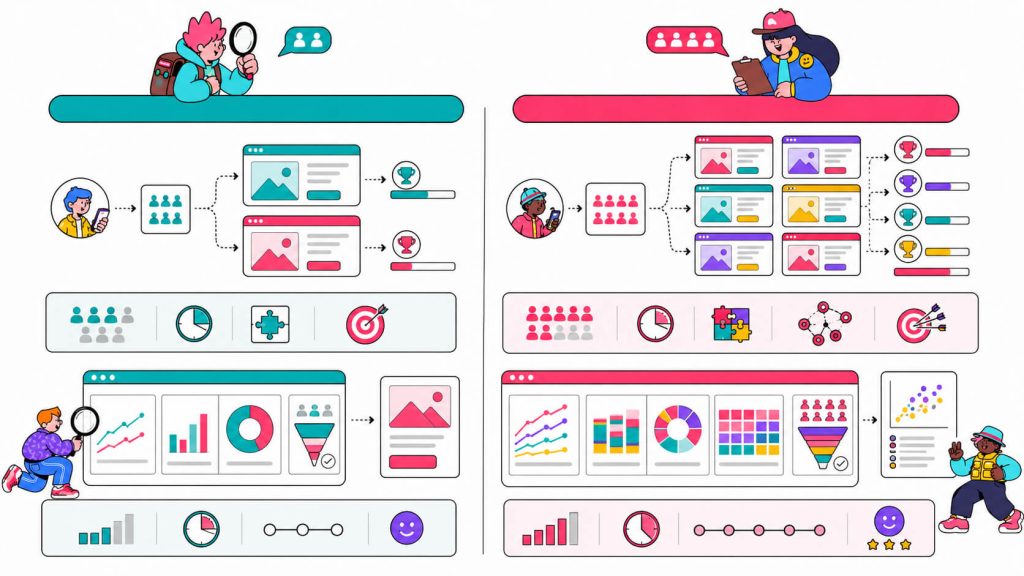
A/B testing (also called split testing) pits a control against a single variant. Version A is the control and, most times, it’s what you already have. Version B is the variant and has one thing changed (a headline, a CTA color, a form length), and your traffic gets randomly split between the two.
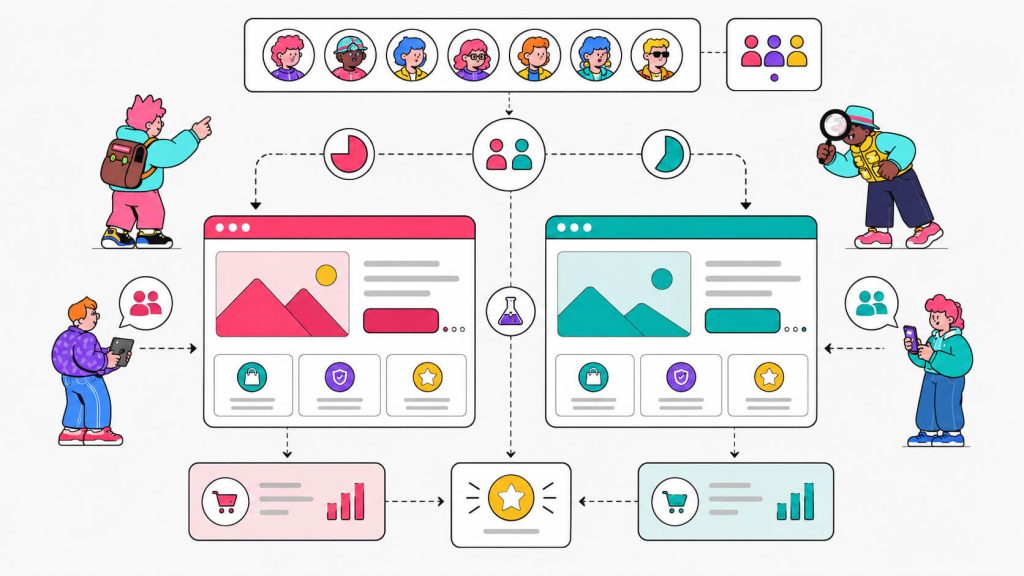
For example, your homepage headline may currently read “Powerful Analytics, Made Simple”. However, you have a hunch that leading with the outcome instead of the feature would land harder, something like “Get Clear Answers From Your Data in Minutes”. Instead of guessing, you send half your visitors to the original headline and half to the new one, then let the data settle the argument. Whichever version drives more of your desired action wins, and you roll it out to 100% of traffic.
Most A/B tests reach statistical significance with somewhere between 1,500 and 5,000 visitors per variation, so a site pulling a few thousand visitors a week can usually get a readable result within a couple of weeks. That’s why it’s the default entry point into experimentation for most CRO programs.
Advantages of A/B Testing
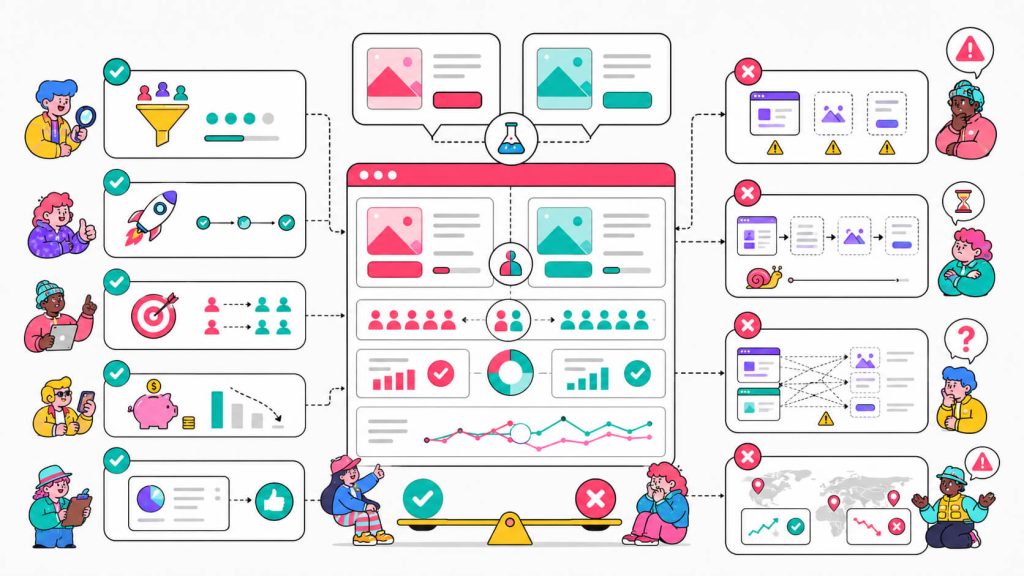
- Low traffic requirements: You don’t need enterprise-level traffic to get a trustworthy answer.
- Fast to launch: You need only one variable and one variant. There’s no complicated build and no developer bottleneck if you’re using a visual editor.
- Clean attribution: Because only one element changes, you know exactly what caused the lift (or the drop). No guessing which of five moving parts did the work.
- Cheap to run: Less traffic and simpler builds mean lower cost per test, which means you can run more of them.
- Beginner-friendly: Anyone can read the results without a statistics degree.
Disadvantages of A/B Testing
- One variable at a time: If you want to test your headline, your CTA, and your hero image, that’s three separate tests run one after another.
- Slow to compound: Sequential testing gets you there eventually, but “eventually” can mean months if you’re chasing a full page redesign one element at a time.
- Blind to interaction effects: A green button might outperform red on its own, but underperform when paired with a new headline. A/B testing won’t tell you that.
- Local optimization: You’re improving pieces without necessarily understanding how they behave together.
Find Your First High-Impact A/B Test
Not sure what to test first? CROLabs analyzes your website and highlights the pages and elements most likely to improve conversions.
Multivariate Testing
Multivariate testing (MVT) tests several elements on a page at once, and instead of just comparing two versions, it tests every possible combination of those elements.
Example, if you change your headline (2 versions) and your CTA button (2 versions), you’re no longer running one test. You’re running four, simultaneously, because MVT wants data on all four combinations. If you add a third element with two variations, you’re now at eight combinations. Add a fourth and you’re at sixteen.
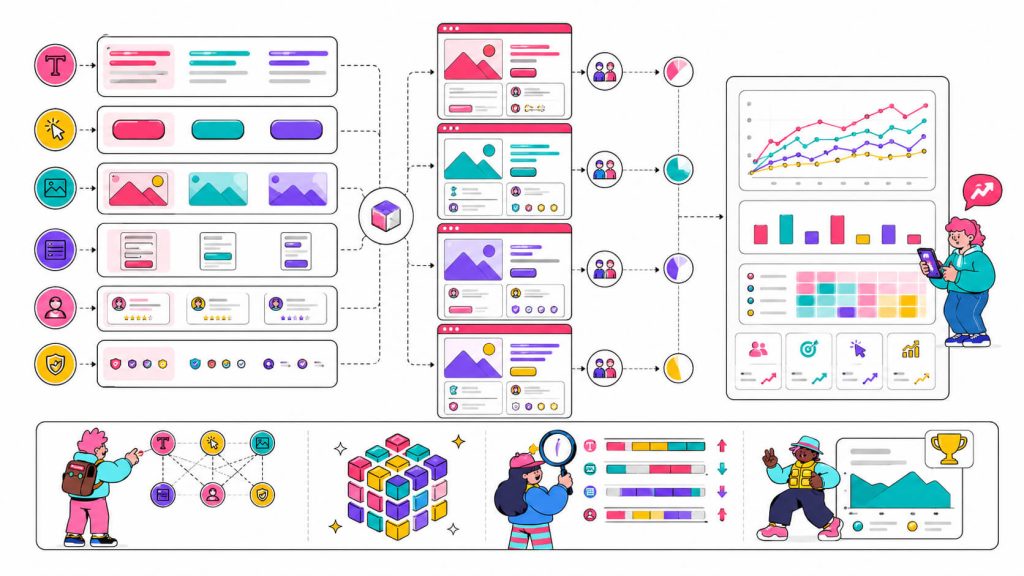
This is exactly why MVT is built for a different job than A/B testing. It doesn’t focus on which singular element wins, rather it’s there to answer how these elements behave when they’re working together, which matters most on high-traffic pages where several elements interact constantly.
Advantages
- Reveals interaction effects: As mentioned earlier, this is the whole focus. You learn whether your new headline and your new CTA reinforce each other or cancel each other out.
- More efficient than a string of A/B tests, for the right page: Instead of testing headline, then CTA, then image separately over months, a single MVT campaign can test all three together if you have the traffic to support it.
- Deeper strategic insight: You come away understanding the relationship between elements on a page, not just which single element performs best in isolation.
Disadvantages
- Traffic-hungry, by a wide margin: Adding more variables means requiring more traffic. This means that a modest multivariate test with just four combinations can need 16,000 monthly visitors or more to reach statistical significance in a reasonable window, since each combination needs its own meaningful sample.
- Long test durations: Lower-traffic sites can watch an MVT run for months and still not reach a confident result.
- Complex to set up and read: You’re not eyeballing a simple A-vs-B chart anymore. You’re interpreting interaction effects across a matrix of combinations, and that takes more than a glance.
- Higher risk of false positives: When you test too many variations against too little traffic, you start seeing “winners” that are really just statistical accidents.
- Not built for small or new sites: If your website conversion rate work is happening on a page with modest traffic, MVT will likely stall out before it tells you anything useful.
Make Every Test Count
Before investing traffic in complex experiments, identify the changes with the highest potential impact using an AI-powered CRO audit.
A/B Testing vs Multivariate Testing
If you’re thinking of which one to use, for most businesses most of the time, A/B testing is the answer.
That’s because it’s the one that actually fits the traffic most websites have. Multivariate testing is a specialist tool for high-traffic pages where you specifically need to understand how elements interact, think a homepage or product page pulling tens of thousands of monthly visitors and not a niche landing page getting a few hundred.
| A/B Testing | Multivariate Testing | |
|---|---|---|
| What it tests | One variable, two versions | Multiple variables, all combinations |
| Traffic required | Lower (roughly 1,500–5,000 visitors per variation) | Much higher, grows with each added variable |
| Test duration | Days to a couple of weeks on decent traffic | Weeks to months depending on combinations |
| Setup complexity | Simple | Complex |
| Best for | Quick, focused wins on individual elements | High-traffic pages needing interaction insights |
| Insight type | Which single element performs better | How elements perform together |
| Risk of false positives | Lower | Higher, especially with too many variations and too little traffic |
| Ideal site stage | Any site, especially smaller or newer ones | Established, high-traffic sites |
Before you run any test to boost your conversion rate, run a CRO audit first to figure out where visitors are actually dropping off and which elements are worth touching. Then you can use A/B testing to knock out the obvious, high-impact single-variable changes such as headline copy, CTA text and color, form length, and trust signals near the fold.
Once you’ve built up a page that’s already performing well and you’re seeing meaningful traffic land on it, that’s when multivariate testing becomes worth the traffic cost. By then, you’ll be fine-tuning interactions on a page that’s already earning its keep.
Before investing traffic in complex experiments, identify the changes with the highest potential impact using an AI-powered CRO audit.
One thing worth remembering through all of this is that every test you run, win or lose, is data. You might assume that a test that doesn’t move your bounce rate or your conversion rate is a failure, but it’s one more assumption you don’t have to guess about again.
Conclusion
A/B testing and multivariate testing are different methods built for different traffic levels and different questions. A/B testing gets you fast, clean answers on individual elements with traffic most sites already have. Multivariate testing gets you a deeper picture of how elements interact, but it demands traffic volume that only a fraction of websites can actually supply.
The real mistake is skipping the audit step and testing on instinct instead of data. Tools like CROLabs exist to close that gap. It allows you to run an AI-powered CRO audit to flag where conversions are actually leaking, then lets you launch A/B or multivariate tests on the elements that are worth touching, without needing a developer standing by.

Start with the audit, test with intention, and let the traffic you actually have decide which method fits.
FAQ
Do I need a developer to run A/B or multivariate tests?
Not with most modern experimentation platforms. Tools like CROLabs have visual editors that let you build and launch both A/B and multivariate tests without touching code, though MVT setups are naturally more involved simply because there are more combinations to configure.
How much traffic do I actually need for multivariate testing?
It depends entirely on how many combinations you’re testing, but as a rough baseline, expect to need at least double the monthly traffic an equivalent A/B test would require. That number climbs fast with every additional element you add.
Can A/B testing hurt my SEO or bounce rate?
When it’s run correctly (proper redirects, no duplicate indexable URLs, reasonable page load times on variants), A/B testing has minimal SEO impact. A poorly built test i.e slow-loading variants, cloaking issues, can absolutely spike your bounce rate, which is more a sign of bad implementation than a flaw in the method itself.
Should I run A/B and multivariate tests at the same time on the same page?
Generally, no. Overlapping tests on the same page contaminate each other’s data, making it impossible to know which test actually drove the result you’re seeing.
Which one is better for a CRO audit follow-up?
A/B testing, in almost every case. A CRO audit typically surfaces individual friction points like a confusing CTA, a weak headline, too many form fields, etc. Those are exactly the single-variable problems A/B testing is built to solve quickly.