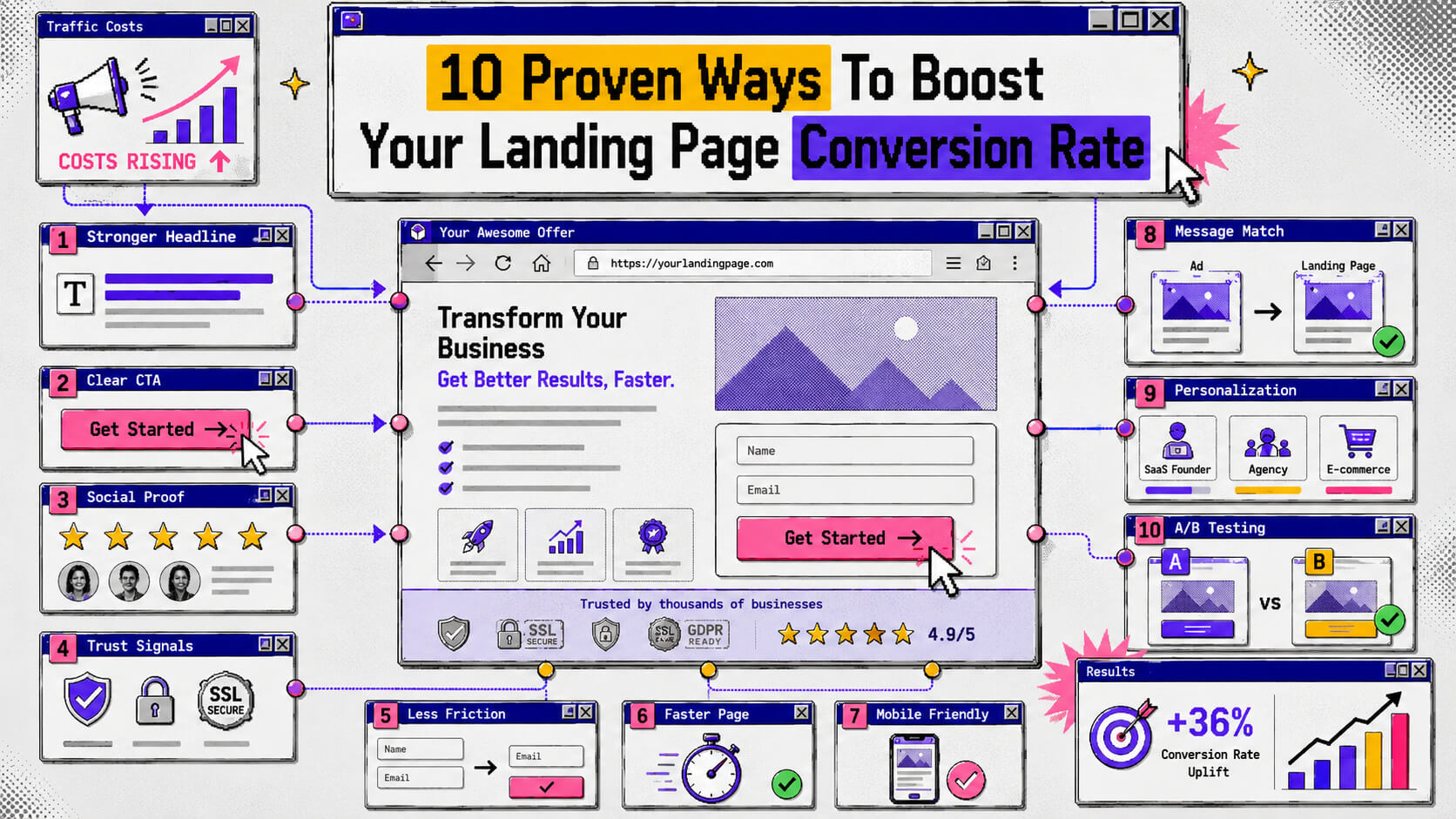
It used to be insignificant if you were somewhat unserious with your landing page, because traffic was cheap enough that a mediocre page could still limp its way to a decent return. But that’s not the case anymore.
Google Search Cost Per Click (CPC) climbed from $2.64 to $2.96 in a single year (Q1 2025 to Q1 2026). That’s a 12% jump, the steepest annual increase since 2021. And that’s before you factor in Meta, where Cost Per Mille (CPMs) are up 20% year-over-year. Paid traffic isn’t getting cheaper anytime soon. If anything, every signal points the other way.
Which means the math on your landing page has changed. You can’t out-spend a bad page anymore, at least not without burning through a budget that used to stretch three times as far.
So the most impactful thing you can do right now, dollar for dollar, is to make the page you already send people to actually convert them.
That’s the whole focus of this article. We’ll look at why it matters, what good looks like, and the tactics (common and less common) that actually move the number.
On This Page
Why Is Improving Landing Page Conversion Rate Important?
a. Increased conversions on the same ad spend or traffic
If your landing page converts at 2% and you bump that to 3%, you didn’t get a 1% improvement. You got a 50% increase in leads or sales, from the exact same traffic, at the exact same ad spend.
Compare that to trying to get the same lift by lowering your CPC. You’ll need exceptional luck because costs are heading up across nearly every platform and every industry. Conversion rate optimization is one of the only levers left in your control that doesn’t get more expensive the more competitors pile into the auction.
b. Better quality score
There’s a quieter reason landing page optimization matters more in 2026 than it used to: your landing page experience directly affects what you pay for clicks in the first place.
Google factors landing page relevance into Quality Score, and a better Quality Score means a better ad rank at a lower cost per click. So a landing page built around genuine conversion rate optimization principles can actually make your ads cheaper to run, not just more effective once someone lands there.
c. Better visitor experience
Better visitor experience is the most obvious benefit here. Every visitor who bounces off your landing page is a visitor you already paid for.
You’ve covered the CPC and the impression. The only thing left un-monetized is the moment they actually landed, and that moment is entirely within your control.
Want To Know What’s Hurting Your Conversions?
What Is A Good Landing Page Conversion Rate?
The short answer is that it depends. Giving a single flat number without asking about your industry, traffic source, or offer is just oversimplifying it.
That said, here’s a real baseline. Across large-scale analyses of tens of thousands of landing pages, the median conversion rate sits around 6.6%. Top-quartile pages clear roughly 11%, and the genuinely elite ones (the top 10%) push past that into the low double digits.
But medians hide a lot. A cold paid-social ad sending someone to a demo request page is playing a completely different game than a warm email list clicking through to a page they already expected.
B2B pages tend to run higher than you’d think (often north of 10%), partly because the traffic is more qualified to begin with. E-commerce pages, on the other hand, often sit in the low single digits simply because impulse-buying a $40 candle is a lower-commitment decision than requesting a sales call, but the traffic volume is much higher.
So instead of chasing an industry number, benchmark against yourself. If your page currently converts at 2.5%, your job isn’t to hit 11% by next quarter, it’s to beat 2.5%. A jump from 2.5% to 3.2% is a 28% lift in output with zero additional spend.
How To Boost Your Landing Page Conversion Rate
Alright, let’s get into the actual tactics. Some of them are well-worn ones that still work (because fundamentals don’t expire) and a few that get talked about a lot less but bring improvement just as much.
1. Get data before you touch anything
Don’t redesign a single element on your landing page until you’re sure which ones actually need it. It sounds like common sense now but it’s really not that common.
A lot of businesses change their hero section, CTA copy, and form length all in the same week. Their conversion rate may move, but they’ll have absolutely no idea which change caused it. Worse, they might “fix” something that wasn’t actually broken.
To get your data, start with an analytics tool that shows you where people are actually dropping off. Tools like Google Analytics 4 work here.
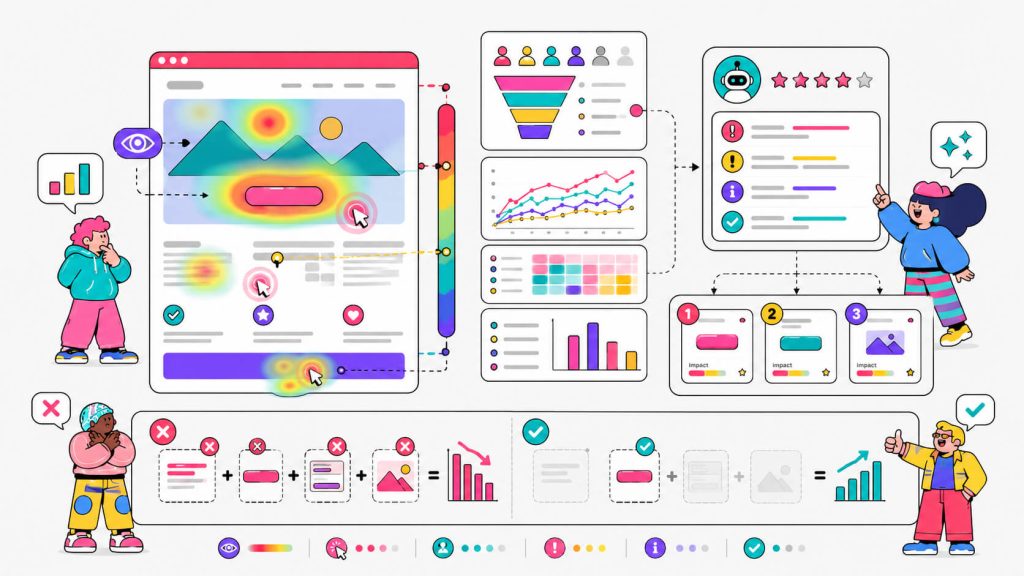
However, if you don’t want to be overwhelmed with data and just want to quickly (and correctly) identify friction points, use a more actionable analytics tool like CROLabs. CROLabs’ AI Advisor will crawl your page and flag which friction points are statistically costing you conversions versus which ones just look ugly but don’t actually matter.
That distinction is the whole ballgame because a lot of “obviously broken” page elements convert just fine, while a lot of pages that look polished are quietly bleeding visitors at one specific step.
Find Your Biggest Conversion Leaks In Minutes
Skip hours of digging through analytics. Let CROLabs identify the pages, elements, and friction points that are actually impacting your conversion rate.
2. Match your message like your ad and page are the same sentence
This is probably the single highest-leverage fix on this entire list. If your ad promises “cut onboarding time in half”, make sure your landing page headline says exactly that or something very close to that. If the landing page headline says something like “The Future of Customer Success”, you’ve just made your visitor do translation work in their head, and most of them won’t bother.
This concept sometimes gets called conversion scent. Conversion scent is the idea that a visitor should feel like they’re still following the same trail from the moment they click to the moment they convert.
Once you break that scent, many of them bounce (usually within the first few seconds) regardless of how good the rest of the page is.
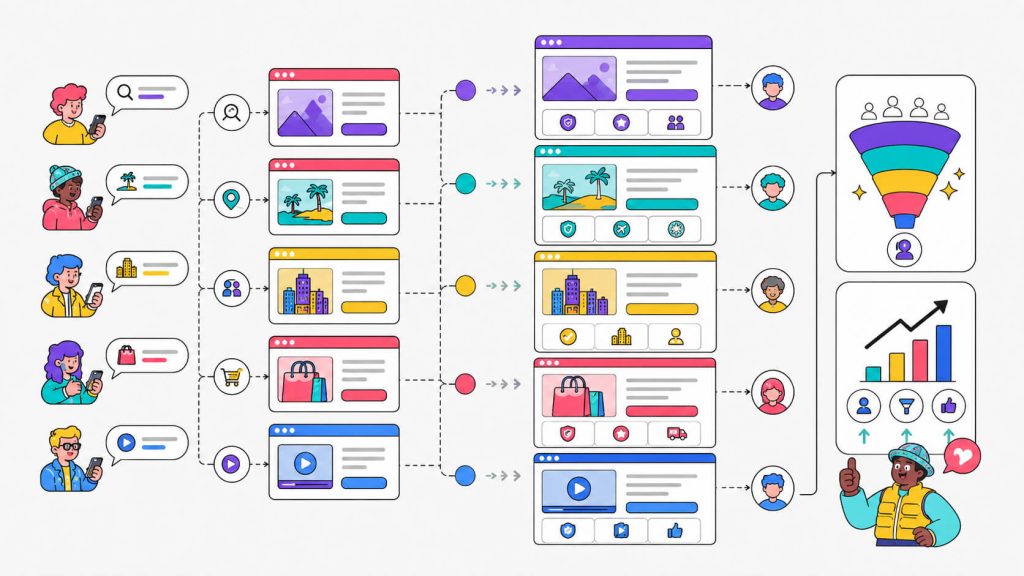
So, before testing headlines, colors, or copy, pull up your top five ads and your landing page side by side. If they don’t sound like the same person wrote them with the same goal in mind, that’s your first fix.
3. Run A/B tests and keep running them
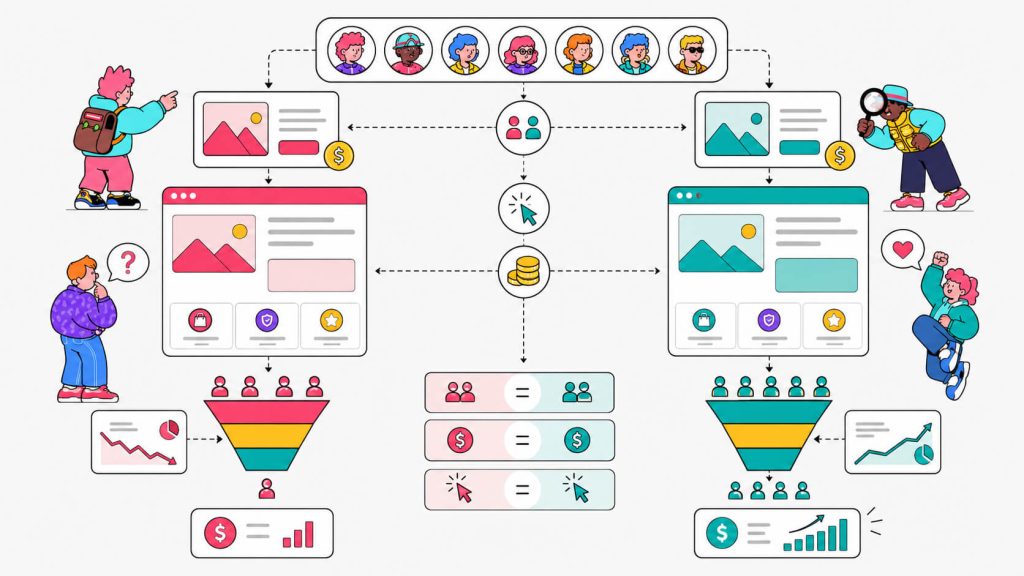
Experimentation is the core mechanic of conversion rate optimization, full stop. You genuinely can’t know in advance whether a green CTA button outperforms a red one for your specific audience, the only way to know is by testing it.
An A/B test splits traffic between a control (version A) and a variant (version B) so you can measure which one actually drives more conversions instead of guessing based on vibes or what looked good in a Figma file.
The part people aren’t well aware of is that continuous testing compounds. When you win one test on your CTA button, that’s a permanent lift. If you move on to testing your headline next, and if that wins too, you’re stacking gains on top of gains.
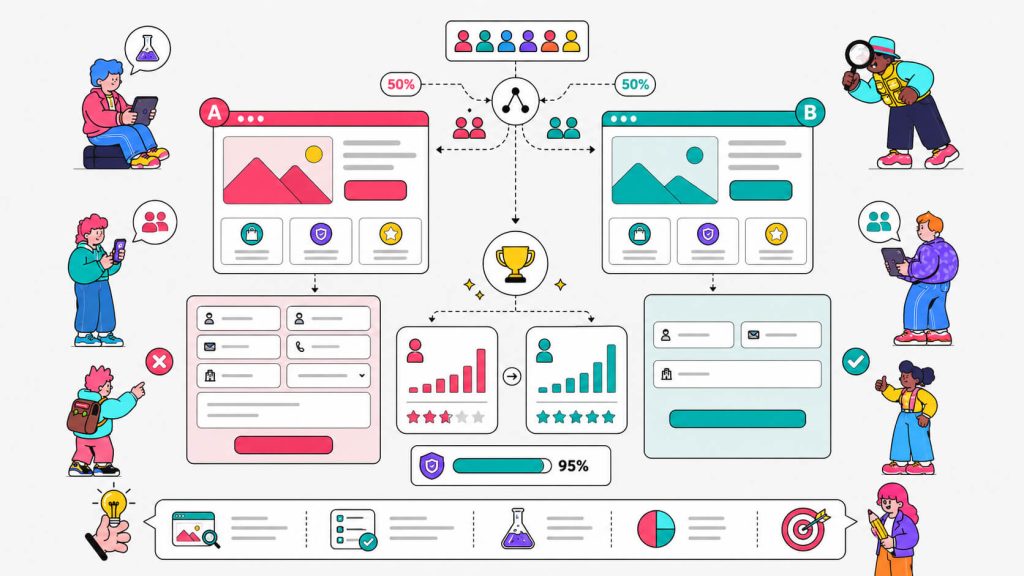
Realistically, most individual tests won’t be winners. Something like 1 in 8 tests shows a statistically significant improvement, but the ones that do win are the ones that add up over a year of consistent testing.
4. Cut your form down but know when not to
The default advice everywhere is that shorter forms convert better and it’s usually true. If you’re only after an email address, don’t also ask for company size, job title, and phone number on the same form. Every extra field is a fresh excuse for your visitors to bail. Besides, you can always collect that additional information after someone’s converted and already invested.
But there’s some nuance to this that isn’t talked about as much. Shorter isn’t automatically better if lead quality is what you actually care about. A form with three fields will out-convert one with seven fields almost every time, but it might also hand your sales team a pile of leads who were never going to buy.
So, taking this into consideration, If your goal is volume, you can strip the form down. But if your goal is qualified pipeline, a slightly longer form that filters for intent can outperform a short one on the metric that actually matters: revenue, not raw submit-button clicks.
5. Build dynamic landing pages instead of one page for everyone
Sending every visitor to the exact same static page regardless of whether they’re cold ad traffic visitors, warm email subscribers, from a specific industry segment or from a specific geography is more common than it should be.
It assumes that all your visitors don’t mind hearing the exact same pitch when, in fact, they do.
Dynamic landing pages swap in different headlines, imagery, or social proof depending on who’s actually looking at the page. It considers their traffic source, their location, the keyword they searched, and even the industry they work in.
This is personalization at the page level, not just the email level, and it’s one of the more underused CRO tactics simply because it sounds more technical to set up than it actually is with modern tools.
Even something as basic as dynamically swapping your headline based on the ad someone clicked can produce a meaningfully higher conversion rate than a generic, one-size-fits-all version. That’s because you’re reinforcing that “conversion scent” from tactic #2 automatically and at scale.
6. Use real urgency, not decorative urgency
Countdown timers are one of the most well-known ways to signal urgency. They’re everywhere and unfortunately, most of them are fake. They reset every time you refresh the page and visitors have caught on.
Fake urgency doesn’t create pressure anymore. It creates distrust, and distrust is much harder to CRO your way out of than a slow page.
Real urgency still works, and it works well precisely because it’s rare now. If the deadline is real, it’ll be in your conversion rate’s best interest to say so plainly. So let the closing day for your enrollment window actually be Friday and your cohort actually have seven spots left.
7. Remove everything that isn’t the one thing you want them to do
Sometimes, a landing page with a full site navigation bar at the top is handing your visitor eight different exits before they’ve even read your headline. If someone can click away to your “About Us” page, your blog, or your pricing page from the top of your landing page, some percentage of them will.
Now, they may or may not convert on that page they clicked away to, but since we’re focusing on landing pages here, we can safely point out that every one of those clicks is a conversion you didn’t get.
Pages built around a single call to action consistently outperform pages offering visitors a menu of choices. This applies to CTAs too: pick one action per page. “Book a Demo” and “Start Free Trial” competing for the same click doesn’t give visitors more options, it gives them more reasons to leave and think about it later which, in practice, means never coming back.
8. Put trust signals exactly where doubt shows up
Testimonials and trust badges scattered randomly around a page do less work than the same elements placed deliberately. The trick to getting it right is proximity.
You have to put the proof right next to the moment someone is deciding whether to trust you. A security badge belongs near your form, not buried in your footer. A testimonial about ease of setup belongs near your “how it works” section so don’t leave it floating alone at the very bottom of the page.
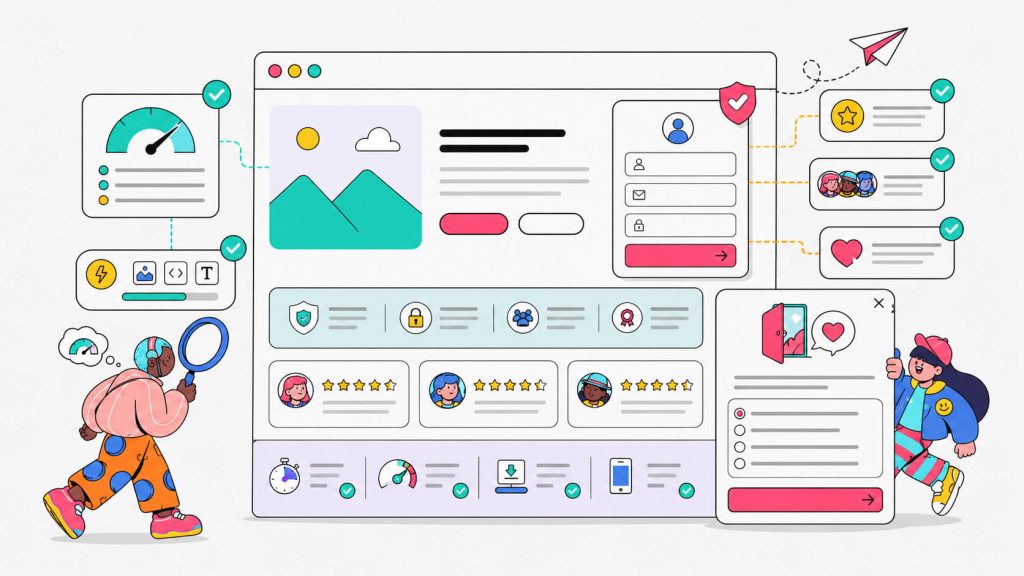
You should also make the proof specific. Using the phrase “Saved us 10 hours a week” beats “great product” every time. It works better because vague praise is easy to write and easy to skip past, while a specific number reads as something that actually happened to a real person.
9. Fix your load time (it’s boring, but it’s one of the biggest levers you have)
Nobody wants to hear that the answer to their conversion problem is to make the page load faster. It feels unglamorous compared to a clever headline rewrite. But the data on this is remarkably consistent: pages that load in under a second convert roughly three times better than pages taking five seconds, and even a single second of extra delay can knock conversions down by around 7%.
Some actions you can take to reduce your page load time are compressing your images, using a CDN, and killing any script you don’t actually need running on that page. None of these require a developer with weeks to spare, most are a same-afternoon fix and it’s one of the few CRO tactics that helps every single visitor, not just the ones in your test’s winning variant.
10. Give leaving visitors a genuine off-ramp, not just a discount pop-up
Some landing pages have implemented discount pop-ups as one of their exit-intent tactics. They work occasionally, but they train visitors to bounce on purpose to trigger a discount, which is its own kind of leak.
A more useful version would be an exit-intent feedback pop-up. When someone’s mouse moves toward the back button, ask them (briefly and not aggressively) why they’re leaving, and offer a low-commitment way to stay in touch (an email or a reminder option) instead of pushing straight for the sale again.
You’ll learn what’s actually stopping people from converting, in their own words, instead of guessing from a heatmap. That feedback becomes the input for your next round of A/B tests, which closes the loop back to tactic #3.
Conclusion
None of this requires a bigger ad budget and that’s really the point. Ad costs are only going one direction, and chasing a lower CPC is a fight you’re increasingly fighting against the entire market. Improving what happens after the click is the lever that’s still fully in your hands.
If you want help finding exactly where your own page is leaking conversions, CROLabs will crawl it, benchmark it against your industry, and hand you a prioritized list of what to fix first.
The best part is you don’t need a developer, just a 14-day free trial to see it for yourself.
FAQ
What’s the fastest way to improve landing page conversion rate?
Fix message match between your ad and your headline, and shorten your form to only what you need right now. Both take under an hour to implement and both typically show up in your numbers within the first week or two of traffic.
How long should I run an A/B test before calling a winner?
At minimum two weeks, regardless of how much traffic you’re getting, so you capture normal day-of-week variation. Wait for statistical significance before you declare a result, calling a test early is one of the most common ways CRO programs end up chasing noise instead of real lifts.
Are dynamic landing pages worth the setup effort?
Usually, yes, especially if you’re running more than one campaign, targeting more than one segment, or advertising in more than one region. Even basic personalization, like swapping a headline or hero image based on traffic source, tends to outperform a single static page sent to everyone.
What’s a realistic conversion rate to aim for?
Benchmark against your own history before you benchmark against industry averages. The median across industries sits around 6.6%, but your own baseline is the number that actually matters. A steady climb from your current rate, even a few percentage points, compounds into a meaningful revenue increase without spending any extra money on traffic.
Does page speed really affect conversion rate that much?
Yes, more than most teams expect. Pages loading in under a second convert roughly three times better than pages taking five seconds, and even a one-second delay can cost you around 7% of conversions. It’s one of the least glamorous fixes on this list and one of the highest-impact ones.