Updated Sep 2026
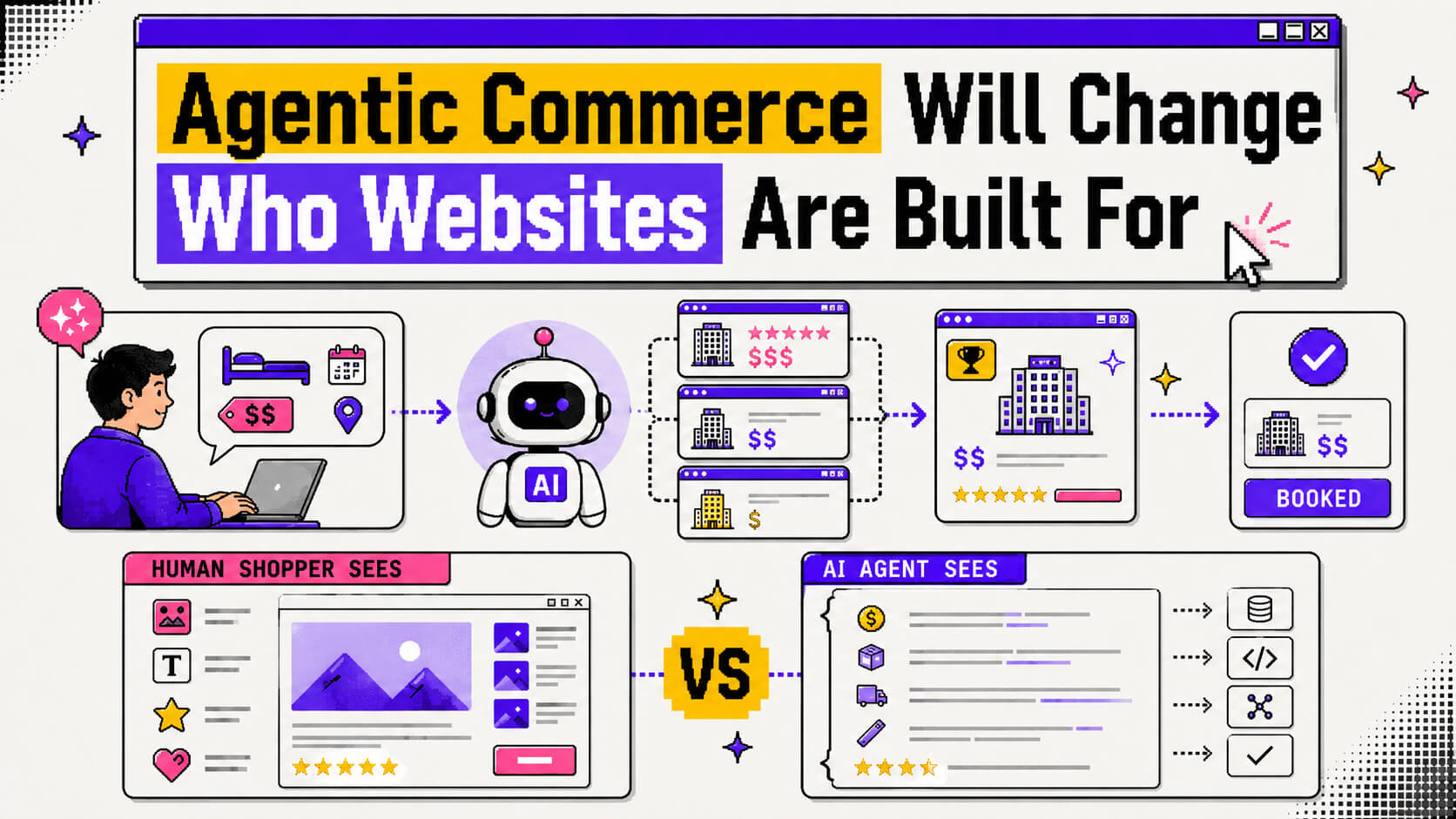
AI has been transforming the way we carry out tasks on the internet for a while now. It’s no surprise that it’s also changing the way we buy but it’s a bit surprising that it may change, or at least add a new layer to, who is being sold to.
Currently, some AI chatbots have been equipped with agentic functionalities, which means they can work on their own to complete multi-step tasks. They plan steps, use tools, and work in digital environments without needing constant human input.
This means that someone can ask ChatGPT to find and book a weekend hotel in Lisbon under a set budget and if the price checks out. There’s no browser tab open and no scrolling through photo galleries, you just have an AI model comparing listings and picking one for them.
Think about what that means if you run CRO for a living. All the visual optimizations that improve your landing page’s conversion rate will not be seen by this person or their agent.
This is agentic commerce. Real money is already moving through it, right now, while most website owners are unaware that it exists.
On This Page
What Is Agentic Commerce?
Agentic commerce is simply what happens when an AI agent does your shopping for you.
Usually, a chatbot is something of an advanced search box. You could type in a command, say “what’s a good pair of trail shoes”, and it would give you a text-based answer. If you wanted it to shop for you, the best it could do is to narrate the experience for you.
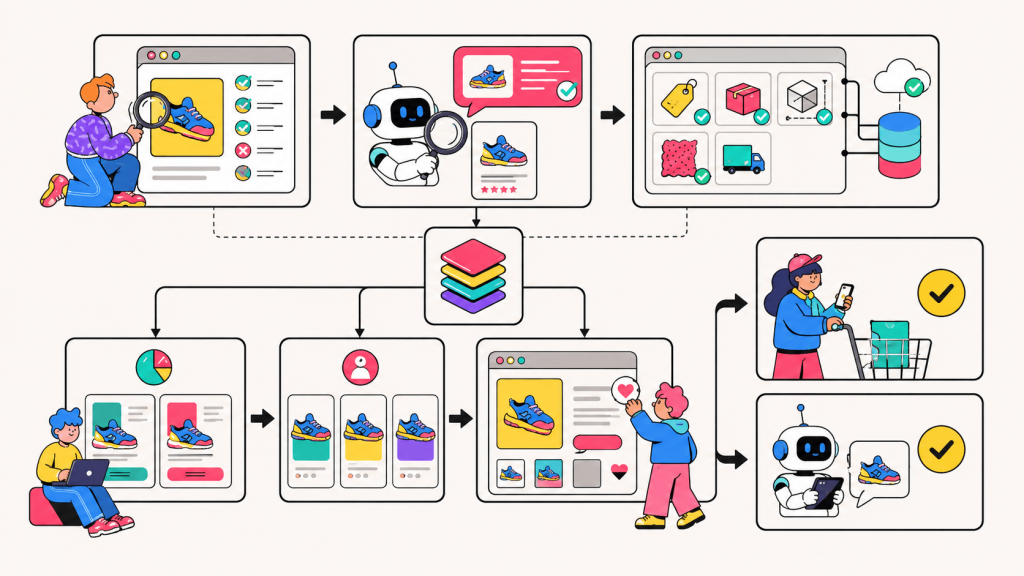
But an AI agent takes this further. With agents, you don’t have to execute tasks yourself if you don’t want to. You give it a goal and some limits, something like “find me trail shoes under $150, waterproof, deliver by Friday”. It then researches options across merchants, checks stock, compares price, and either hands you a shortlist or completes the purchase on its own.
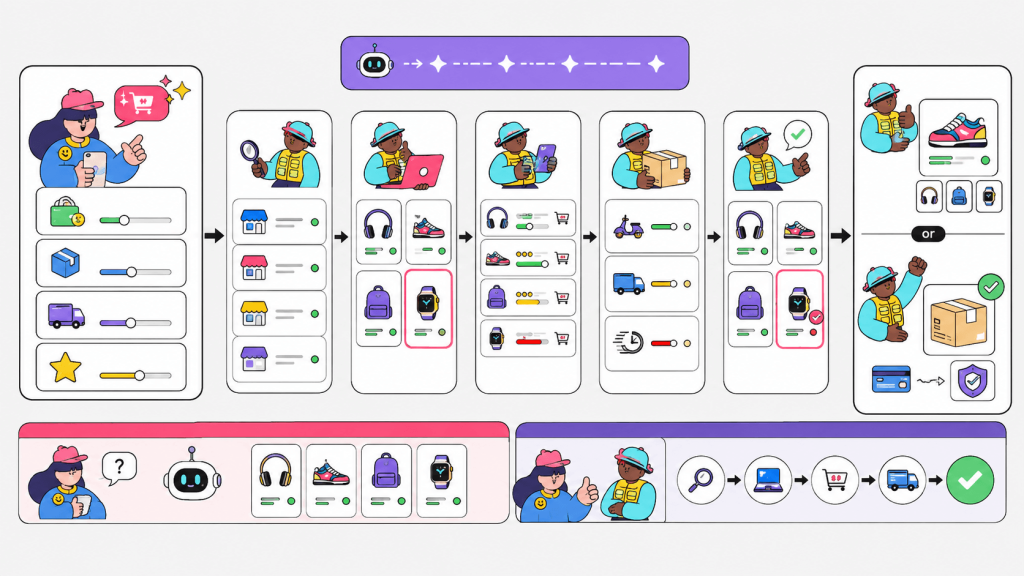
Three protocols do most of the work behind this shift.
- ACP (Agentic Commerce Protocol): Built by OpenAI and Stripe, this is what powers product discovery and merchant handoff inside ChatGPT Shopping.
- UCP (Universal Commerce Protocol): Google’s version, and it’s broader. It covers the whole journey, from a shopper’s first question through post-purchase support.
- MCP (Model Context Protocol): Anthropic’s contribution, and it’s less about the storefront and more about the data underneath it. MCP is what lets an agent pull live inventory, current pricing, and product details instead of guessing from a page it read three days ago.
All three protocols exist to answer one question for the agent: can it trust what your site is telling it right now?
McKinsey puts the number AI agents could influence in global retail commerce at $3 to $5 trillion by 2030. Morgan Stanley thinks close to half of online shoppers will be using an agent to shop by then, accounting for roughly a quarter of their spend. All of that is running in production right now, and it’s expanding every quarter.
What an AI Agent Sees When It Lands on Your Page
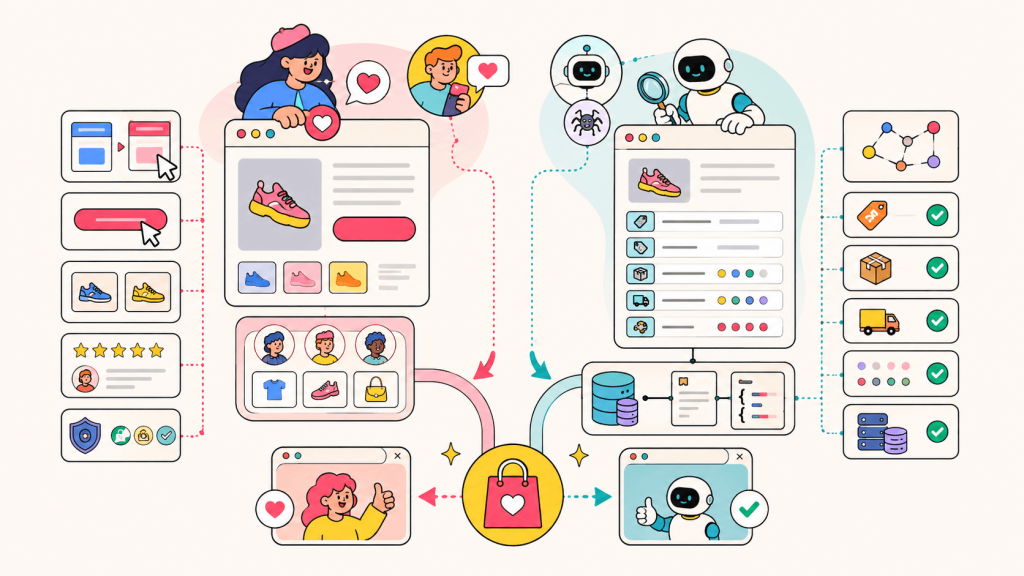
AI agents don’t browse the way people do. When we browse, we scan a website’s visual layout on whatever screen we’re using, but AI agents pull the website’s raw HTML and structured data instead.
A well-designed button means nothing to an agent because it’s a system that never renders that button. An agent cross-checks the price you’re showing against what you charge at checkout, and it does the same with your stock count.
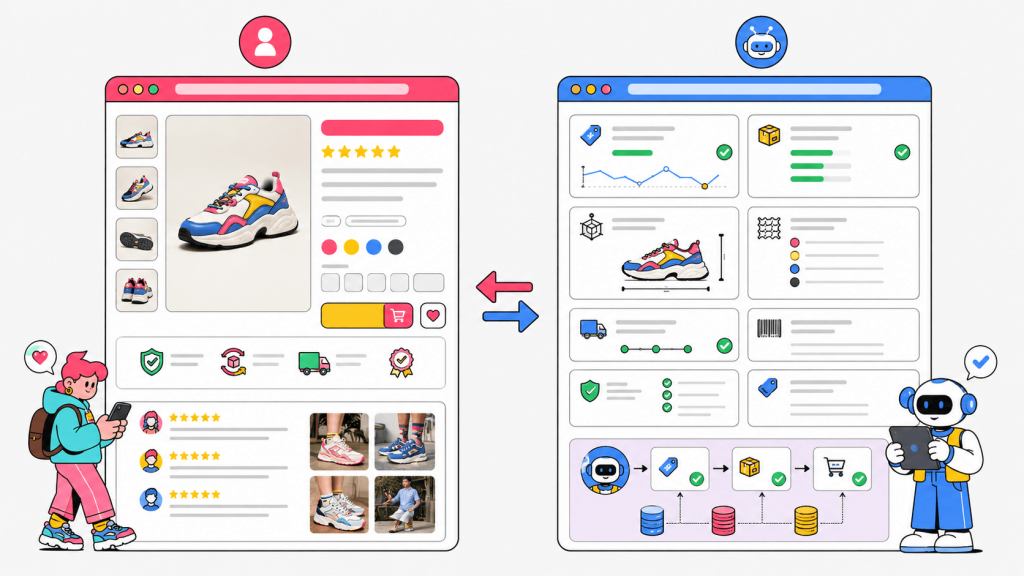
Adobe’s own data from March 2026 backs this up. Traffic referred by AI assistants to US retailers had already become the highest-converting channel they tracked, up 393% year over year and converting 42% better than everything else on the site. So the page you built to persuade a human is now being read, in parallel, by something that skips the persuasion and goes straight for the facts.
Audit Your Site For AI Agents
Your site may be optimized for people, but what about the agents buying for them? AI agents are already changing how shoppers discover, compare, and purchase products. Make sure your structured data, product information, pricing, and inventory are ready for the next generation of buyers.
Cancel anytime.
The Technology Powering Agentic Commerce (ACP, UCP, and MCP)
The infrastructure for agentic commerce is already being built and used by some of the biggest names in commerce.
a. Agentic Commerce Protocol
OpenAI and Stripe have built the Agentic Commerce Protocol (ACP), which lets businesses sell directly through ChatGPT. ChatGPT users can already buy from Etsy sellers without leaving the conversation, and the system is already routing ChatGPT shopping traffic to more than a million Shopify merchants.
b. Universal Commerce Protocol
Google is building the same kind of infrastructure from a different angle. Its Universal Commerce Protocol (UCP) is designed to let AI agents handle more of the shopping journey, from discovering a product to checking out and getting post-purchase support. Shopify, Etsy, Wayfair, Target, and Walmart helped build it, with major payment and retail companies including Visa, Mastercard, American Express, Best Buy, Macy’s, and Home Depot backing the ecosystem.
c. Model Context Protocol
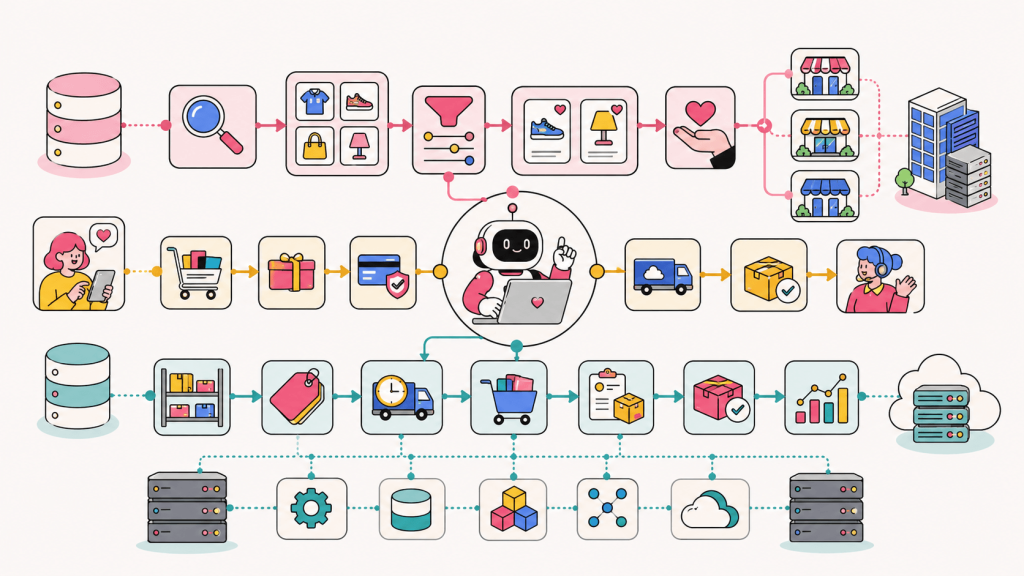
MCP, or Model Context Protocol, is perhaps the easiest one to misunderstand because it isn’t a commerce protocol in the same way ACP and UCP are. Anthropic created MCP as a standard way for AI applications to connect to external tools and data sources. You can think of it as a common language between an AI agent and the systems it needs to interact with.
An agent can’t make a useful purchasing decision from a product page alone. It might need to check whether an item is actually in stock, retrieve the current price, see which delivery options are available, apply a promotion, create a cart, or check the status of an existing order. MCP gives businesses a standardized way to expose those capabilities to an agent instead of making the agent scrape a page and hope the information is accurate.
d. Additional Protocols
Amazon is already doing something similar inside its own ecosystem. Its Rufus shopping assistant has been used by more than 250 million customers, and Amazon says customers who use Rufus during a shopping journey are more than 60% more likely to convert. Its Buy for Me feature is also letting customers use Amazon’s AI to find and purchase products from other sites.
The important part isn’t which protocol wins or which company builds the dominant shopping agent. It’s that the buying journey is already moving away from the traditional model of searching, clicking, browsing, comparing, and adding to cart. AI is becoming another layer between the shopper and the store, and increasingly, it can handle much of that work itself.
What This Means for CRO
We’ve spent years telling people to test headline copy, shrink form fields, and stack trust signals above the fold. Yes, all of that still works, but it just covers less of the job than it used to.
An agent evaluating your page has no read on CTA button color, and it doesn’t register customer logos or most things that build trust in human visitors and improve your conversion rate. Instead, it reads your product schema for completeness and checks whether the stock status matches reality to the minute. It needs the underlying data structured well enough that it can verify a claim without circling back to ask.
A lot of CRO teams are going to keep running A/B tests on pages that a growing share of “visitors” will never render at all. You can run the tightest experimentation program in the industry and still lose a sale to a competitor with a messier-looking site and cleaner structured data, because the agent making the comparison never saw either design. It read both sets of markup, compared the numbers, and picked one.
We know that’s an uncomfortable thing to say to an industry built on testing what humans see and feel, especially with Adobe’s own numbers showing how much revenue is already moving through this channel.
But if an agent can bypass your storefront and query the systems underneath it directly, then having a beautiful page is only part of the job. The website is no longer necessarily the place where the conversion happens or even where the decision gets made.
Your product information has to be accurate, your inventory has to be accessible, your pricing has to match reality, and the systems behind your website need to be able to communicate with the agents making decisions for your customers.
Where Human Persuasion Still Wins
Don’t throw out the concept of a conversion-optimized website just yet. Those headlines, trust badges, and page design still matter because somebody has to decide to delegate the task to an agent in the first place, and somebody has to trust the shortlist the agent hands back before they’ll buy anything on it.
Brand recognition still shapes whether a shopper lets an agent buy on their behalf at all, or whether they’d rather compare the options themselves. Recognizable, trustworthy sites are also more likely to get picked up and described accurately by the AI systems doing the summarizing, which is the same problem we cover when we talk about generative engine optimization. Getting your brand described correctly in an AI answer and getting your product picked by a shopping agent turn out to be two versions of the same challenge, which is “can a machine understand and trust what you’re telling it?”.
Search is also changing for a similar reason. We wrote recently about how Google’s AI Max is already changing what message match even means, and agentic commerce is that same story, one step closer to the purchase.
What To Do About It Now
If you sell anything online, this is where we’d start. Some of it is opinion based on what we’re seeing across client sites right now.
a) Audit your product schema line by line
List your product’s price, availability, materials, dimensions, shipping timelines, etc, in a format an agent can parse without guessing.
b) Test whether agents can find you at all
Ask ChatGPT or Google’s AI Mode to find a product in your category and see if you show up, and whether what it says about you is even accurate.
c) Treat structured data like a real conversion lever
It’s becoming the above-the-fold section for a growing chunk of your traffic. Give it the same rigor you’d bring to testing a landing page with a CRO tool built for it.
d) Keep testing for humans too
Your personalization program and your A/B testing program still matter. Humans are the ones setting the goals agents execute against, and personalizing what they see still shapes whether they trust you enough to delegate the purchase at all.
Conversion rate optimization is splitting into two jobs that used to be one: optimizing for the person who might buy and optimizing for the system that might buy on their behalf. Most sites right now are built for exactly one of those visitors.
The teams that build for both are going to out-convert everyone still optimizing for just one.
FAQs
What is agentic commerce?
Agentic commerce is when AI agents handle shopping tasks on a person’s behalf. Instead of simply recommending products, an agent can search for options, compare prices and availability, and in some cases complete the purchase based on the shopper’s preferences and limits.
How does agentic commerce affect CRO?
Agentic commerce adds a new layer to conversion rate optimization. Traditional CRO focuses on persuading human visitors through design, copy, personalization, and UX. AI agents may instead evaluate structured product data, pricing, availability, and other machine-readable information when deciding which products to recommend or purchase.
What does an AI agent see when it visits a website?
An AI agent can rely heavily on a website’s raw HTML, structured data, and connected systems rather than experiencing the page visually like a human does. This makes accurate product information, schema markup, pricing, inventory, and other machine-readable data increasingly important.
What is ACP in agentic commerce?
The Agentic Commerce Protocol (ACP) is a protocol developed by OpenAI and Stripe to enable AI-assisted commerce. It provides a standardized way for merchants and AI systems to handle product discovery and purchasing within agentic shopping experiences.
What is UCP in agentic commerce?
Universal Commerce Protocol (UCP) is Google’s open protocol for connecting AI agents with commerce systems. It is designed to support more of the shopping journey, including product discovery, checkout, and post-purchase interactions.
What is MCP and how does it relate to agentic commerce?
Model Context Protocol (MCP) is a standard developed by Anthropic for connecting AI applications to external tools and data. In commerce, it can allow agents to access information such as product details, pricing, and inventory directly from the systems behind a website rather than relying solely on what is displayed on the page.
Does traditional CRO still matter in an agentic commerce world?
Yes. Humans still decide what goals to give an agent and whether to trust the recommendations or purchases it makes. Landing page design, messaging, personalization, social proof, and other human-focused CRO strategies still influence those decisions, even as businesses also need to optimize the underlying data agents use.