Updated Sep 2026
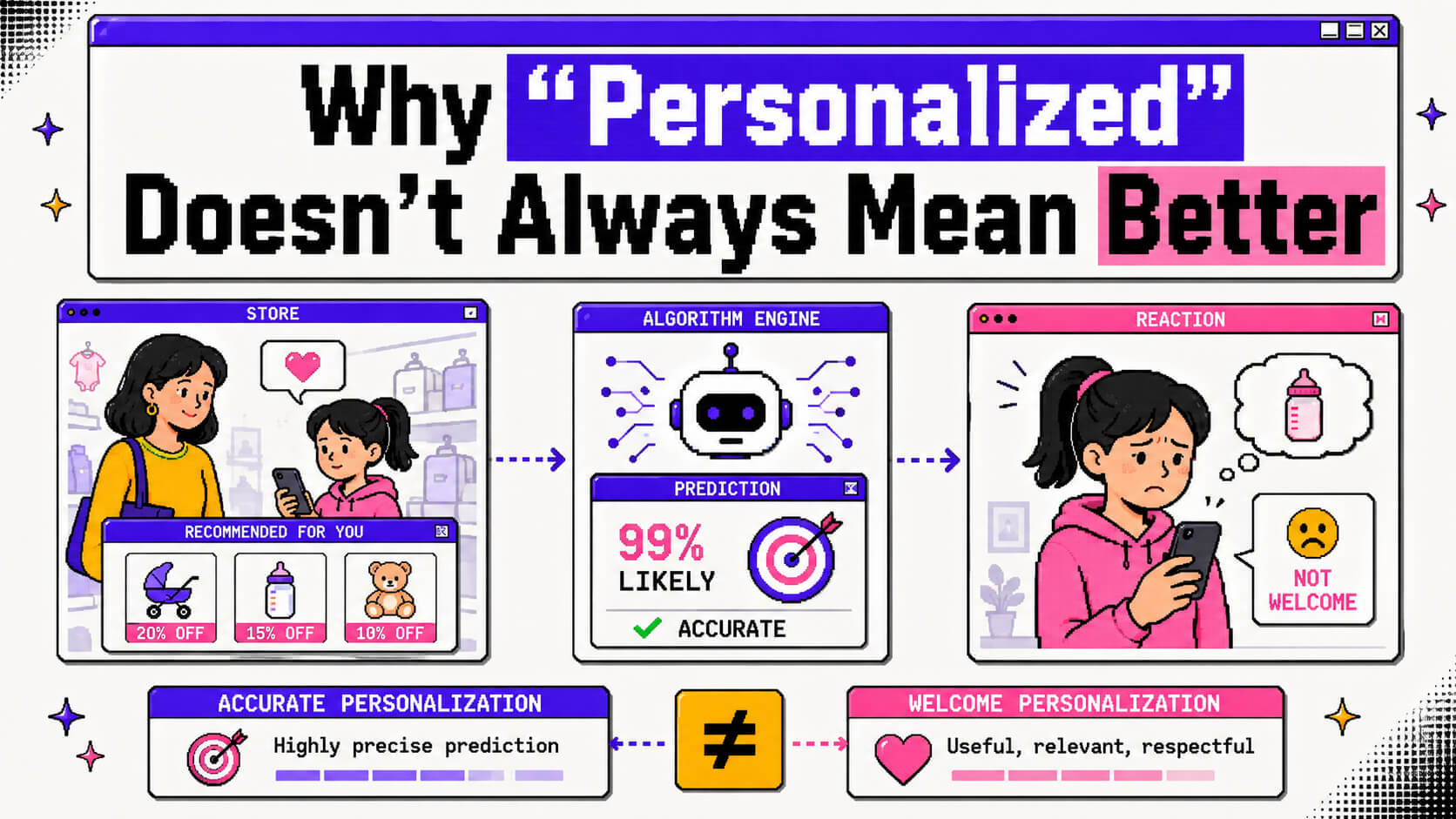
In 2012, a man entered a Target store outside Minneapolis and demanded to know why his teenage daughter was being sent coupons for cribs and baby clothes. He assumed the store was pushing her toward something.
What he didn’t know yet was that Target’s purchase-pattern models had picked up on a shift in her shopping weeks earlier and flagged her as likely pregnant, before she’d told him or anyone in her own family. The algorithm turned out to be right. Her father stormed out anyway, and came back later to apologize once he learned the truth.
This story gets told a lot in marketing circles, usually as proof that personalization works so well it’s almost scary. That’s fair enough, but there’s a second reading of it that gets less attention: the model was accurate and it still cost Target a furious customer at the door. Precision and welcome reception aren’t the same thing, and mixing them up is where a lot of CRO teams get personalization wrong.
If you run a SaaS product, an ecommerce store, or any site where you’re already testing headlines and CTAs, you’ve probably been told personalization is the next logical step. Personalized content gets treated like a synonym for better in a lot of marketing content but, as you’ve seen with the given example, that isn’t always the case.
On This Page
The Case For Personalization Isn’t Made Up
Before anything, let’s give personalization its due first, because the benefits are real.
Epsilon found that 80% of consumers said they’re more likely to buy from a brand that personalizes the experience. Another study found that product recommendation engines tuned to individual browsing history convert up to 288% better than generic suggestions shown to everyone.
You may recognize this product recommendation strategy (which is a form of personalization) from Netflix. They built an entire product around it and so did Amazon.
There are multiple case studies that prove the advantages of personalization, so the fact that it’s beneficial is not in dispute. The problem shows up once teams stop treating “personalize it” as one option among several and start treating it as the default answer to every conversion problem, whether or not there’s data to support the specific change being made.
Where It Starts Working Against You
Personalization has a ceiling, and past that ceiling it stops feeling helpful and starts feeling like surveillance.
InMoment surveyed 2,000 consumers and found that 75% of them think most personalization is at least somewhat creepy, and 22% said they’d actually leave a brand after being creeped out by it. Cisco’s Privacy Benchmark study also found something similar. Per the study, over 80% of people said they feel nervous about how companies use their data, and close to half said over-personalization made them trust a brand less, not more.
Wayne Hoyer, a marketing professor at UT Austin’s McCombs School of Business, has a name for this: creepiness as an emotional response that kicks in once personalization crosses a boundary the person didn’t agree to. And what’s more, his research found that response doesn’t just annoy people, it reduces their willingness to buy.
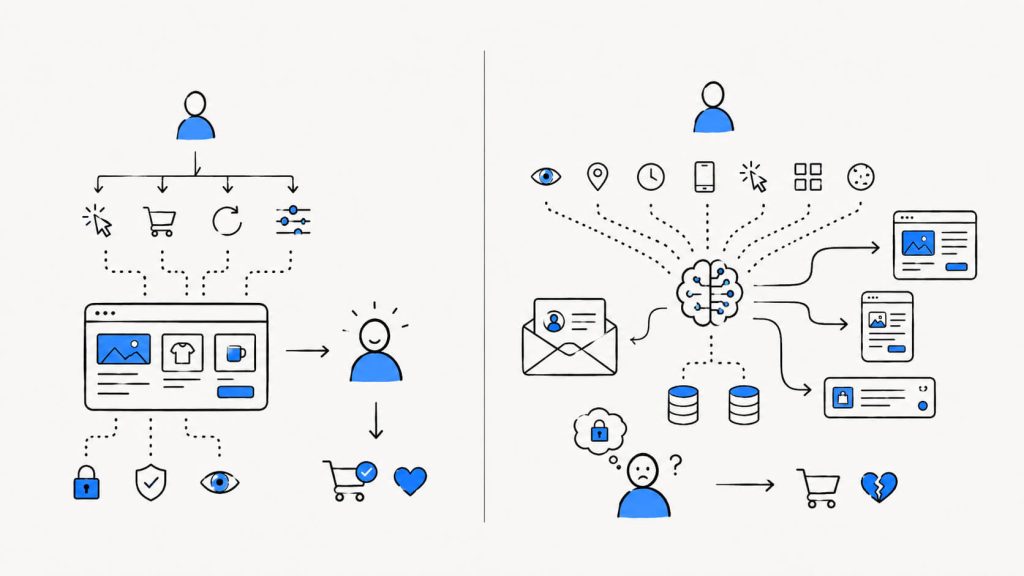
So the exact tactic meant to increase conversions can end up suppressing them once it tips too far.
A few patterns tend to trigger that reaction:
- The ad that follows too closely: You mention a product out loud or search for it once, and it stalks you across three platforms for a week.
- The email that admits too much: Subject lines like “we noticed you looking at…” tell the reader exactly how much you’ve been tracking, which is rarely the impression you want to leave.
- The wrong guess treated as fact: These can be a misspelled name, an assumed gender, a “welcome back” to someone who’s never visited, etc. Bad personalization is more damaging than no personalization, because it signals the system doesn’t actually know the person it’s addressing.
These are all examples of common outcomes of teams overutilizing personalization. When you turn on every personalization feature a tool offers just because the features exist (and not because a specific problem called for it) you’ll likely end up damaging your conversions.
The Gartner Prediction Worth Revisiting
Back in 2019, Gartner made a prediction that got a lot of pushback at the time. They claimed that by 2025, 80% of marketers who’d invested in personalization would abandon their efforts. They cited weak ROI and the headaches of managing customer data as reasons for this. We’re now past that date, and it’s worth asking honestly whether it happened.
The blunt version, that personalization died out, clearly didn’t come true. Recommendation engines, dynamic pricing, and behavior-based email flows are more common now than they were in 2019, not less.
However, the more specific part of Gartner’s warning held up better than people give it credit for. A lot of personalization programs got built without a clear tie to revenue, they ran for a year or two without anyone checking whether they actually moved conversion rate and got quietly deprioritized once budgets tightened.
So the undisciplined use of personalization disappeared in a lot of teams. Also, personalization stopped being the differentiator it was in 2015, mostly because it stopped being rare. When everyone’s homepage greets you by first name and everyone’s product page shows “recommended for you”, none of it seems as special anymore.
Since it now reads as standard software behavior to a lot of visitors, the bar for personalization to actually earn a conversion lift got a lot higher than most teams realize.
More Personalized Doesn’t Mean More Accurate
There are personalized experiences that simply don’t work, even when nobody finds them intrusive.
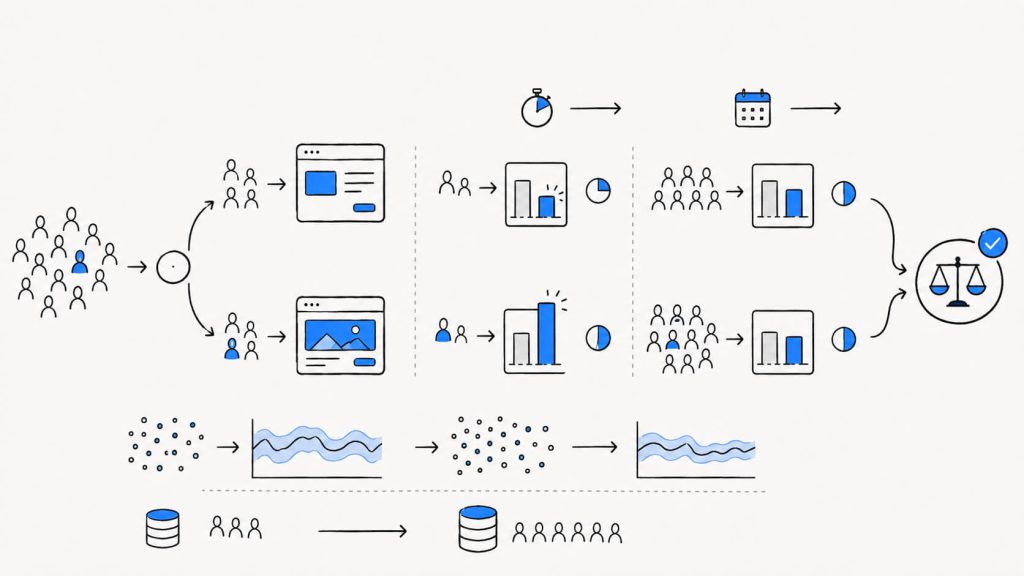
Credera published a case study that showcases this. Working with a client, their team was fairly confident that an auto-advancing carousel on the homepage was hurting conversions, based on well-known usability research showing carousels perform poorly. Rather than swap it out on instinct, they ran a proper A/B test, sending half of visitors to the carousel and half to a static grid. The result showed no measurable difference between the two, at a confidence level above 95%. Their strong intuition, backed by industry research, was flat wrong for this specific audience.
The team also pointed to a subtler trap called regression to the mean. Early in a test, small sample sizes can make a personalized variant look like it’s winning by a wide margin. Teams call the test, roll out the change, and then watch the lift shrink or disappear entirely as more data comes in, because the early result was noise dressed up as a signal.
This is exactly why A/B testing has to sit underneath any personalization effort. A personalized variant is a hypothesis, not a guaranteed improvement. The only way to know if it’s actually converting better than your control is to test it properly against real traffic and wait for statistical confidence.
Signs Your Personalization Might Be Doing More Harm Than Good
If you’re already running personalized experiences on your site, here’s a checklist to quickly discern if your personalization is harming your conversion rate:
- You can’t point to a test that proves the lift:
If a personalized page has been live for months and nobody ran it against a control, you don’t know if it’s helping. You only know that it’s different.
- Your segments are too thin to mean anything:
A segment with 40 monthly visitors won’t generate a trustworthy result no matter how clever the targeting logic is behind it.
- Support tickets or opt-outs mention it:
If people are emailing to ask how you knew something about them, that’s a direct signal that your personalization efforts are not crossing a line.
- The personalized version and the generic version perform about the same:
That’s not a neutral outcome. It usually means the added complexity, maintenance, and data collection aren’t buying you anything.
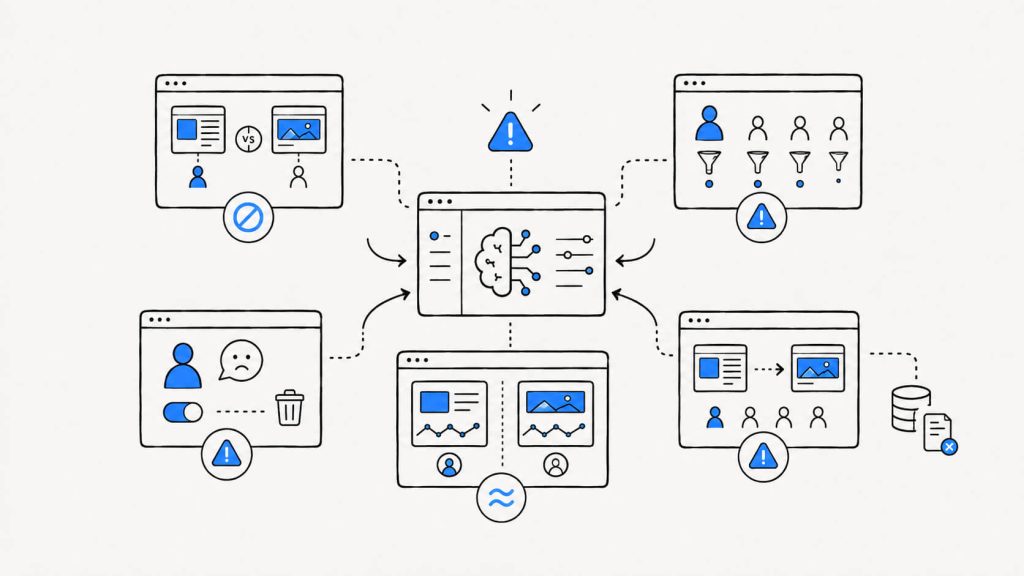
- You’re personalizing because a competitor does it:
That’s a reason to look into it, but it’s not a reason to ship it without validating the idea against your own audience.
Is Your Personalization Actually Improving Conversions?
A personalized experience can look impressive without moving your conversion rate.
Use CRO Advisor to identify where visitors are dropping off and uncover opportunities worth testing before adding more personalization.
Cancel anytime.
When Personalization Actually Earns Its Keep
As we’ve said previously in this article, none of this is an argument against personalization as a category. Instead, it’s an argument for being specific about where it belongs.
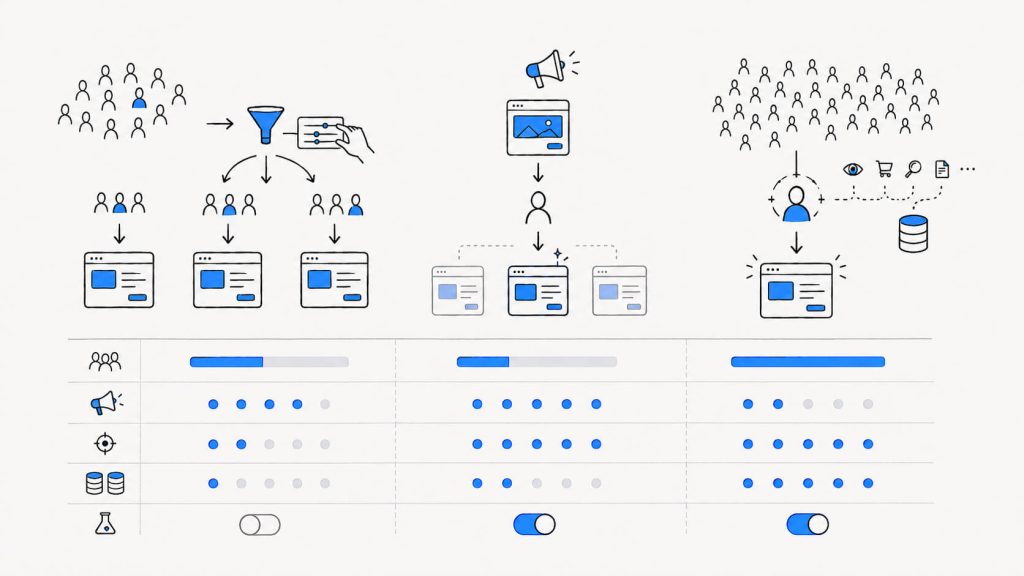
For example, segment-based personalization tends to work well for teams that don’t have huge traffic volumes yet, or that operate in industries like healthcare or finance where a human needs to approve every claim on the page. You group visitors by traffic source, industry, or company size, and you control exactly what each group sees.
Ad-to-page matching is another case where personalization reliably earns its place. If someone clicks a LinkedIn ad built for healthcare buyers, landing them on a generic homepage instead of a page that echoes the ad’s language is a self-inflicted drop-off. This kind of message match is less about knowing a visitor personally and more about basic consistency between what was promised and what got delivered.
Per-visitor personalization, the kind that reacts to an individual’s own behavior in real time, needs real traffic and real behavioral history before it has anything useful to learn from. Even though it’s useful, you still have to be specific about when it’s needed because turning it on with a trickle of monthly visitors doesn’t create a smarter experience. Rather, it creates a system that guesses based on noise, which tends to hurt conversion rate rather than help it.
Pro Tip: If your stack is also moving away from third-party cookies, that changes what’s even possible to personalize on. Cookieless personalization is an option you should consider before building anything that depends on tracking you may not have access to for much longer.
Conclusion
A simpler way to think about personalization use isn’t “should we personalize this”, it’s “what problem, specifically, is this solving, and how will we know if it worked”. That’s the framing that holds up best.
Also, to ensure that you’re personalizing responsibly, start with data on where visitors are actually dropping off. This gives you ideas on what to personalize.
CROLabs’ CRO Advisor is built around this first step, flagging where visitors are dropping off before you build anything new on top of the page. And whether you land on segment-based targeting or something closer to individual personalization, running it through structured A/B testing ideas is what separates a real lift from a page that just looks different now.
Stop Guessing What Your Visitors Need
Find out where visitors are dropping off, uncover potential conversion opportunities, and build your next CRO test around real visitor behavior.
Cancel anytime.
FAQ
Is personalization always worth the investment?
No, and that’s fine. Personalization pays off when you have enough traffic to validate the change and a specific drop-off point it’s meant to fix. Without those two things, you’re often just adding complexity for a result you can’t actually measure.
What’s the difference between personalization and over-personalization?
Personalization uses data a visitor has clearly given you, through behavior, source, or stated preference, to make an experience more relevant. Over-personalization is when the experience reveals more about what you’ve tracked than the visitor expected to share, which shifts the feeling from helpful to watched.
How do I know if my personalization is actually helping conversion rate?
Run it against a control group through proper A/B testing rather than judging it by how sophisticated it looks. If the personalized version doesn’t beat the control at statistical confidence, it isn’t helping yet, regardless of how the early numbers looked.
Do I need a lot of traffic before personalizing my site?
For per-visitor personalization, yes, generally a few thousand monthly visitors with real behavioral history. Segment-based personalization needs far less data and can work on smaller sites, since it relies on a handful of shared traits rather than individual tracking.
Should I choose per-visitor or segment-based personalization?
It depends on your traffic and how much control you need over the messaging. Lower-traffic sites and regulated industries usually do better with segments a person can review and approve. Higher-traffic sites with rich behavioral data have more to gain from per-visitor targeting once the underlying model has enough history to work with.
Start with traffic source. Build one segment for paid traffic and one for organic, match landing page copy to whatever brought each group there, and test the result against your current page before expanding into more granular segments.